

The Miracle of the Snow by Masolino da Panicale. Christ and the Blessed Virgin Mary observe Pope Liberius, who marks in the legendary snowfall the outline of the basilica by Masolino da Panicale (Public Domain)
Nine centuries later Bartolomeo da Trento in his 13th-century Liber epilogorum in gesta sanctorum wrote that when the event of the miraculous summer snowfall had occurred in the fourth century, Pope Liberius traced the perimeters for the basilica of Santa Maria Maggiore in the snow on the ground. Two centuries thereafter someone read in the ancient chronicle of Fra’ Bartolomeo from Trento, a description of this strange event and commissioned the artist Masolino da Panicale to paint the Tryptych of the Madonna della Neve.
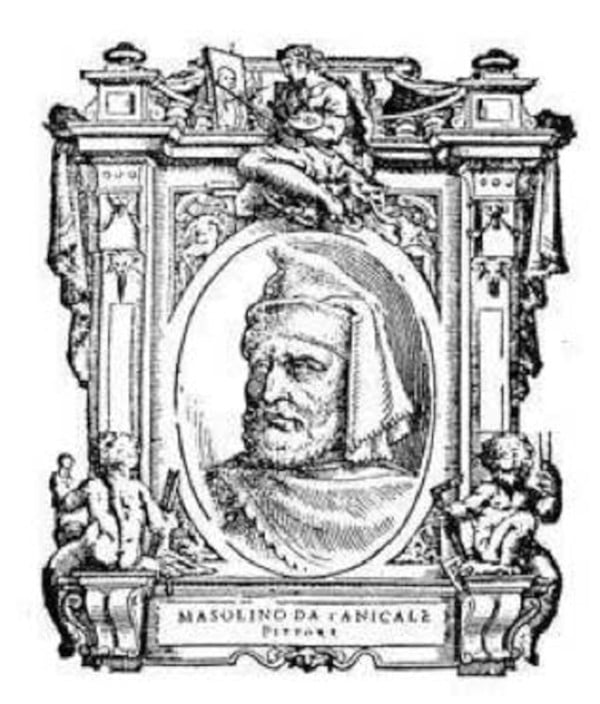
Masolino da Panicale: Illustration from "Le Vite" by Giorgio Vasari, (1568 edition) (Public Domain)
Madonna Della Neve
Tommaso di Cristoforo Fini, known as Masolino, was born in 1383 in Panicale in Valdelsa. Giorgio Vasari, defined as one of the best rinettatori (cleaners and engravers of bronze tiles used in artistic castings) and in the service of Lorenzo Ghiberti, (a Florentine artist and the creator of the bronze doors of the Florence Baptistery) was in an excellent position to capture the history of contemporary artists in his Lives of the Most Excellent Painters, Sculptors, and Architects. He recorded Masolino began painting in AD 1402, in Florence. In circa AD 1423 at a mature age, he enrolled in the Corporation of Doctors and Speeches, which also included painters since they worked with 'chemical materials' - the pigments used to produce colors. He returned to Florence at 40 years old, after traveling extensively and having spent time in Rome. It was in Rome, perhaps, where he had heard about that 'miracle' which six years later inspired him to paint the Triptych of the “Madonna della Neve in collaboration with Tommaso di Ser Giovanni di Monte Cassai, better known as Masaccio, and the illustrious Paolo Schiavo.
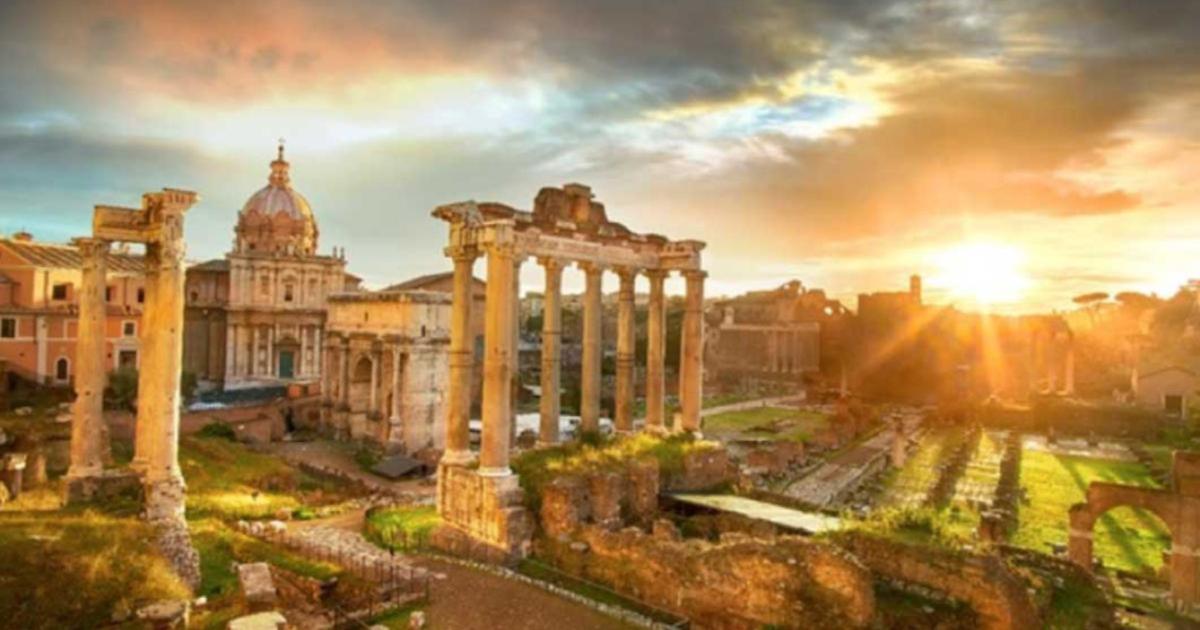
Dr Pinotti in his 1996 Angeli, Dei, Astronavi (Angels, Gods and Spaceships) poses the question how could Masolino da Panicale have dared to describe the sighting of a UFO and summer snow in Rome during an era when everything slightly removed from the acceptable norm would have been regarded as witchcraft or a miracle? The answer lies therein that various artists of the 15th century chose to frame such unconventional themes within a mystical religious dimension.
- What Did the Ancients See? Unidentified Flying Objects that Made an Impact on Early History
- The ancient history of UFOs and the unclassified document of Oppenheim and Einstein
- The Twisted Phenomena and Strange Features of Medieval Art
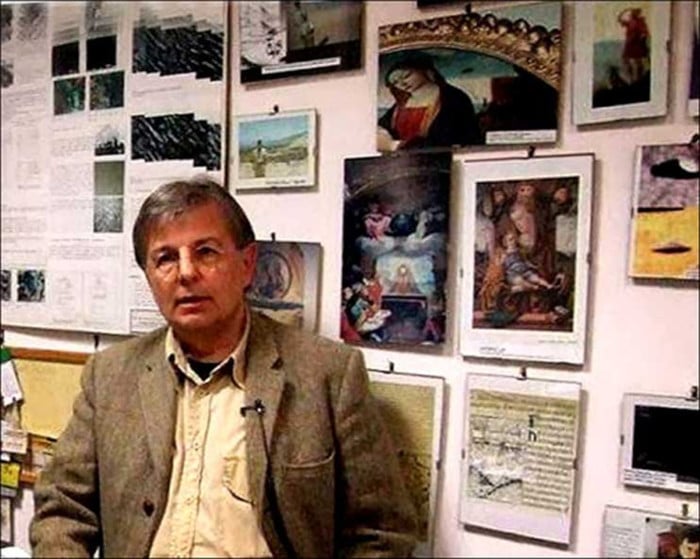
Dr Roberto Volterri in his study at the university, with behind him a good number of images about strange objects that in the distant past evolved in our skies and that were immortalized by some famous painters (Image: Courtesy Roberto Volterri)
Dr Roberto Volterri, an archaeologist from the University of Rome, deals among other things with 'archaeometallurgy', that is the analysis of metal finds by means of sophisticated techniques such as Scanning Electron Microscopy (SEM) and Energy Dispersion Microanalysis (EDS). While having infinite respect for the more scientific aspects of knowledge in the broadest sense; while appreciating very much the so-called 'Galilean method'; while having almost blind trust in the Goddess of Reason, every now and then he admits to having some healthy doubts. What if there really is something true about the repeated sightings of Unidentified Flying Objects, namely the 'notorious' UFOs?
This led him to study the unusual pictorial representations, that delude to or bears testimony to crafts built by alien 'hands', that had crossed the skies of this 'almost insignificant' planet, placed at the edge of a galaxy, lost in an endless Universe. His doubts multiply as the perplexities of the 'revealed scientific truths' extend beyond all proportion and he experiences a desire to spread such healthy doubts as opposed to some 'given truths', in an attempt to make another small contribution towards the fascinating hypothesis that we may not be alone in the Universe, and every now and then, someone comes to visit us.
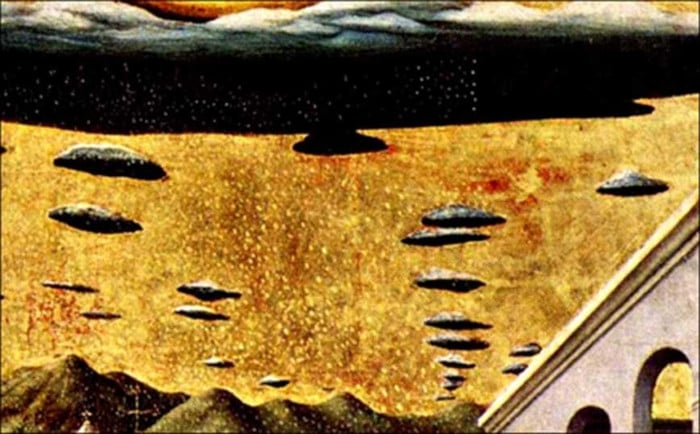
Detail of the painting by Masolino da Panicale: the 'snowflakes' falling from the strange 'clouds' are clearly visible. It is extremely plausible that Masolino made use of ancient chronicles describing the fall of 'bambagia silicea' from OVNI. (Deriv: Roberto Volterri)
The 'snow' in the painting (at the Museum of Capodimonte, Naples) falls from an elongated 'cloud', almost cigar-shaped (mothership?). Below and behind smaller 'clouds' are visible, well outlined in their contours, and as Roberto Pinotti points out, most of the 'daytime discs' are fitted with a dome. Dr Volterri compares the well-known photos of another 'day disk', taken on June 5, 1955 in the sky of Namur (Belgium) to a segment of Masolino’s painting above the cornice:
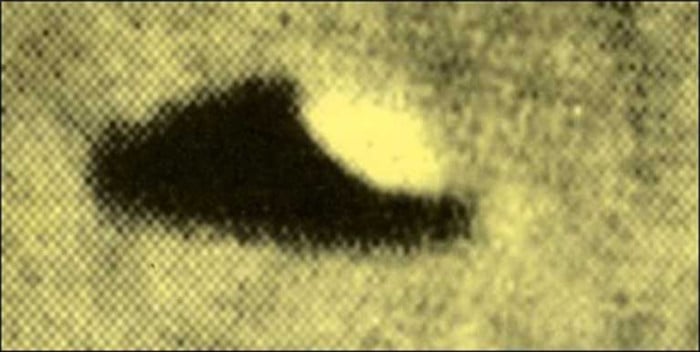
Photo of an Unidentified Flying Object taken on 5 June 1955 in the sky of Namur (Belgium). (Image courtesy Dr Roberto Volterri)
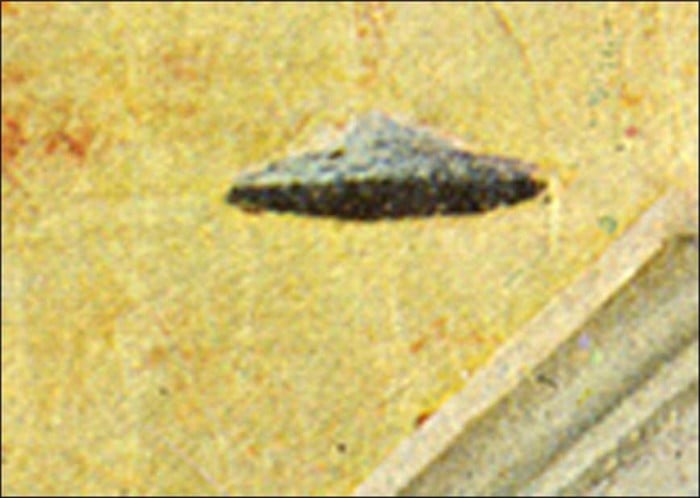
The "cloud" - the one on the far right of the painting, near the cornice of the building - that most resembles an"Unidentified Flying Object", in short to a disc-shaped UFO. (Deriv: Roberto Volterri)
Madonna of the Flying Saucer
The 15th-century artist Sebastiano Maonardi (1460 – 1513) immortalized a similar strange event on canvas in La Madonna e San Giovannino (Madonna and child with St John). This painting, preserved in Florence, Palazzo Vecchio, Sala di Ercole, Loggiato di Saturno, depicts a widespread iconographic motif of the Renaissance, that of the Virgin kneeling with her hands bent and outstretched towards the Child Jesus, resting on a hem of her dress.
The hidden gem in the painting is described in an article by Daniele Bedini, entitled Madonna of the flying saucer, published in Notiziario Ufo of July - August 1996: "it is clear the presence of an aerial object, lead grey, inclined on the left and equipped with a ‘dome’ or ‘turret’, apparently identifiable as a flying vehicle of oval shape in motion". In this painting over the right shoulder of the Madonna a shepherd - along with his dog that barks - observes the curious bright discoidal object, as it evolves in the sky. Dr Volterri, with the use of software for the treatment of images, highlights another shepherd, sitting with his sheep, also observing the strange object hovering in the sky.
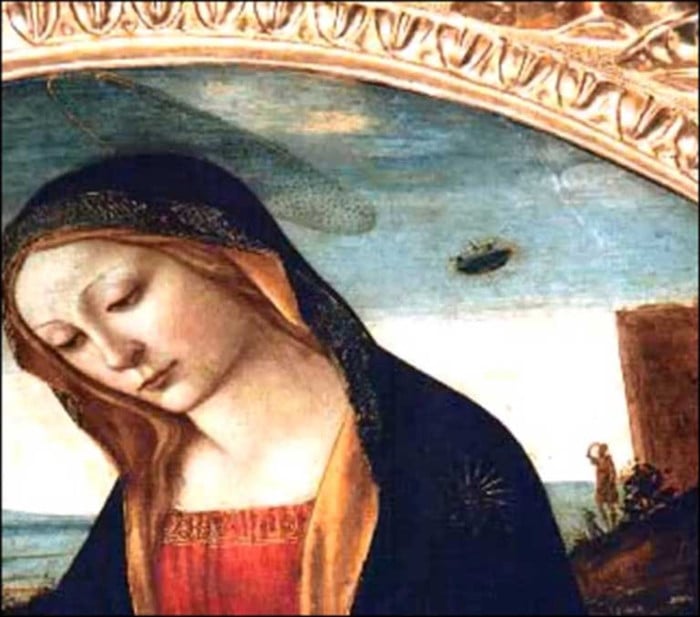
Detail of The Madonna with Saint Giovannino (Public Domain)
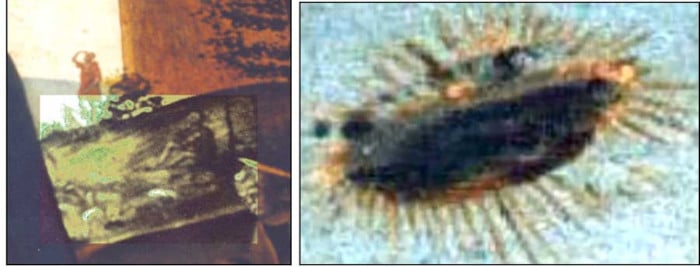
Left: the painting attributed to Sebastiano Mainardi (1460-1513) which depicts a disc-shaped object observed by a shepherd and his dog and the other hidden observer sitting among his sheep. Right: close-up of the concrete object, very bright, observed by the two men and the barking dog. (Image deriv: Roberto Volterri)
Some people link the pictorial representation to the luminous cloud described in the story of the Nativity contained in the apocryphal Proto-Gospel of James 19: 2: "they stopped at the place where the cave was, and there was a cloud of light shading the cave. And the midwife exclaimed, 'Today my soul has been magnified, because my eyes have seen a wonderful miracle: that salvation for Israel is born. And immediately the cloud dissipated from the cave and a great light appeared in the cave, so much so that our eyes could not bear it..." (I Vangeli Apocrifi, edited by Marcello Craveri, Turin, 1969).
Another biblical source of inspiration is found in a passage from Luke 2: 10: "In that region there were some shepherds who watched over their flock at night. An angel of the Lord came before them and the glory of the Lord enveloped them in light. They were taken by great fear, but the angel said to them: Do not be afraid, behold, I proclaim to you a great joy, which will be of all the people: today in the city of David was born unto you a Saviour, who is Christ the Lord".
There has been some controversy as to the creator of this painting. Some years ago, the museum's card bore the name of Jacopo del Sellaio, but later this artist’s name was replaced by Sebastiano Mainardi who was very active in Florence and worked in the school of his brother-in-law, Ghirlandaio.
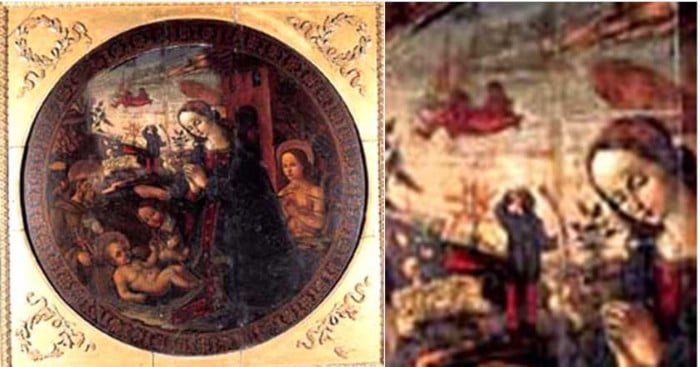
Painting attributed to Sebastiano Mainardi preserved in the Parish Church of the Holy Spirit (17th century) in Sommariva Perno. On the right is the detail of a shepherd observing a strange apparition / angel in the sky, covering his eyes because of the remarkable brightness of what he is seeing. (Image: sommarivaperno/ archive)
The attribution is therefore not certain, but another painting of the Mainardi school preserved in the Parish Church of the Holy Spirit (17th century) in Sommariva Perno, Piedmont, is quite similar as it depicts another shepherd with his hand partly covering his forehead, observing the arrival of an angel on a sort of cloud and in this case the shepherd’s dog also appears to be barking at what he sees in heaven.
Aliens at the Florence Football Match
By applying sophisticated image analysis computer programs, Dr Volterri investigated some photographs of 'daytime discs', taken in Florence in 1954, when 'snow', or rather, 'siliceous cotton wool', fell on this city during a football match.
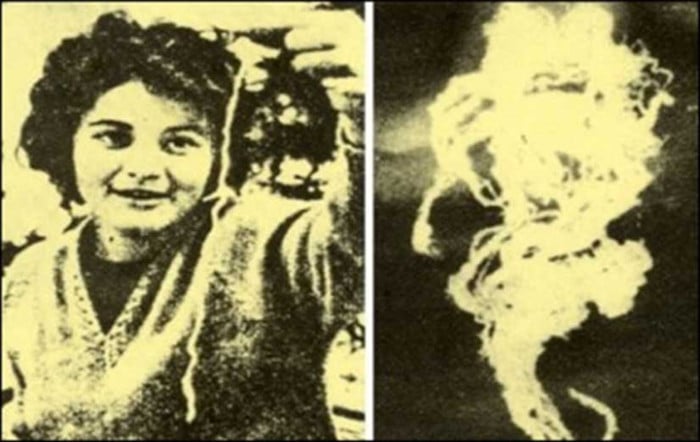
White filaments similar to "snow" fell from strange unidentified flying objects (Image: Courtesy Dr. Enrico Baccarini)
At 3.27 pm. on Wednesday October 27, 1954 the Fiorentina-Pistoiese football match, was suspended for a certain time because all the spectators watched as white filaments similar to snow fell from strange unidentified flying objects. This substance representing white cotton wool was analyzed by Professor Giovanni Canneri at the Institute of Analytical Chemistry of the University of Florence, who found it was composed of boron, silicon, calcium and magnesium. Dr Volterri asks if this may perhaps be the same substance that fell in Rome in a distant August of AD 358?
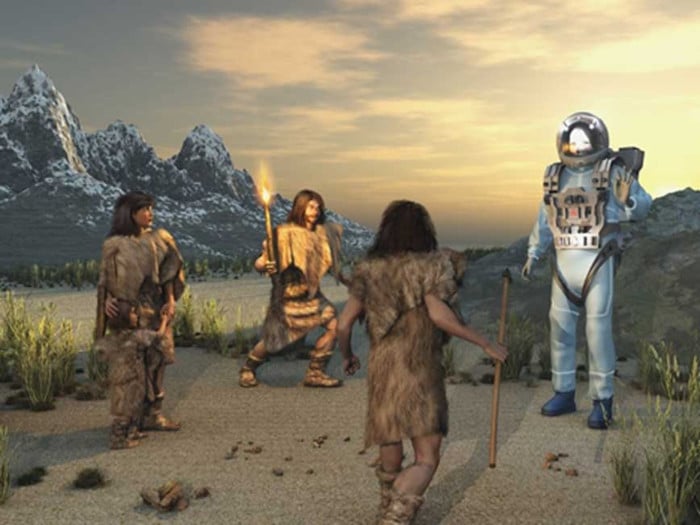
Encounter of human ancestors with an extraterrestrial. (anibal / Adobe Stock)
Science is Truth
With a motto of: “Science is Truth. Don't be fooled by the facts!” the first 'commandment' of the famous Decalogue of the Experimenter, Dr Roberto Volterri promotes reflections of science, mysteries of life and healthy fruitful curiosity about the possibility that from the depths of the cosmos, or perhaps even from our small solar system, someone, since distant antiquity, has had the idea of visiting us. Someone who still seems to want to leave only impalpable, elusive - sometimes very unlikely, but sometimes tangibly disturbing - traces. Someone whose identity we do not know, but of whose passage through the skies of our small planet we are sufficiently certain. We can be almost as much certain as the testimonies of the dark 'painters' of the Tassili caves - who, perhaps, had very close encounters - almost as much as the disoriented inhabitants of the first cities of our peninsula, whose 'visions' have been handed down to us by the most celebrated writers such as Tito Livio or Giulio Ossequente, almost as much as established artists such as Filippo Lippi, Ventura Salimbeni and Masolino da Panicale to whom this article is dedicated.
Dr Roberto Volterri is the author of 40 books including IFO Flying Objects Identified (Italian).
Top Image: Roman Forum. Ruins of Roman Forum in Rome, Italy during sunrise. (twindesigner / Adobe Stock)
References
Bedini, D. 1996. Madonna of the flying saucer. Notiziario Ufo July - August 1996
Birnes, W. 2016. UFO Hunters Book Two. Macmillan.
DaTrento, B. 2001. Liber epilogorum in gesta sanctorum. Sismel
Kroth, J. 2010. Aliens and Man? A Synopsis of Facts and Beliefs. Algora Publishing
Pinotti, R. 1996. Angeli, Dei, Astronavi. Mandadori
Pinotti, R. 2016. UFO: il fattore contatto: Alieni, intelligence ed esopolitica. Mondadori.
Stiebing, W. H. 1984. Ancient Astronauts, Cosmic Collisions and Other Popular Theories About Man's Past. Prometheus Books
Von Däniken, E. 1972. Chariots of the Gods. Berkley, Publishing Group.
Van Däniken, E. 1973. The Gold of the Gods. Translated by Michael Heron (1 ed.). London: Souvenir Press