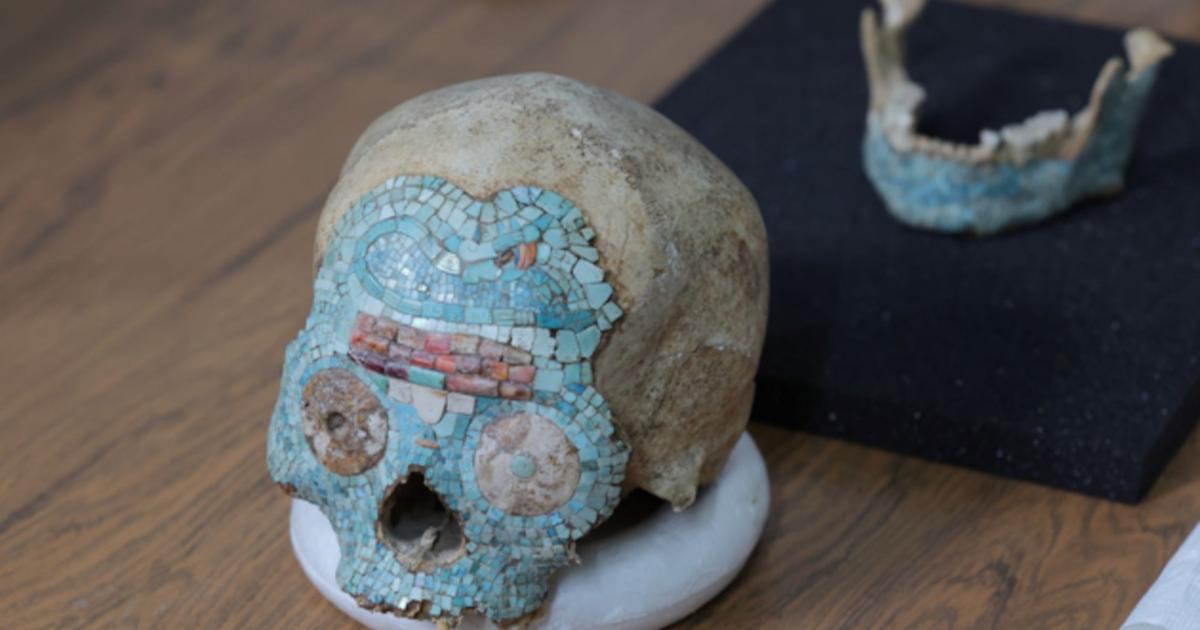

Mexico’s National Institute of Anthropology and History (INAH) has taken custody of a remarkable turquoise mosaic skull, returned from the Netherlands after decades in a Leiden museum collection. Part human remains, part Mesoamerican mosaic, the object is poised to yield fresh evidence about the man behind the ornament and the tangled history of how it was collected. Its return also brings an unresolved question into sharper focus: although the skull and its inlays are ancient, the arrangement seen today includes modern intervention. With potential future study and a possible home in Oaxaca, its journey is only beginning.

Left, front on view of the skull. Right; Left-profile view showing the contrast between the mosaic-covered face and the cranium. (INAH)
From Leiden to Mexico
According to an INAH release, the skull reached Mexico in May 2025 after approximately 60 years on display at Leiden’s Wereldmuseum. Mexican authorities and the civil-society collective Nohivi Ñuu Savi pursued its return, while INAH specialists have now registered, inventoried and digitally documented the object. Mexico’s Culture Secretary Claudia Curiel de Icaza called the recovery an act of “historical justice,” crediting the collective’s role in reconnecting the remains with community memory. The story adds a human dimension to the wider work of Mexican archaeology, in which provenance is as important as the artefacts themselves.
The Dutch Ministry of Education, Culture and Science formally handed the skull to Mexico’s embassy in The Hague in December 2024, following a request from the Mexican government. Its official announcement notes that human remains can be returned in response to specific requests, even though they sit outside the Netherlands’ policy framework for colonial collections. Leiden had purchased the object on the art market in 1962, without reliable archaeological provenance. That missing context matters particularly in Oaxaca, where the material record of places such as Monte Albán remains central to interpreting the region’s past.
- The Lost City of Aztlan – Legendary Homeland of the Aztecs
- A Unique Mesoamerican City: How the Urban Design Teotihuacan was Lost and Found
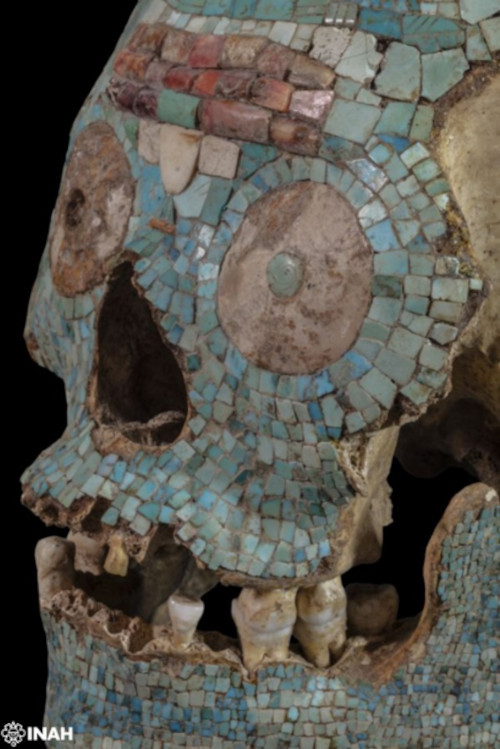
Close view of the turquoise, shell and other mosaic components on the repatriated skull. (INAH)
Ancient Materials, Modern Arrangement
The frontal bone holds small tesserae that represent a schematic serpent. The INAH identifies the blue tesserae as turquoise, and the several reddish and white pieces located near the brow and eye sockets as shell. Jadeite has been found in the left eye socket, and rock crystal makes up the serpent’s eye.
The technique is documented in Late Postclassic Mesoamerica, from about AD 1200 to 1521, particularly in areas now within Puebla and Oaxaca. The mosaics, like many other artifacts found in Mesoamerica, are part of an extremely diverse group of Mesoamerican artifacts from various geographic regions, and they reflect a wide variety of political and ritual traditions.
- What Lies Under Teotihuacan? – The Real City of the Gods
- Biggest Aztec Starfish Altar Ever, Found in Templo Mayor, Mexico City!
Yet the turquoise mosaic skull is not a simple, untouched survival from the past. Research undertaken in 2011 and 2012 found that the male skull, from an individual estimated to have died aged 25 to 40, and the mosaic materials are pre-Hispanic; a 2013 study by Martin E. Berger similarly described a modern combination of ancient components. However, twentieth-century adhesive was detected beneath some tesserae, meaning the composition visible now was assembled or reworked comparatively recently. The distinction guards against easy labels while making the object’s biography—from ancient materials to modern art-market handling—an archaeological subject in its own right, as it is for objects recovered from sites such as Teotihuacan.
Research and Community Stewardship
INAH’s physical anthropologists believe radiocarbon dating and ancient-DNA work could provide further insight, with teeth or the dense temporal bone among the possible sampling targets. They also caution that the individual’s identity should not disappear behind the striking mosaic: the comparison to a decorated skull from Tomb 7 at Monte Albán suggests the ornament may have honored a person of high significance. The Museo Comunitario Yucu Saa, in Villa de Tututepec, Oaxaca, has expressed interest in safeguarding and exhibiting the remains, subject to suitable conservation and security conditions. If that happens, the repatriated skull may bring scientific investigation, local stewardship and the enduring questions of Mesoamerican urban and social history together in one carefully managed object.
Top image: Landscape view of the pre-Hispanic turquoise-mosaic skull returned to Mexico. Source: Gerardo Peña/INAH Bulletin 345
By Gary Manners
References
Berger, M. E. 2013. Real, Fake or a Combination? Examining the Authenticity of a Mesoamerican Mosaic Skull. In Geurds, A. and van Broekhoven, L. (eds.), Creating Authenticity: Authentication Processes in Ethnographic Museums. Sidestone Press. Available at: https://www.sidestone.com/openaccess/9789088902055.pdf#page=21
Government of the Netherlands. 2024. Mixtec skull from Wereldmuseum Leiden collection returned to Mexico. Available at: https://www.government.nl/latest/news/2024/12/12/mixtec-skull-from-wereldmuseum-leiden-collection-returned-to-mexico
INAH. 2026. Bajo resguardo del INAH, el cráneo prehispánico con mosaico de turquesa, repatriado desde Países Bajos. Available at: https://www.inah.gob.mx/boletines/bajo-resguardo-del-inah-el-craneo-prehispanico-con-mosaico-de-turquesa-repatriado-desde-paises-bajos