
After more than 160 years of digging, Troy has produced what the ministry says is its first musical instrument. Excavators announced on October 22, 2026 that a bone flute about 2,800 years old had surfaced in an Archaic layer of the site, alongside an idol head roughly 4,500 years old. The timing places the flute close to the age usually given for Homer's poems, which raises an obvious question for anyone who has read them. Did anyone in Homer's world ever play it?
According to Türkiye's Ministry of Culture and Tourism, in a statement carried by the state news agency Anadolu Agency (AA), the flute came from a settlement fill of the Archaic period, which the ministry dates to about 750 to 480 BC. The statement says the head section attached to the flute's body survives, which should help researchers study how the instrument was built and played.
Culture and Tourism Minister Mehmet Nuri Ersoy announced the finds in a statement on social media, as reported by AA. He described the flute as the first and only musical instrument recovered in the long history of excavations at Troy, and as direct archaeological evidence of music at the site.
What Exactly Came Out of the Ground?
Rüstem Aslan, who heads the excavation, told reporters that the flute came from a layer of the eighth century BC, according to AA, DHA and IHA. Work this season is running in four areas of the site on behalf of Çanakkale Onsekiz Mart University, under the Heritage for the Future project, with the company İÇDAŞ as main sponsor.
The ministry's statement adds useful context, noting that instruments made of organic materials rarely survive, and that the wind instruments of the period included the syrinx, or panpipe, made from bone or reed pipes of different lengths. It also says some wind instruments were associated with the cult of Dionysus, and that music was part of religious ritual and public life.
However, the published details stop there, since no length, finger hole count or photograph scale has been released, and no scientific date has been announced beyond the layer itself. A layer of the eighth century is a promising start, but the ministry's own label, Archaic, covers nearly three centuries. That makes the find indicative rather than conclusive for any single generation of Trojans.
Why Does Homer Keep Coming Up?
Headline writers did not invent the pull toward Homer, because the Iliad itself gives the Trojans music. In Samuel Butler's translation, Agamemnon lies awake and marvels at the Trojan watchfires and "at the sound of pipes and flutes and of the hum of men" rising from the plain. On Achilles' shield, "the youths danced to the music of flute and lyre".
The dates also line up, at least loosely, and a British Museum essay by Daisy Dunn notes that the Iliad and Odyssey are "conventionally dated to the late 8th or early 7th century BC." An instrument from an eighth century layer at Troy therefore belongs, in broad terms, to the century in which many scholars place the poems' composition.
Aslan himself drew the parallel, saying, according to AA, that Homer specialists accept that the poet lived in the eighth century, and that many researchers accept the epics were written down then. Finding such an object in an Archaic layer of the same century was, in his words as translated from AA's report, quite important for the excavation.
Some English coverage has gone further than the Turkish reports. HeritageDaily wrote that archaeologists stressed the flute cannot currently be directly linked to Homer or to any performance described in the poems, without naming who said so. The same report adds that Aslan emphasized there was no direct connection between the artifact and the film. The Turkish agency reports tell a slightly different story.
According to DHA and IHA, Aslan's caution concerned a film rather than the poet. Asked about the movie The Odyssey, he said it was not possible to link the Troy flute directly to the film, while praising the production. AA reports that he said the film's song of the Sirens had been made experimentally with an eighth century flute, a detail he called an interesting coincidence for the dig.
That claim about the soundtrack rests on Aslan's remarks alone, so it remains Unverified. However, nothing in the excavation's announcements ties the flute to a bard, a recital or any scene in the epics. Arkeonews reports that no direct link to a ceremony or cult has been established, and Anatolian Archaeology says the flute is not yet tied to any specific performance.
Flute, Aulos or Something Else?
Calling the object a flute is the excavators' choice of word, and the type remains open. The best known Greek wind instrument of the period was the aulos. Britannica describes it as a reed pipe and states: "Each aulos was made of cane, wood, or metal and had three or four finger holes." Without hole counts or a published drawing, matching the Troy find to that design is premature.
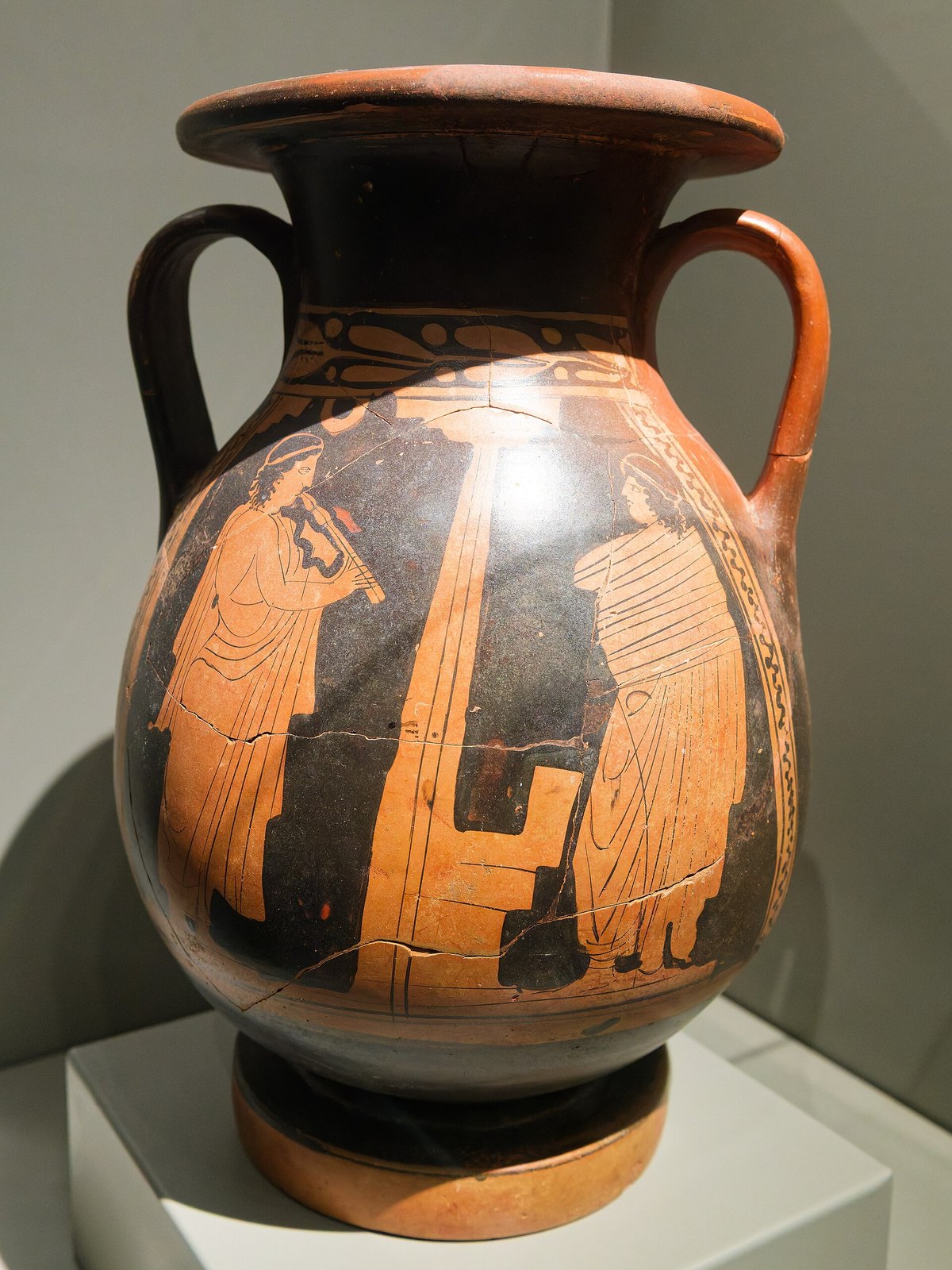
An aulos player on an Athenian red figure pelike, late fifth or early fourth century BC, Museo di Antichità, Turin. Photo: Marie-Lan Taÿ Pamart, via Wikimedia Commons, CC BY 4.0
Bone flutes are hardly new to archaeology either, and Aslan noted, according to AA, that bone flutes in Europe go back to the Paleolithic and that far older examples are known from Anatolia. What is new is the setting, since Charles Brian Rose of the University of Pennsylvania writes in The Archaeology of Greek and Roman Troy (Cambridge University Press) that sealed Archaic layers survive only in a few areas of the site.
Rose also offers a reason for caution about Homeric heroes. He argues that the link between legendary Troy and the historical town of Ilion "must have occurred by ca. 700 B.C. at the latest." Yet he adds: "There is no proof that Troy's new cult facilities were tied to specific Homeric heroes when they were first installed." The flute sits in that same uncertain window.
There is a dating wrinkle too, because the ministry places the Archaic period at about 750 to 480 BC, while Rose's scheme for Troy treats roughly 1050 to 650 BC as Geometric and 650 to 480 BC as Archaic. The two systems agree on the layer itself, although they show how far a single period label can stretch.
A Bronze Age Face From the Troy II Gate
The second find is far older, and the ministry says the idol head dates to around 2500 BC, in the Early Bronze Age, and was found near the city gate of Troy II, a phase it dates to about 2500 to 2300 BC. Aslan told reporters it came from a burned layer inside the gate area and was a cult object, according to AA and DHA.
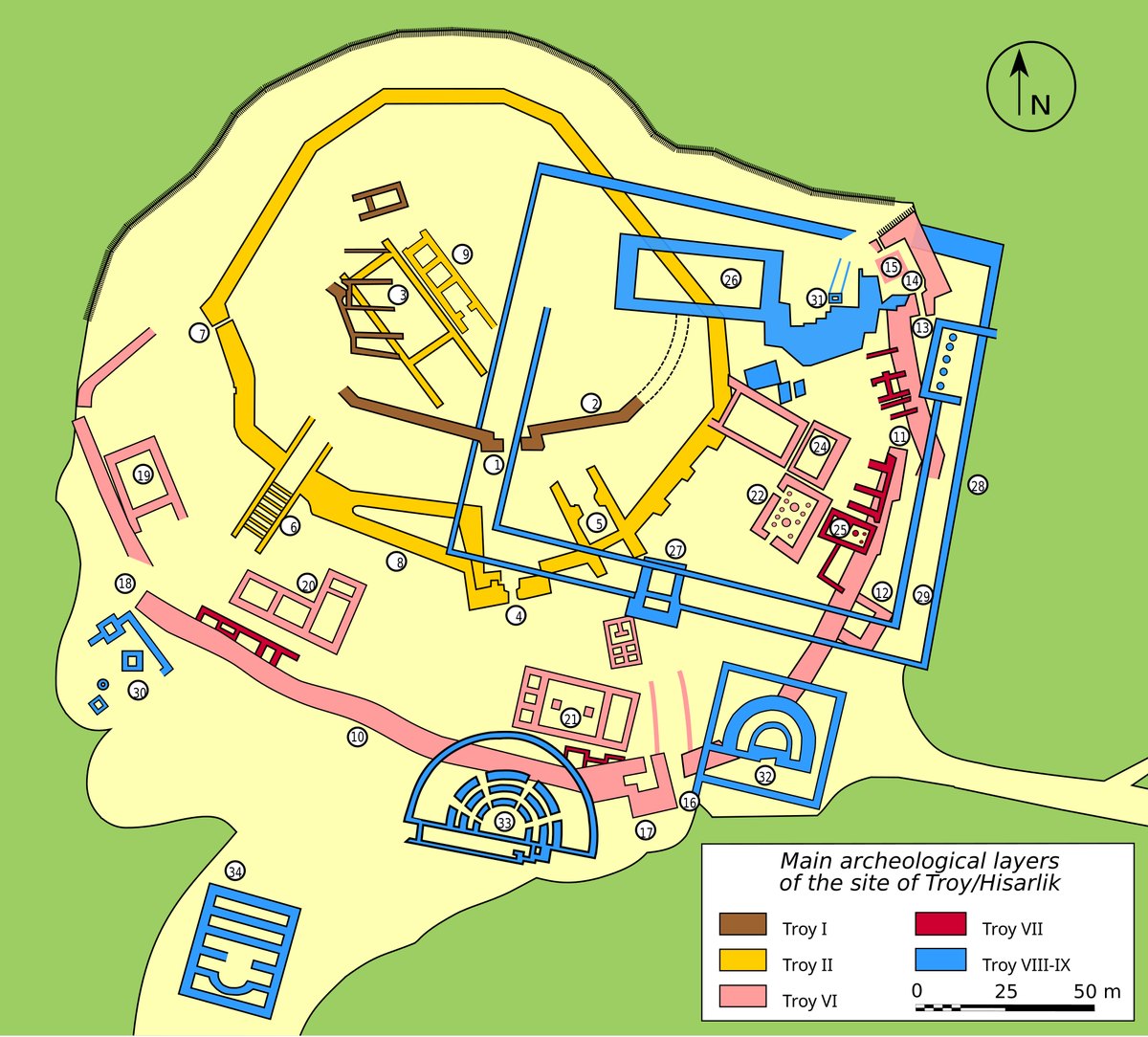
Plan of the archaeological site of Troy at Hisarlik, showing the main layers, with the walls of Troy II in yellow. Drawing: Bibi Saint-Pol, via Wikimedia Commons, public domain
The ministry describes small human-shaped idols as characteristic of western Anatolia in the third millennium BC. Aslan was reported as saying only three to five similar pieces had emerged in 160 years at Troy. That figure comes from him alone and could not be checked, and the excavation has not said which type of idol it is counting.
Heinrich Schliemann's 1880 book Ilios illustrates many flat marble idols from the layer he called "the third, the burnt city," most with an owl's head incised. A count of three to five similar finds therefore probably refers to a narrower class of object, such as a carved head. Until photographs and dimensions are published, any comparison remains provisional.
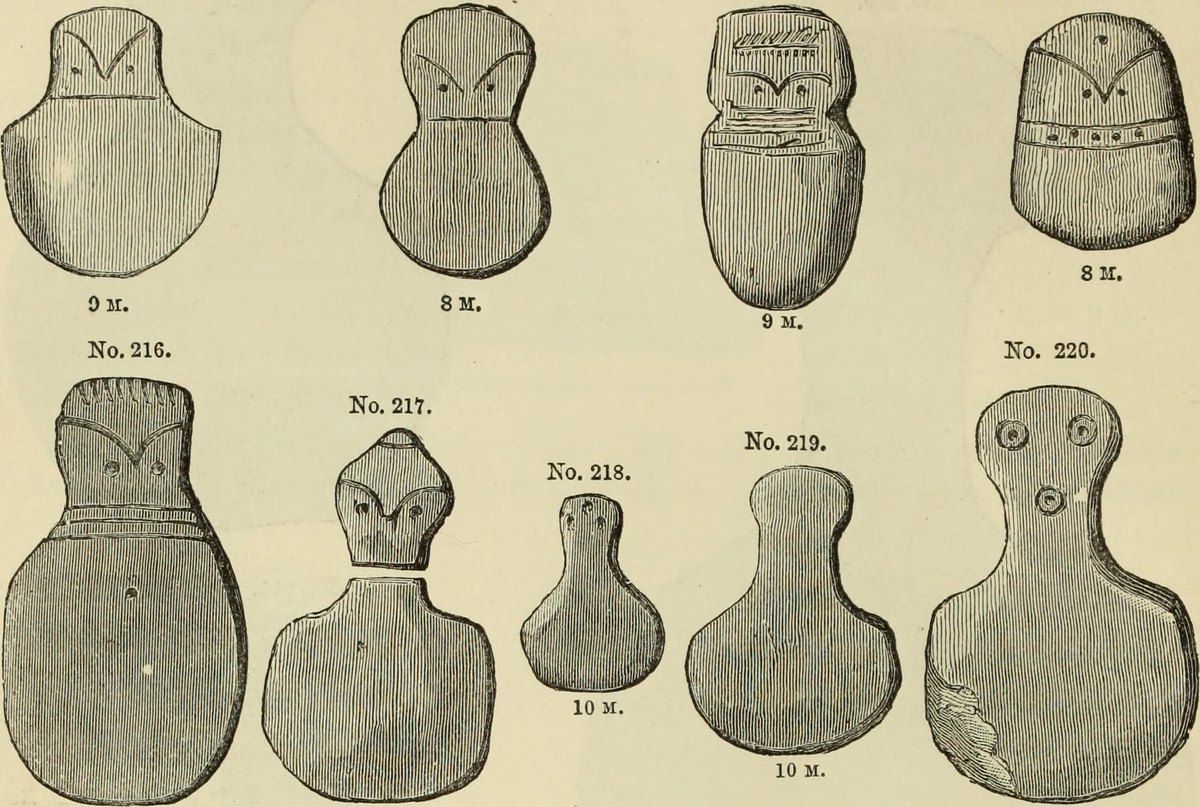
Flat marble idols from Troy, engraved for Heinrich Schliemann's Ilios (1880). Depths are given in meters. Image: Internet Archive Book Images, via Wikimedia Commons, no known copyright restrictions
Where This Leaves the Trojan Flute
The discovery itself, and its context as stated by the ministry, are Established. The date of the Homeric poems is Disputed among scholars, and any link between this flute and Homer, the instrument's exact type and the film soundtrack story are all Unverified. A full excavation report would answer several of these questions.
For now, the bone flute of Troy suggests that music was played at Ilion in the period when the Iliad likely took shape. Whether it ever accompanied a song about Achilles is another matter, and on the evidence released so far, the find remains less a relic of Homer than a rare glimpse of the music of Archaic Troy.
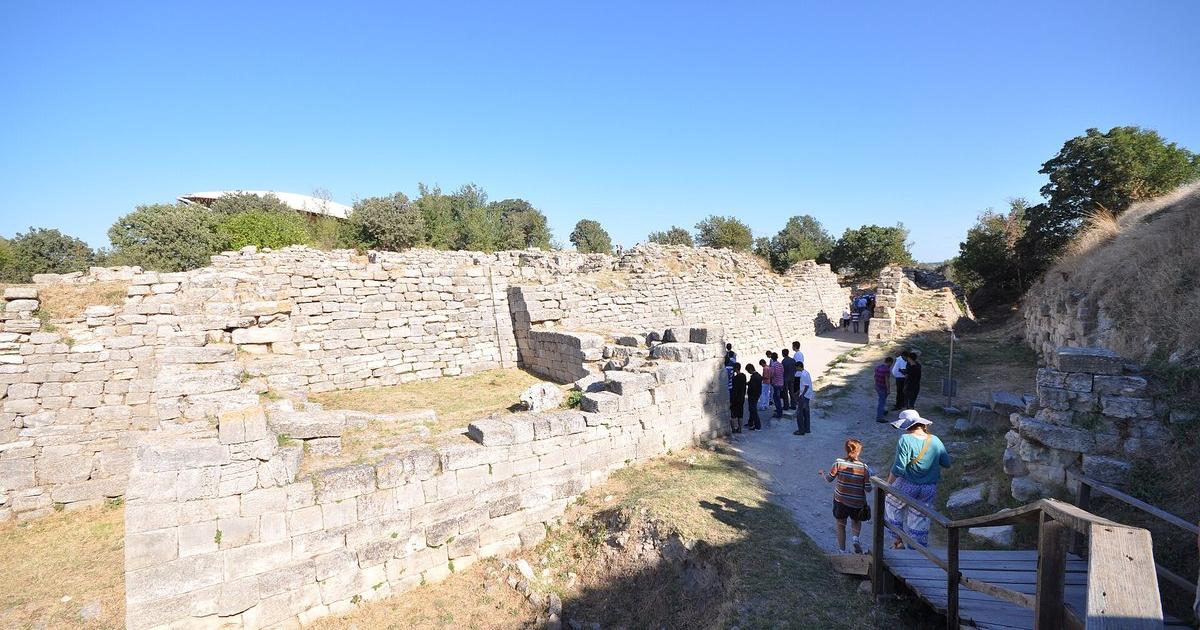
Stone walls at the archaeological site of Troy, at Hisarlik in northwest Türkiye. Photo: Jorge Láscar, via Wikimedia Commons, CC BY 2.0
By Aris Manus
Sources
- Anadolu Agency (AA). Kalyoncuoğlu, Y., Alyanak, Ç. M. and Aslan, S. G. October 22, 2026. Troya'da 160 yılı aşkın kazı tarihinde ilk müzik aleti bulundu. In Turkish. AA
- Demirören News Agency (DHA). Şen, N. C. October 22, 2026. Çanakkale Troya'da 2 bin 800 yıllık kemik flüt ve 4 bin 500 yıllık idol başı bulundu. In Turkish. DHA
- İhlas News Agency (IHA). October 22, 2026. Troya’da 160 yılı aşkın kazı tarihinin ilk müzik aleti bulundu. In Turkish. IHA
- Milligan, M. October 22, 2026. 2,800-year-old bone flute unearthed in Troy. HeritageDaily. HeritageDaily
- Arkeonews. October 2026. Troy’s First Musical Instrument Discovered Alongside 4,500-Year-Old Idol Head. Arkeonews
- Anatolian Archaeology. October 2026. 2,800-Year-Old Bone Flute: First Musical Instrument Found at Troy. Anatolian Archaeology
- Rose, C. B. 2013. Troy during the Archaic Period. In The Archaeology of Greek and Roman Troy. Cambridge University Press. Cambridge Core
- Dunn, D. January 22, 2020. Who was Homer? British Museum blog. British Museum
- Britannica. Aulos. Encyclopaedia Britannica. Britannica
- Homer. The Iliad. Translated by Samuel Butler. Project Gutenberg. Project Gutenberg
- Schliemann, H. 1880. Ilios: The City and Country of the Trojans. Internet Archive
Quotations from the AA, DHA and IHA reports are translated from Turkish.