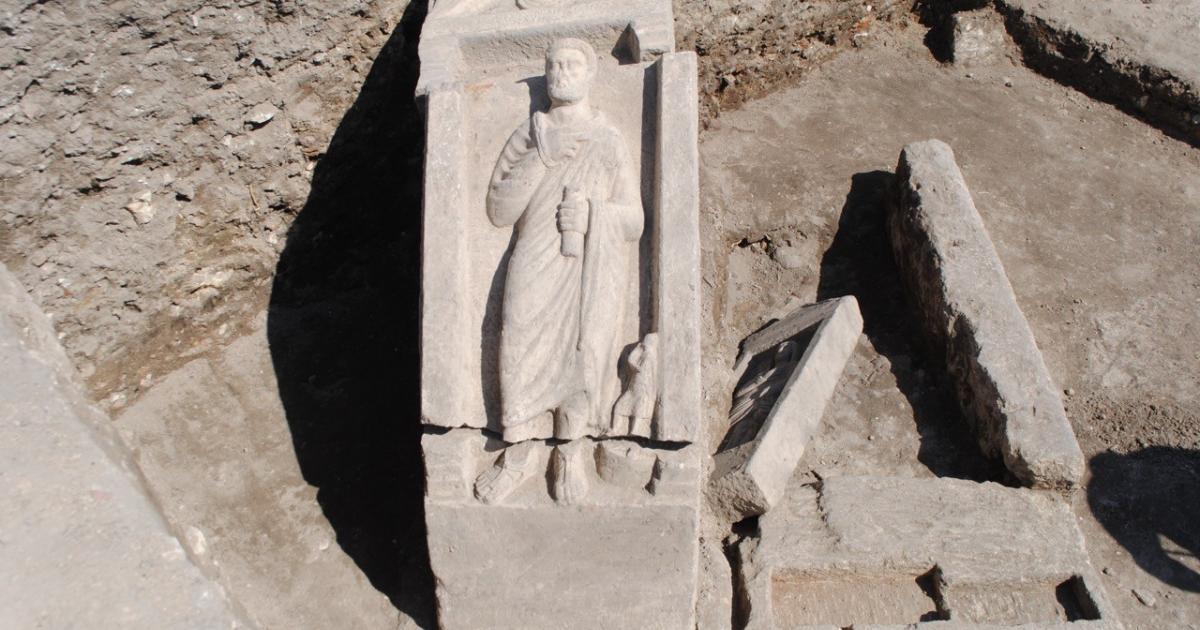

Nearly 2,000 years ago, a teenage girl named Annion was laid to rest in an inscribed marble funerary monument in the necropolis outside Tauric Chersonesos, surrounded by the possessions of a privileged life cut tragically short after only eighteen years. Her treasures – including gold jewelry, cosmetics, and other personal objects - were placed beside her in the tomb, perhaps intended to preserve her beauty and status beyond death. Now, after surviving remarkably intact for two millennia, Annion’s burial offers an intimate glimpse into the life, identity, and funerary traditions of a young woman living in Roman-period Tauric Chersonesos, the centuries-old Greek city on the Black Sea.
Viktor Vakhoneev and the IHMC RAS Introduce Annion’s Tomb
Following the large-scale 2021-2023 excavation, and several subsequent years of conservation, cataloging, and interpretation, the research team from the Center for Rescue Archaeology of the Institute for the History of Material Culture of the Russian Academy of Sciences (IHMC RAS), led by senior researcher Viktor V. Vakhoneev, has devised a unique introduction to Annion and her world as well as the complex process of preparing her tomb to tell her story.
- Early Middle Ages Jewelry Unearthed from Opulent Graves in Crimea
- The Royal Kurgan of Kerch: The burial mound built by a king
Annion’s Tomb was Discovered Beside Tauric Chersonesos
Annion’s tomb is located near the Southern Suburb of Chersonesos, within the UNESCO World Heritage property Ancient City of Tauric Chersonese and its Chora, which is designated a UNESCO World Heritage site. Vakhoneev, known for his investigation of the ancient submerged city of Akra in the Crimean Bosporus, explained the daunting task facing the archaeological team in an interview generously shared by Arkeonews. Researchers were not simply examining one ornate grave in isolation; rather, they were investigating the entire Roman-era cemetery, and particularly a family funerary complex associated with inscriptions naming members of the Ariston family, a wealthy Chersonite family during the 1st-2nd centuries AD. According to Vakhoneev, buildings in the complex included a slab-built above-ground tomb, a crypt columbarium containing multiple burials in niches, and funerary stelae with inscriptions and portraits.
- The Maykop: Lost Bronze Age Culture of the Exotic Caucasus Region
- A Tiny Silver Door to the Afterlife? Muroma Teenager's Grave Explored
Researchers date the main grave structures to the late 1st-2nd century AD, but the wider funerary complex continued to be used for burials into the first half and perhaps into the middle of the 2nd century AD. Annion’s chamber was first uncovered in 2022, with continued study during the following years. Annion’s unique tomb, just outside the city walls, seems to have been one part of the Ariston’s family memorial, located in the necropolis of the Southern Suburb, near the ancient city gates. Her slab tomb was marked by a carved marble funerary stela with an inscription in ancient Greek documenting her name and family lineage: “Annion, daughter of Aischines, son of Heroides, who died at the age of eighteen.”
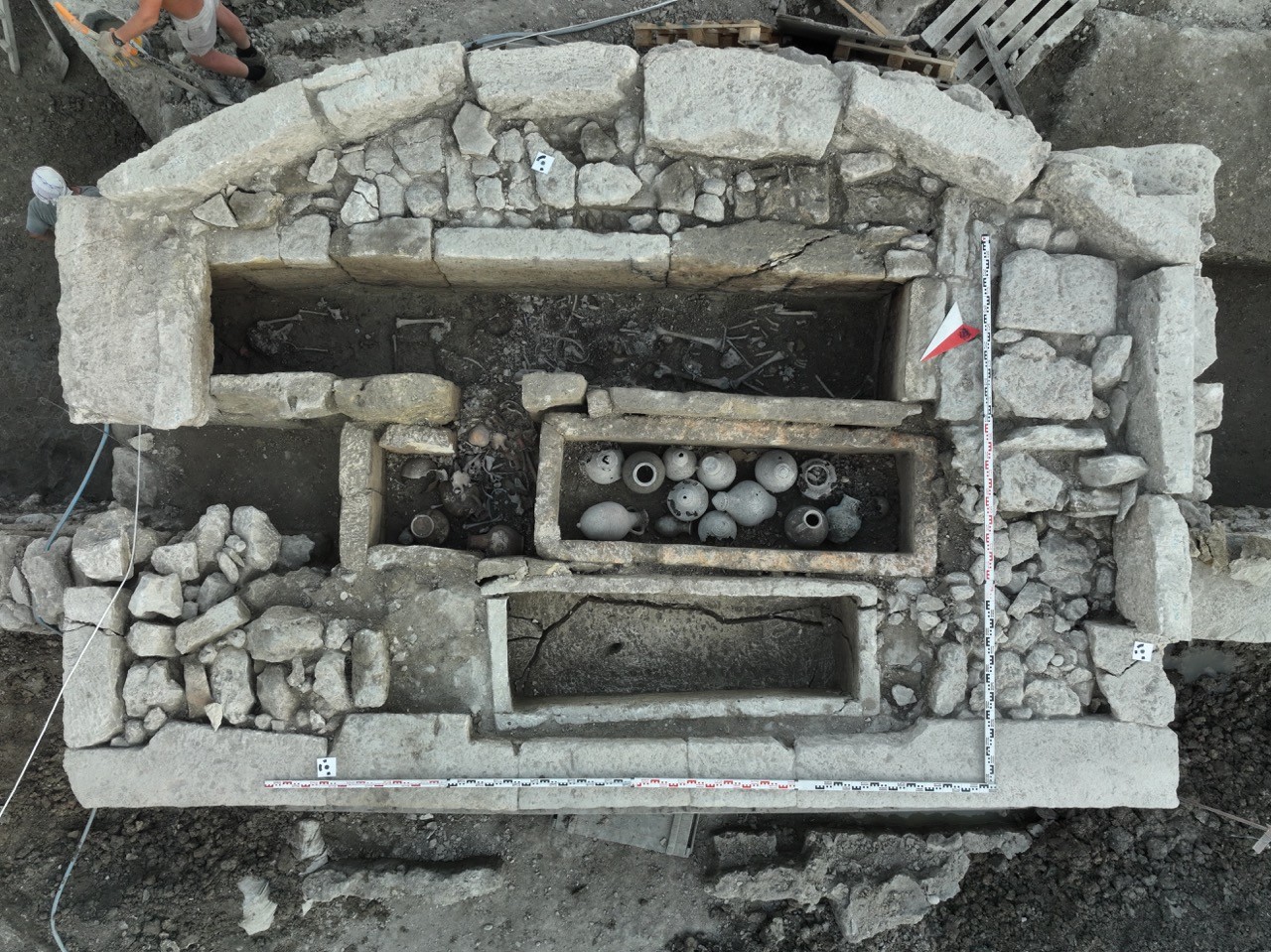
Overhead view of the monumental Roman-period funerary complex during excavation in the Southern Suburb of Tauric Chersonesos. The complex contained a family columbarium, numerous funerary monuments, and the slab tombs of Ariston and Annion. (Rescue Archaeology Center, Institute for the History of Material Culture, Russian Academy of Sciences.)
Annion’s Tomb Contains Her Prized Possessions
Vakhoneev, an archaeologist experienced in piecing together pottery fragments to identify human remains, was amazed to find absolute certainty in the written records of Annion’s tomb, waiting for his team to tell her story. Her name is carved in stone and painted on her possessions, such as a red-glaze bowl among her grave goods. Her makeup boxes, bone pyxides, would still have traces of her rouge. Now, her hairpins, spindles, and beads, preserved for nearly two thousand years, became the carefully cataloged evidence of her world, analyzed by researchers who studied her life and times.
Anthropological Analysis Confirms Identification, Prevents False Assumptions
Using anthropological analysis, Vakhoneev and the research team noted that the tomb does contain the remains of a woman, approximately twenty years of age at the time of death. At present, the cause of Annion’s death has not been determined. More bone-sample analysis and broader scientific examination of the necropolis have shown that a seasonal respiratory illness was a common cause of death during that time period. He also cautioned against assuming that a man named Ariston is buried with Annion. In fact, her family name is repeated in stelae throughout the complex. Near Annion, archaeologists recovered the remains of a child approximately six or seven years old, not an adult man.
- The Ural Pictograms: Ancient Rock Art Depicting Modern Chemical Compounds
- Gone Forever? The History and Possible Future of the Recently Destroyed Monumental Arch of Palmyra
The Remarkable Process of Relocation
One of the most remarkable aspects of the work of Vaknoneev and his research team was the intricate process of relocating the tomb structures from the slopes of a ravine where flowing water precluded in-place conservation. The IHMC RAS team used their extensive training and experience from projects such as the restoration of the Triumphal Arch of Palmyra in Syria, which, according to the Institute’s project page, received high assessments from the international expert community and UNESCO, to design the multifaceted restoration process. According to documentation shared by Arkeonews, the team relocated six funerary monuments, including the tomb of Annion, the tomb of Ariston, a tholos, a columbarium-tomb, and a memorial exedra-crypt.
Damage Assessment, Digitizing, and the Anastylosis Principle
The two-year project required several stages. First, the team assessed the condition of each object, noting damage from water or exposure to the elements. Every block was digitally recorded using laser total stations,drone-based geodetic surveys, and photogrammetry. 4,627 individual architectural blocks were scanned during the project. Technicians constructed 3D models accurate to within a tenth of a millimeter using tools such as Artec Eva scanners. Each element was individually marked before disassembly. The team used non-destructive methods, since many of the structures contained stone already weakened by erosion or cracking. Advanced architectural software integrated the digital models, producing restoration plans that followed the anastylosis principle: original elements would be returned to their positions using traditional materials and methods whenever possible, rather than fabricating replacements.
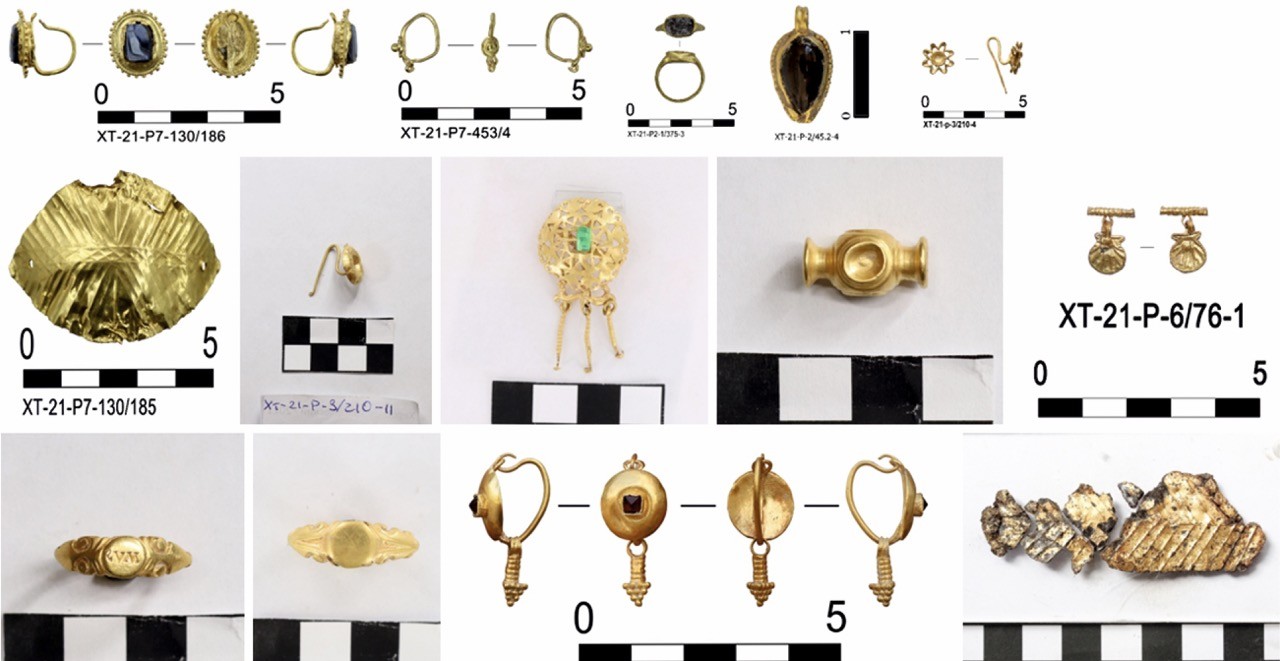
Gold jewelry recovered from ancient burial complexes in the Southern Suburb necropolis of Tauric Chersonesos. The extensive excavations uncovered an extraordinary collection of personal ornaments and other grave goods. (Rescue Archaeology Center, Institute for the History of Material Culture, Russian Academy of Sciences.)
Painstaking Physical Conservation Produces Public Access
The physical conservation work was equally painstaking. The team removed biological growth, such as fungi, from the stone, cleaned it without damaging the original surfaces, reinforced weakened blocks with resin, and rejoined broken fragments using specialized adhesives and anchor pins. The team used reliable conservation compounds to consolidate structural stone, as they restored more than 800 stone blocks, reassembling them at the museum. They even used lime-based mortar created to match the original material. Vakhoneev noted that the completion of conservation and restoration work now allows academic study, photography, and publications on Annion’s tomb to proceed. Readers interested in the full restoration process, including step-by-step documentation and 3D models of the reassembled monuments, can find further detail through the Center for Rescue Archaeology of the Institute for the History of Material Culture, Russian Academy of Sciences.
- Recreating The Faces Of Two Scythian Empire Rulers With High Tech
- Baba Yaga: The Wicked Witch of Slavic Folklore
The Palpable Presence of a Young Woman’s Life
Because of the efforts of Vaknoneev and his staff, Annion’s tomb has been moved to the southern facade of the Museum of Antiquity and Byzantium in New Chersonesos, where the public can gain understanding of the differences and commonalities between the life of a young woman two thousand years ago and the lives of modern teens. Annion’s presence, represented by a stela bearing her carved image, is palpable at the exhibit.
Top Image: Funerary stela uncovered in situ within the monumental Roman-period burial complex containing the tombs of Ariston and Annion in the Southern Suburb necropolis of Tauric Chersonesos. Source: Rescue Archaeology Center, Institute for the History of Material Culture, Russian Academy of Sciences
By Ramsey Hardin
References
Altuntas, L. August 10, 2026, “Chersonesos Unearths a Girl’s Gold, Rouge and Perfume After 1,900 Years.” Arkeonews. Available at: https://arkeonews.net/chersonesos-unearths-a-girls-gold-rouge-and-perfume-after-1900-years/
Center for Rescue Archaeology of the Institute of the History of Material Culture of the Russian Academy of Sciences. 2026. “Restoration of ancient architecture in the southern suburbs of Chersonesos”.Available at: https://rac.archeo.ru/projects/chersones-restoration/