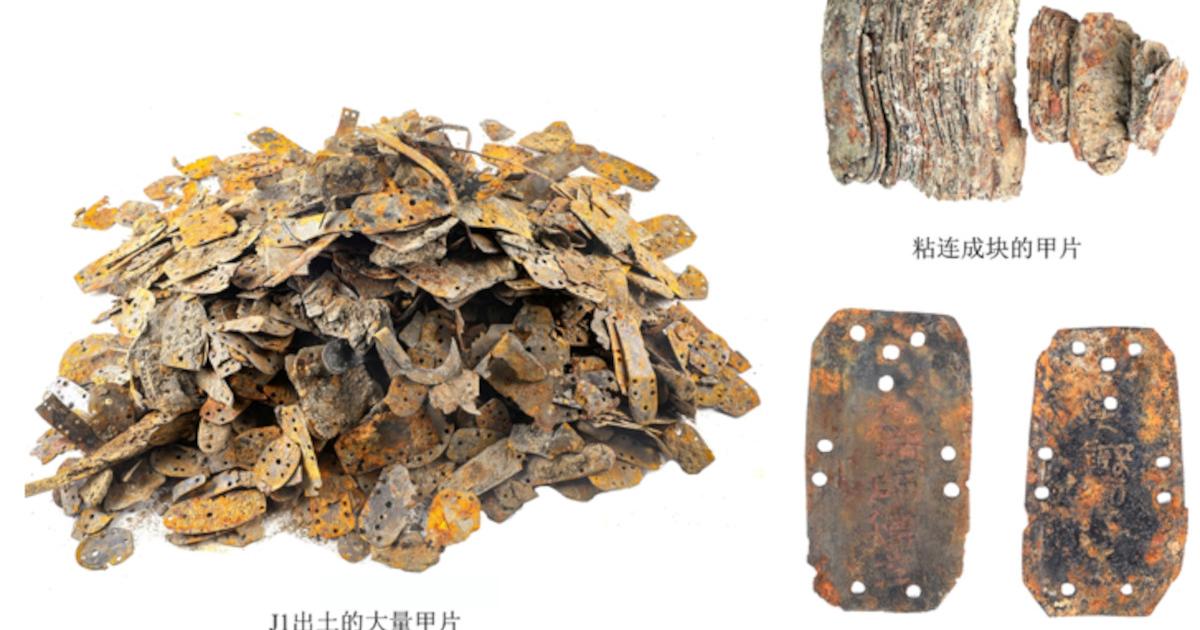

Archaeologists in Shaoxing, in East China's Zhejiang Province, have uncovered hundreds of tinned iron armor plates dating back 1,700 years to the Three Kingdoms period. The discovery, made at the Jizhong ruins site, represents the earliest known tinned iron artifacts in China and the earliest evidence anywhere in the world of an organized tin-plating industry for ironwork, according to the Global Times.
Silver-Coated Armor of the Eastern Wu
The armor plates were found in the past three years in historical wells and ash pits at the Jizhong site, which is located in the southern part of old Shaoxing. The plates are believed to be from the Wu period of the Three Kingdoms (AD 222–280), when the Eastern Wu kingdom, founded by Sun Quan, controlled large parts of the lower Yangtze region. In addition to the finished armor plates, archaeologists discovered semi-finished pieces, ironworking refuse, and the raw tin material indicating that a full cycle of production was taking place there.
- Royal Tomb from The Three Kingdoms Period Excavated in Central China
- The Jin Dynasty: The Sima Clan Fights to Hold China Together
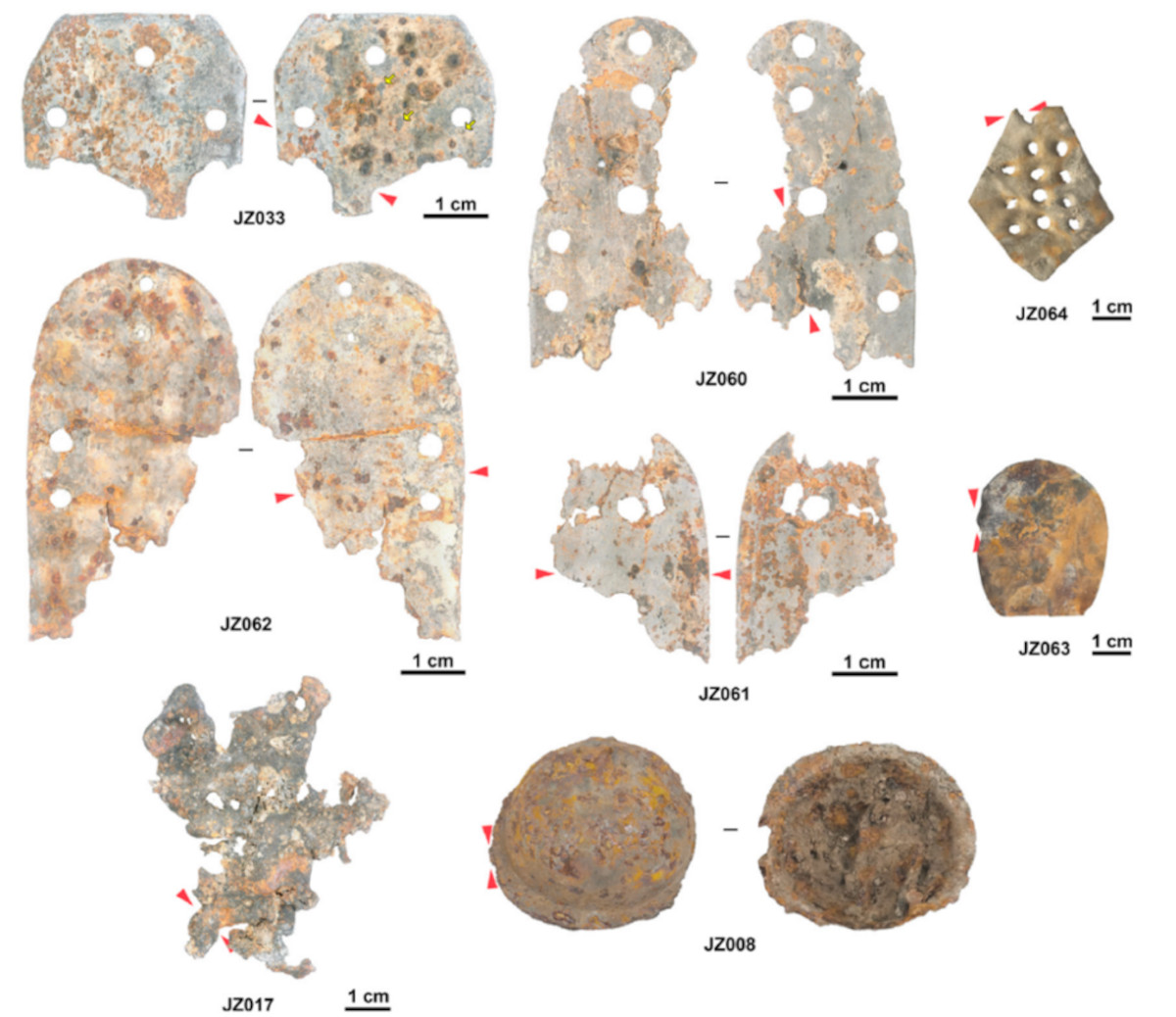
Tinned iron armor fragments, tinned iron decorative bosses, and tin materials unearthed at the Jizhong site. (University of Science and Technology Beijing (USTB))
Hot-Dip Tinning: An Ancient Anti-Rust Secret
According to the findings of the University of Science and Technology Beijing and Shaoxing Institute of Cultural Relics and Archaeology, the method of making the armor was discovered. Scanning electron microscopy, X-ray diffraction, and micro-CT imaging were used in the research, confirming that the skilled craftsmen dipped the ready iron plates into molten tin, which created one continuous layer with a thickness ranging between 110 and 330 micrometers. In addition, a microscopic layer of FeSn₂ formed where the iron met the tin, and droplet-like flow marks around holes and edges confirmed the hot-dip tinning technique.
The tin plating did two important jobs. Tin happened to be non-toxic and easy to melt, as well as able to resist corrosion well, so the coasting provided protection to iron materials against rusting. Even after being placed underground for 1,700 years, many plates can still be found shining in silvery-white color. This outstanding color could have distinguished this armor from regular iron materials giving it status of an advanced military asset. It has been suggested that it might have be linked with with ‘Mingguang’ or ‘Bright Light’ armor referred to in Three Kingdoms legends, although this remains speculation.
- Ancient Chinese Paper Armor Was Tougher Than Steel
- 2600-Year-Old Leather Armor Found In China Was Made In Assyria
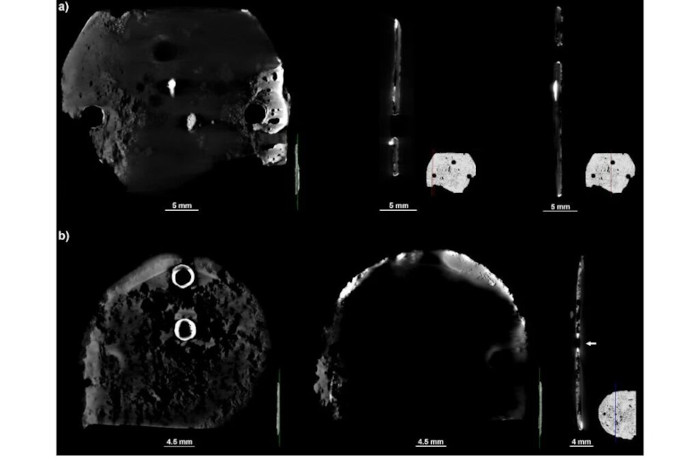
Micro-CT image of a tinned iron armor plate revealing the tin coating. (University of Science and Technology Beijing (USTB))
A Systematic Industry Ahead of Its Time
Even though tin coatings began to be used on bronze pieces in Greece and Etruria in the fifth century BC and other tinned iron items were discovered in Roman antiquity, the find at Jizhong is remarkable for its magnitude. According to Arkeonews, the discovery of coated armors, tin raw material, intermediate and leftover products made it possible to understand the first stages of artificial iron coating production — the first known evidence in the world of iron-tinning as a separate craft industry.
This method was most probably developed from the previous local custom. In the period from the pre-Qin to the Han dynasty, artisans in China already covered bronze vessels and ceramic goods with tin. In the workshop of Jizhong where bronze casting and iron making were carried out simultaneously, the knowledge was modified to protect military items. This finding marks an important stage in the metallurgical history of China and demonstrates that organized tin plate production existed even at the time of the Three Kingdoms, thus allowing military officers` equipment to shine for 2,000 years.
The study was published in the Journal of Cultural Heritage.
Top image: A number of tinned iron armor plates excavated from the Jizhong site. Source: Shaoxing Institute of Cultural Relics and Archaeology / Global Times
By Gary Manners
References
Altuntaş, L. 2026. 1,700-Year-Old Chinese Armor Still Shines Thanks to an Ancient Metalworking Secret. Arkeonews. Available at: https://arkeonews.net/1700-year-old-chinese-armor-still-shines-thanks-to-an-ancient-metalworking-secret/
ezhejiang.gov.cn. 2026. Shaoxing site reveals China's earliest tin-plated iron artifacts. Available at: https://regional.chinadaily.com.cn/ezhejiang/2026-08/06/c_1202977.htm
Peng, Q., Ge, S., Li, L., Lou, Y., Zhang, J., Chen, K. 2026. Iron tinning in 3rd-century China: Evidence from the Jizhong site, Shaoxing. Journal of Cultural Heritage 80 (2026 ) 219–231. Available at: https://www.sciencedirect.com/science/article/abs/pii/S1296207426000889
Yuqiao, J. 2026. World's earliest tinned iron production remains from 1,700 years ago unearthed in East China. Global Times. Available at: https://www.globaltimes.cn/page/202608/1368467.shtml