
A new study has found that the people who made China’s Terracotta Army may have included women and children, not only adult men. Researchers reached that conclusion after examining tiny fingerprints pressed into the wet clay of 36 warriors. The finding adds a human dimension to one of archaeology’s most imposing monuments and challenges a long-standing assumption about Qin imperial labor.
Fingerprints in Wet Clay
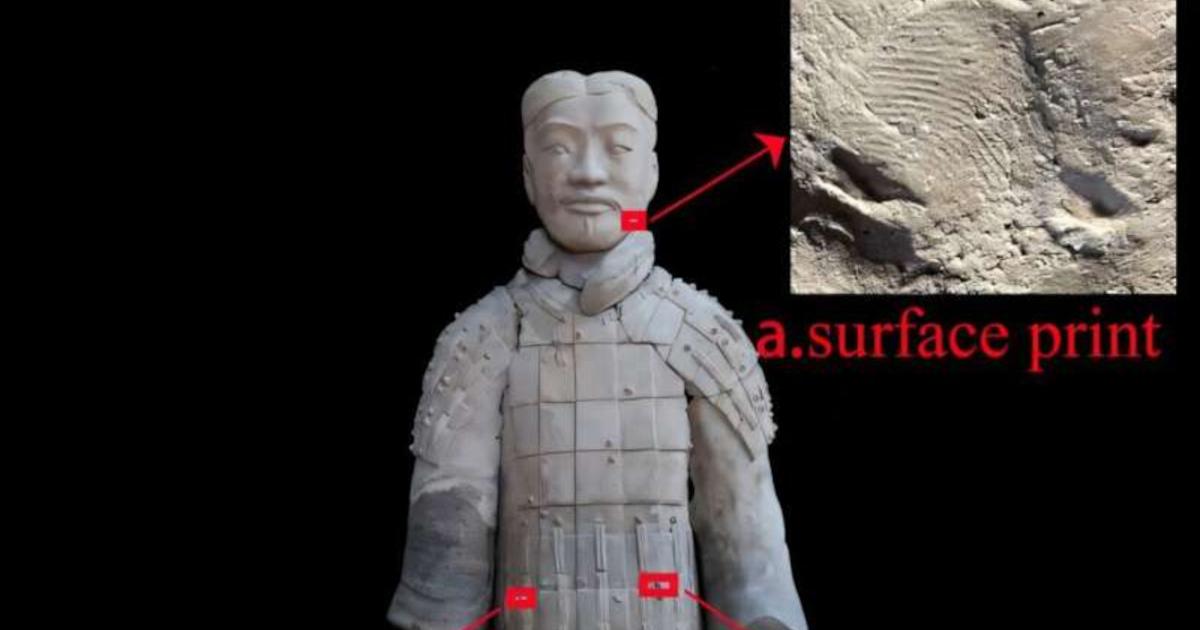
The research, published in the Journal of Cultural Heritage, examined 79 usable fingerprints from Unit T23 in Pit 1. The study was led by Xiaoxi Li of the Emperor Qinshihuang’s Mausoleum Site Museum, while a Phys.org report explains how the marks were measured on heads, arms, armor and other parts of the figures.
Rather than assigning an age and sex to each print, the researchers used a Bayesian mixture model to estimate the makeup of the group as a whole. The model attributed about 45 percent of the prints to adult men, 32.7 percent to adult women and 22.3 percent to juveniles under 15. As the study puts it, “the artisan community was not exclusively composed of adult males.”
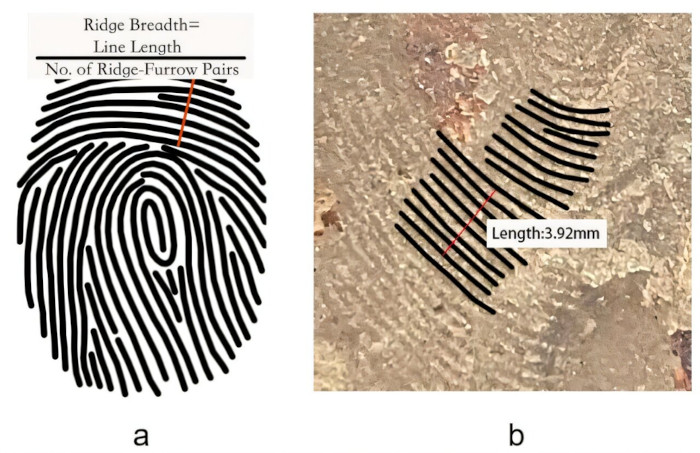
Fingerprint method of mean ridge breadth measurements (a. after Acree 1999 and [12]; b. the fingerprints measured in this study). (Li et al./Journal of Cultural Heritage)
The key measurement was mean ridge breadth, or the average distance between the ridges in a fingerprint. Ridge spacing increases as children grow, while adult men tend to have slightly broader spacing than adult women. Because the ranges overlap, especially between adolescent boys and adult women, the researchers treated the result as a population estimate rather than a set of individual identifications.
- Archaeologists discover tombs of Terracotta Army builders in China
- Chinese Terracotta Warriors Were Likely Replicas of Real Soldiers
A Workforce Beyond the Familiar Story
The result fits other evidence that Qin state workshops were not necessarily staffed by one narrow group. The researchers point to inscriptions on Qin lacquerware that refer to adult women, young girls and young boys, while surviving texts describe apprentices learning under experienced artisans. That context makes the fingerprint evidence plausible, although it cannot show precisely what tasks each person performed.
The Terracotta Army was part of the vast mausoleum of Qin Shi Huang, the ruler who unified China in 221 BC. UNESCO describes the complex near Xi’an as containing hundreds of pits and thousands of life-sized soldiers, horses, chariots and weapons. Readers can explore the wider setting in Ancient Origins’ The Secret Tomb of the First Chinese Emperor and its report on 2,200-year-old stone armor.
- Terracotta Army Weapons Were Genuine, Military Grade and State of the Art
- Cosmic Rays Could Finally Reveal Structure of Mysterious First Emperor’s Tomb
Why the Numbers Need Caution
The percentages do not amount to a census of the people who built the army. All 79 prints came from one localized area, and one worker could have left several marks while another left none that survived. The study also relies on modern European reference data, so differences between ancient and modern populations may affect the estimates.
Even with those limits, the evidence is difficult to reconcile with a workforce made up exclusively of adult men. As Science Alert’s report notes, the prints may preserve traces of a production system in which experienced craftspeople worked alongside younger helpers. A larger fingerprint database from other pits could reveal whether this was a local pattern or a feature of the Terracotta Army as a whole.
Top image: Terracotta figurine and one of the fingerprints on it. Source: Li et al./Journal of Cultural Heritage
By Gary Manners
References
Arnold, P. 2026. Who really made China’s Terracotta Army? Fingerprints reveal new clues. Available at: https://phys.org/news/2026-10-china-terracotta-army-fingerprints-reveal.html
Li, X. 2026. Who produced Emperor Qin Shihuang’s Terracotta Army, China? A Bayesian mixture model approach to fingerprint age and sex determination. Available at: https://www.sciencedirect.com/science/article/abs/pii/S1296207426002062
Science Alert. 2026. 2200-Year-Old Fingerprints Reveal Who Really Built China’s Mysterious Terracotta Army. Available at: https://www.sciencealert.com/2200-year-old-fingerprints-reveal-who-really-built-chinas-mysterious-terracotta-army
UNESCO World Heritage Centre. n.d. Mausoleum of the First Qin Emperor. Available at: https://whc.unesco.org/en/list/441/