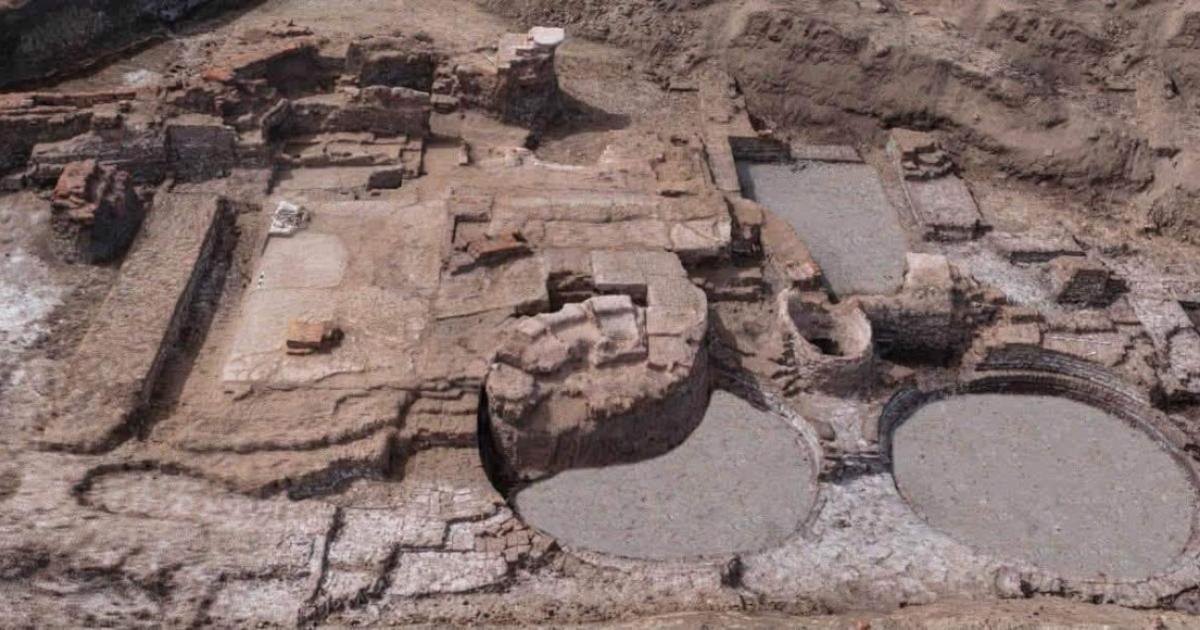

Archaeologists in Egypt have discovered an incredible bathing complex at the Tell Nasser archaeological site in Port Said. The complex is the first to be found in the region and helps us to better understand the settlement’s history, its architectural style, and evolution of public services in the eastern Nile Delta during Ptolemaic and Roman periods. The complex, which includes both public and private bathing facilities, demonstrates an advanced level of hydraulic engineering and suggests the area was occupied much earlier than previously thought.
The Egyptian archaeological mission, operating under the Supreme Council of Antiquities, made the discovery during its first excavation season at the site. Tell Nasser is located approximately 40 kilometers (25 miles) south of Port Said and 35 kilometers (22 miles) north of Qantara West. According to Sherif Fathy, Egypt’s Tourism and Antiquities Minister, the discovery underscores the archaeological significance of the Port Said region and highlights its potential for further historical research into the growth of settlements in the eastern Nile Delta

Aerial view of the bath complex at Tell Nasser, Port Said, Egypt. (Ministry of Tourism and Antiquities)
Traces of a Pre-Ptolemaic Settlement
Preliminary analysis of the archaeological layers at Tell Nasser has revealed that the site was occupied long before the construction of the bathing complex. Dr. Hisham El-Leithy, secretary-general of the Supreme Council of Antiquities, explained that the earliest remains date back to the late fourth and early third centuries BC, preceding the Ptolemaic period. The presence of Cypriot-style pottery and Greek amphorae confirms the existence of an earlier settlement at the site.
Later Ptolemaic layers, dating from the second and first centuries BC, yielded stamped Rhodian amphorae along with a mix of locally made and imported pottery. These findings point to continued occupation and active trade in the region. El-Leithy noted that the Tell Nasser excavation marks the first time a complete bathing complex has been scientifically uncovered in the area. The findings also indicate that the complex remained in use during the Roman period, undergoing architectural modifications while continuing to serve its original function.
- Hidden Greek and Roman City Revealed Beneath Alexandria
- Ancient Greek-Style Bathhouse for Egyptian Military Found
Advanced Hydraulic Engineering and Design
The Tell Nasser bathing complex stands out as one of the most complete examples of ancient hydraulic engineering discovered in the eastern Nile Delta. While its design shares similarities with Hellenistic baths previously found in Egypt, such as the recently excavated bath at Tell El-Herr in North Sinai, the Tell Nasser complex is unique in its inclusion of both public baths and a separate private bathing unit, all connected by an integrated water supply and drainage system.
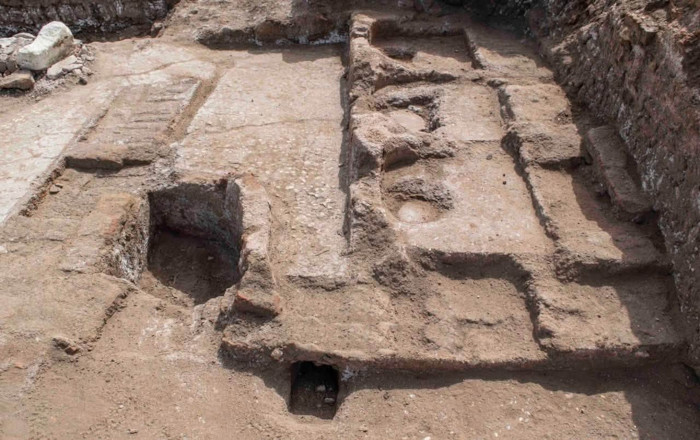
Part of the private bathing unit. (Ministry of Tourism and Antiquities)
Mohamed Abdel Badie, head of the Egyptian Antiquities Sector, detailed the layout of the complex. The private bath features a circular basin measuring about 2.5 meters (8 feet) in diameter, constructed from fired red bricks and coated with waterproof pink plaster. Archaeologists also discovered two oval foot baths, drainage channels, and a low-built structure likely used for heating water.
The public baths include two circular rooms, or tholoi, each measuring about 5 meters (16 feet) across. One of these rooms contains five foot-bathing stations, three of which are largely intact, complete with built-in backrests, armrests, and circular foot basins.
A Sophisticated Water Management System
The excavation team, led by Khaled Farid, director of the Port Said archaeological region, uncovered a sophisticated water management system. This system is built around a fired-brick channel nearly 6 meters (20 feet) long, which was raised above ground and partly covered by a vaulted brick roof to protect the water as it flowed through the complex.
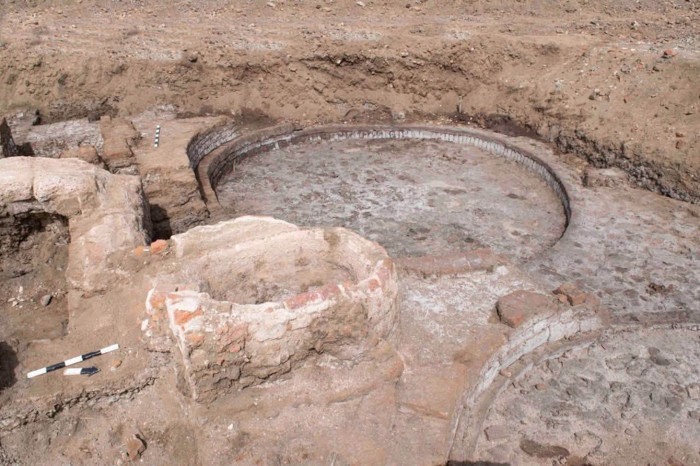
A circular bathing room, or tholos, uncovered at Tell Nasser. (Ministry of Tourism and Antiquities)
In addition to the main conduit, excavators found an integrated drainage network, an older water channel beneath the primary one, and buried residential walls. These findings confirm that Tell Nasser experienced multiple phases of construction prior to the establishment of the bath complex.
Abdel Badie suggested that the complex was likely built in the late first century BC and remained in use until the second century AD. This timeline is supported by pottery recovered from the site, including lamps, plates, and tableware. During the Late Roman period, parts of the complex were converted into storage areas, as evidenced by the discovery of Gaza amphorae. The artifacts recovered, including stamped Rhodian amphorae bearing Greek names, have been crucial in dating the site’s archaeological layers and reconstructing its history from the pre-Ptolemaic period through the Roman era.
Top image: An aerial view of the newly uncovered bathing complex at Tell Nasser in Egypt. Source: Ministry of Tourism and Antiquities
By Gary Manners
References
Egyptian Gazette. 2026. Egypt discovers Ptolemaic-Roman bath complex in Port Said. Egyptian Gazette. Available at: https://egyptian-gazette.com/entertainment/egypt-discovers-ptolemaic-roman-bath-complex-in-port-said/
La Brujula Verde. 2026. Thermal complex with circular pools from the Ptolemaic and Roman periods discovered in the eastern Nile Delta. La Brujula Verde. Available at: https://www.labrujulaverde.com/en/2026/07/thermal-complex-with-circular-pools-from-the-ptolemaic-and-roman-periods-discovered-in-the-eastern-nile-delta/
Zahid, N. 2026. Ancient Site in Egypt Reveals Greek Presence Before the Ptolemaic Era. Greek Reporter. Available at: https://greekreporter.com/2026/07/30/egypt-greek-presence-before-ptolemaic-era/