
In the 1850s, the British explorers Captain Felix Jones and Sir Austen Henry Layard dug into a low mound south of Baghdad and pulled out two hollow copper-alloy maceheads. Each carried the inscription "E.GAL ha-am-mu-ra-bi", which the University of Catania's Baghdad Urban Archaeological Project (BUAP) translates as "the palace of Hammurabi." On Monday, October 26, 2026, Iraqi and Italian archaeologists presented new finds from that same mound, Tell Muhammad, and showed off plans for a protective roof over the ruins, which they intend to turn into an archaeological park. So did the maceheads mark a palace of Hammurabi, and what has the new work found?
Walls, gates and a small postern
The National reports that Iraq's State Board of Antiquities and Heritage (SBAH) announced the discoveries as part of a joint project with Italy's University of Catania. According to the newspaper, the finds "include walls and gates, facilities that may have been used for food production, and traces of metalworking and ancient funeral practices." The excavations began in 2022.
The dig is led by Professor Nicola Laneri of the University of Catania. The National prints his surname as "Aneri", but Shafaq News, the BUAP website and the team's own 2026 paper in the journal Heritage all give it as Laneri. Speaking to local media, as The National reported, he described the work this way:
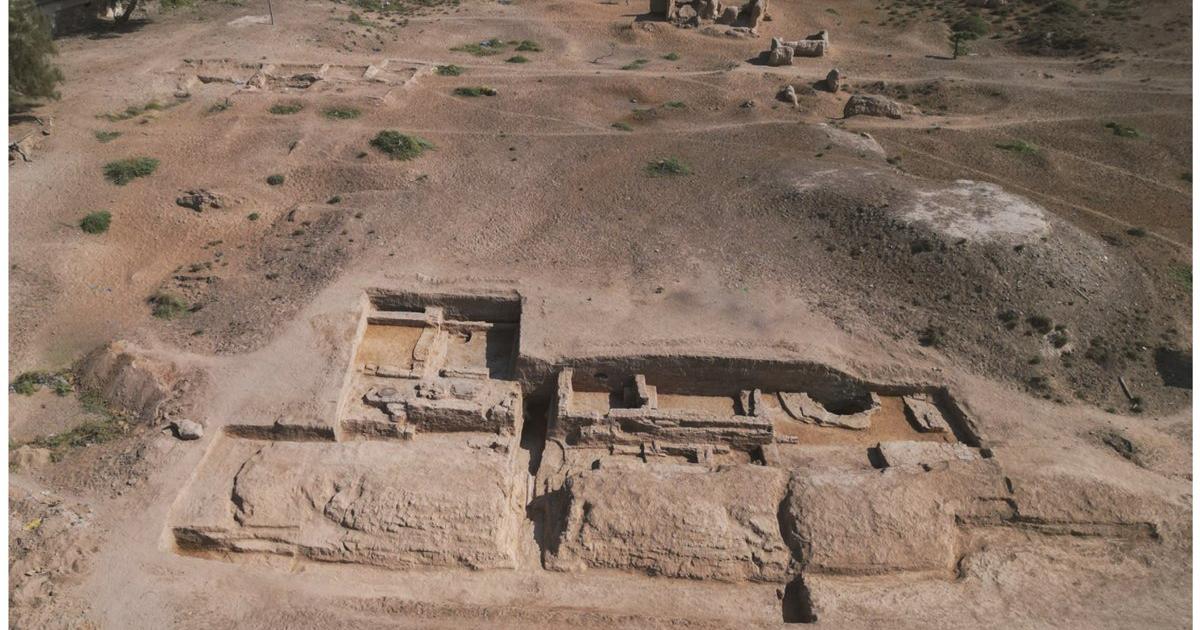
"We excavated areas related to the fortification walls, where we found two gates, one small postern [gate] for probably the military forces. After that, we decided to create an archaeological park," he told local media.
His word "probably" matters, because the military use of the small gate is Laneri's reading and the sources available so far give no further evidence for it.
The Heritage paper, by Laneri and nine colleagues, adds detail. It says the Catania team resumed digging in 2022 in the northwestern part of the mound, "focusing on the fortification wall and the city gate protruding along a canal." The authors describe a middle phase, Level III, dated to around the 18th and 17th centuries BC, that is "characterized by pyrotechnological activities, as demonstrated by the presence of kilns, metal production areas, and a large kitchen facility."
The Italian news agency LaPresse lists further finds, including clay jars, fragments of figurines, metal blades and a tablet inscribed in cuneiform (translated from the Italian). SBAH chairman Ali Obaid Shalgham said the newly uncovered artifacts will go to the Iraq Museum in Baghdad, The National reports, but he did not say how many items were found or what they were.
Graves beneath the floors
The "funeral practices" mentioned in the announcement are described more fully in the Heritage paper. The authors report graves, mostly of infants, buried beneath building floors throughout the excavated area. One room in the corner of a building next to the main city gate held five jar burials of infants and a large mudbrick grave with a corbel-vaulted roof. In it lay an adult with two ceramic goblets, which the authors call standard funerary goods for the Old Babylonian period.
The same room contained an altar with miniature vessels beside it. The excavators interpret it as a space for the cult of the ancestors, a practice they note is also known from ancient Mesopotamian written sources. The sources so far do not say who the dead were or how many graves have been opened.
Whose city was it?
Tell Muhammad sat in contested country between two kingdoms. The National describes it as one of the settlements of the Kingdom of Eshnunna, which it says flourished between 2000 and 1761 BC. The Heritage paper places Eshnunna near the Diyala River, about 40 kilometers (25 miles) east of Tell Muhammad, and calls the land along the Tigris "a frontier zone, originally under the control and cultural influence of Eshnunna."
To the south lay Babylon, ruled by Hammurabi and his famous code of laws. The Heritage paper dates his life to around 1810 to 1750 BC and says conflict between the two kingdoms grew until, "in the thirty-eighth year of his reign, Hammurabi destroyed Eshnunna by means of a great flood." He belonged to the dynasty founded by the Amorite kings of Babylon, and the paper calls him the sixth king of the First Dynasty of Babylon.
The maceheads are the reason Hammurabi's name is attached to this site. The BUAP website says they "confer to the site a probable Old Babylonian presence during Hammurabi's kingdom." The Heritage paper is more cautious still, describing the inscriptions as referring to a "possible" palace of Hammurabi, and elsewhere rendering the phrase as "property of the palace/fortress of Hammurabi." The maceheads are now in the British Museum. None of the sources identifies any building at Tell Muhammad as Hammurabi's palace, or ties the maceheads to a particular structure on the site.
A long life on the Tigris
The site was occupied for centuries before and after Hammurabi. According to the BUAP website, its sequence of layers starts in the Ur III period, at the end of the third millennium BC, and ends in the Kassite period, around the 16th to 13th centuries BC. The Heritage paper describes a major expansion in the 19th century BC, continuity through the following two centuries, and a final phase in which the site shrank.
Iraqi archaeologists had dug at Tell Muhammad long before the Italian team arrived. The BUAP website says SBAH excavations between 1978 and 1985 uncovered a sacred area and "hundreds of cuneiform tablets probably dated to the end of the Old Babylonian period." Among them, it says, are tablets with chronological references to the fall of Babylon, which the project dates to 1595 BC. The Heritage paper gives the Iraqi campaigns as running from 1977 to 1985, with a final season in 1999, so the sources differ by a year on the start date.
Bigger than the mound
Today the visible mound covers about 2.5 hectares (6 acres). However, the Heritage authors estimate that the original settlement "must have extended to about 24 hectares," or roughly 59 acres. That figure is the team's estimate rather than a measured extent.
The site sits beneath the crossroads of two major highways, the Muhammad Ibn Al-Qasim Highway and the Doura Expressway, where it "is observed by thousands of people daily."
Plans for the park
The roof unveiled on October 26 is part of a longer plan. The Heritage paper describes a roofing system, designed by the Carlo Pianosi architectural firm of Rome, to protect the two main areas of mudbrick architecture, the sacred area and the fortifications. A small building near the entrance is to become an antiquarium, or small site museum, "where the history of Babylon and Eshnunna during the time of Hammurabi will be narrated." A path would then lead visitors to the sacred area and the fortification wall.
The authors also plan to connect the park with a refurbished version of the existing park at nearby Tell Harmal, a few hundred meters away, where the Laws of Eshnunna were found.
When the park will open is not yet clear. The National says officials plan to open it to the public. Shafaq News reports that Italian Ambassador Niccolò Fontana hoped the site would soon welcome tourists.
However, LaPresse reported that the park opened to the public on Monday (translated from the Italian). Shafaq News also notes that earlier this month Iraq opened the first section of an archaeological park at Aqar Quf, under a €3 million Italian-backed program involving the universities of Bologna and Catania.
What remains open
The earlier Iraqi seasons at Tell Muhammad produced hundreds of cuneiform tablets, and the new seasons have mapped a wall, two gates and workshops, but the full excavation reports have not yet been published. Whether the inscribed maceheads point to a royal building on this mound, and what the small gate was used for, are questions the team has not yet answered.
How we label claims
Established: the location of Tell Muhammad on the southern edge of Baghdad, the joint SBAH and University of Catania project, excavation since 2022, the fortification wall and gates, the kilns, metal production areas and kitchen facility, the infant and adult burials described in the Heritage paper, the 19th century maceheads and their inscription, the earlier Iraqi excavations and their tablets, and the plan for a roofed archaeological park. Disputed: that Hammurabi had a palace at Tell Muhammad, which rests only on the maceheads, while no building on the site has been identified as that palace. Unverified: that the small postern gate served soldiers. Unverified: the estimate that the town covered about 24 hectares. Disputed: whether the park is already open to visitors, since the reports disagree.
Aerial view of the excavations at Tell Muhammad, Baghdad, seen from the north. Photo from the BUAP archive, published in Laneri et al. 2026, Heritage 9(2): 47, CC BY 4.0.
By Aris Manus
Sources
- Mina Aldroubi, Iraqi excavations to reveal secrets of life in Mesopotamia 4,000 years ago, The National, October 29, 2026
- Italian excavations reveal ancient structures at Baghdad site, Shafaq News, October 28, 2026
- Iraq, apre al pubblico un nuovo parco archeologico mesopotamico, LaPresse, October 29, 2026 (Italian)
- Baghdad Urban Archaeological Project, University of Catania
- Nicola Laneri, Germana Barone, Paolo Mazzoleni, Chiara Pappalardo, Alice Mendola, Rachele Mammana, Maura Fugazzotto, Aurora Borgesi, Vittorio Azzaro and Marilisa Spironello, Conserving the Memory of Hammurabi: A Sustainable Model for Ancient Heritage Management at the Old Babylonian Site of Tell Muhammad, Iraq, Heritage 9(2): 47, January 28, 2026