
The Egyptian Archaeological Mission of the Supreme Council of Antiquities has unearthed a significant portion of a Greco-Roman era necropolis at Tell Kom Aziza in the Beheira Governorate. This major discovery highlights the long-standing historical importance of the site, revealing it as a multi-layered archaeological record that spans several millennia. Among the most intriguing finds are the complete burials of wild boars, a highly unusual occurrence in ancient Egyptian funerary contexts that has left researchers searching for answers.
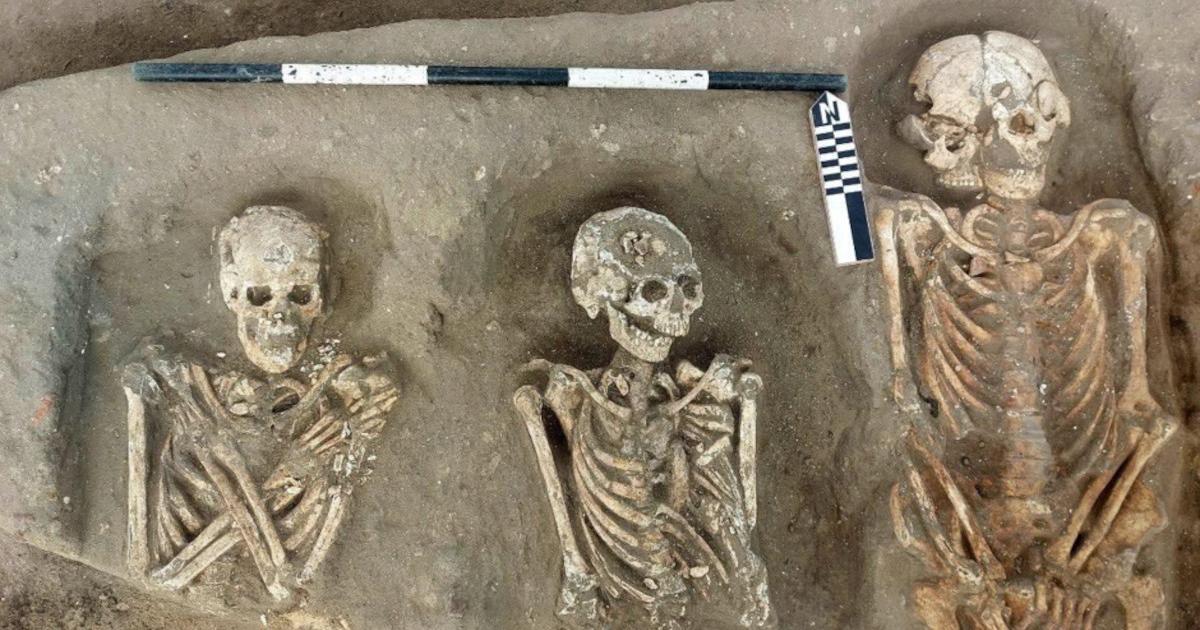
The excavation work has brought to light an incredibly diverse array of burial practices. According to Dr. Hisham El-Leithy, Secretary General of the Supreme Council of Antiquities, the human remains exhibit significant variation in burial rituals. Bodies were found oriented along both north-south and east-west axes, and the positions of the arms varied widely. Some individuals were placed with their hands crossed over the pelvis or near the neck, while others were found in the classic Osirian pose with arms crossed over the chest, or with arms extended straight along the thighs.
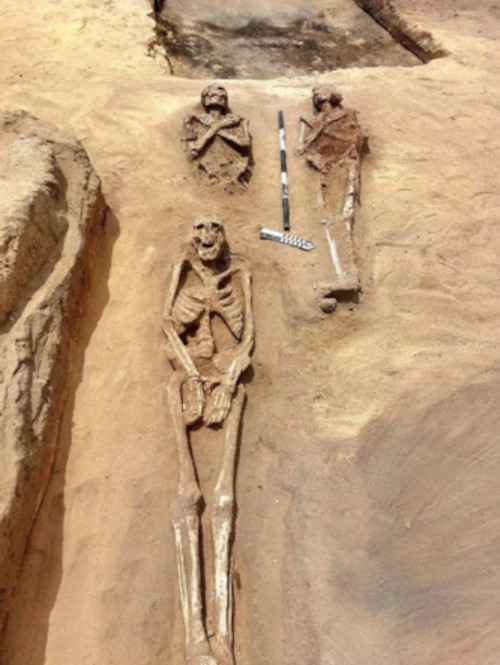
Multiple skeletons found at Tell Kom Aziza showing different burial positions. (Egyptian Ministry of Tourism and Antiquities)
A Multitude of Funerary Styles
The graves themselves also varied greatly in construction. Archaeologists discovered simple pit burials dug directly into the earth, alongside more elaborate graves lined with mudbrick. Additionally, several burials were found within painted plaster coffins, and others in distinctive barrel-shaped pottery coffins. The barrel-shaped pottery coffin was particularly common during the Ptolemaic period.
- Archaeologists Uncover Preserved Ancient Pottery Workshop in Egypt
- Rural Burials Reveal Origin of Ancient Egyptian Religion
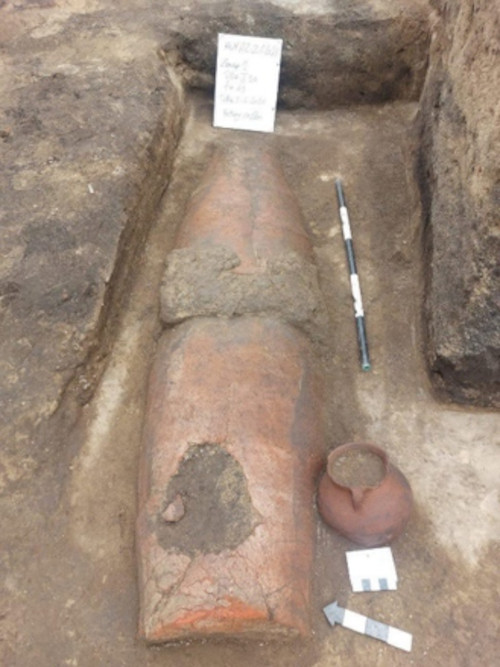
A barrel-shaped pottery coffin excavated at the site. (Egyptian Ministry of Tourism and Antiquities)
Mr. Sherif Fathy, Minister of Tourism and Antiquities, emphasized that Tell Kom Aziza is not merely a cemetery. The site provides a comprehensive archaeological record of settlement patterns, daily life, and the interaction between humans and their environment over thousands of years. The Greco-Roman necropolis was built over layers of much older settlements, with evidence of continuous occupation dating back to the Old Kingdom, through the New Kingdom and the Late Period, and finally into the Greek and Roman eras.
The Enigma of the Wild Boar Burials
Perhaps the most surprising discovery at Tell Kom Aziza is the presence of complete wild boar (Sus scrofa) burials within one of the archaeological layers. Khaled Abdel Ghani Farhat, Director General of the Beheira Antiquities and head of the excavation mission, noted that this is an exceptionally rare find. In ancient Egyptian religious traditions, pigs and wild boars were often associated with impurity and carried negative symbolism, primarily due to their connection with the god Set, the deity of chaos and disorder.
- War Pigs: A Flaming History of Nature's Cutest Creations in Battle
- The Outstanding Story of Osiris: His Myth, Symbols, and Significance
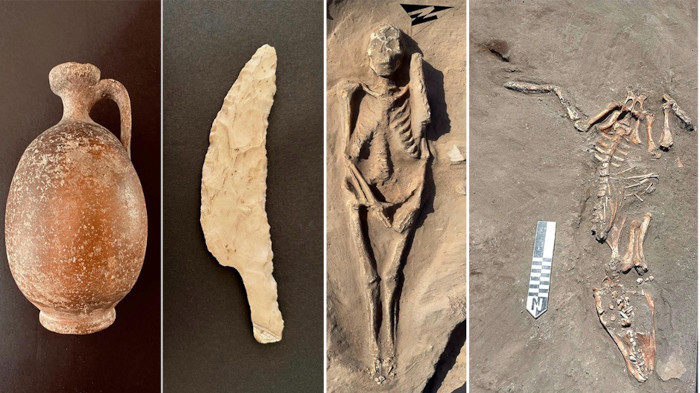
Grave goods found at the site, plus a boar remains. ((Egyptian Ministry of Tourism and Antiquities)
The excavation leaders suggest that these isolated boar burials might be linked to economic or domestic activities at the site during a specific phase of occupation, rather than being part of a formal funerary ritual. However, definitive interpretations will require further analysis of the faunal remains.
Glimpses into Daily Life in the Delta
Beyond the funerary evidence, the archaeological mission uncovered a wealth of artifacts related to everyday life at the settlement. Mr. Mohamed Abdel Badie, head of the Egyptian Antiquities Sector, detailed the recovery of ceramic and stone vessels, bread-making molds, multi-purpose stone tools, ovens, and storage jars.
The team also found large quantities of fish spines, bird bones, and mammal remains. This extensive collection of faunal evidence will be crucial for reconstructing the diet, food processing methods, and local economic activities of the people who inhabited this part of the Nile Delta across different historical periods.
The ongoing excavations at Tell Kom Aziza promise to reveal even more secrets about this fascinating site. The discovery of the wild boar burials, in particular, opens up new avenues of research that may challenge existing understandings of the role of wild fauna in ancient Egyptian society, at least within the delta region.
Top image: Rare wild boar burials and Greco-Roman cemetery uncovered at Egypt’s Tell Kom Aziza site. Source: Egyptian Ministry of Tourism and Antiquities
By Gary Manners
References
Al-Ahram. 2026. Beheira discovery sheds light on settlement and burial practices in Greco-Roman era. Al-Ahram. Available at: https://english.ahram.org.eg/NewsContent/9/41/570199/Antiquities/GrecoRoman/Beheira-discovery-sheds-light-on-settlement-and-bu.aspx
Archaeology Magazine. 2026. Rare wild boar burials and Greco-Roman cemetery uncovered at Egypt’s Tell Kom Aziza site. Archaeology Magazine. Available at: https://archaeologymag.com/2026/06/wild-boar-burials-and-greco-roman-cemetery-tell-kom-aziza/
Greek Reporter. 2026. Ancient Greco-Roman Cemetery Discovered in Egypt’s Nile Delta. Greek Reporter. Available at: https://greekreporter.com/2026/06/06/ancient-greco-roman-cemetery-discovered-egypt-nile-delta/
Heritage Daily. 2026. Major new discoveries at the ancient site of Tel Kom Aziza. Heritage Daily. Available at: https://www.heritagedaily.com/2026/06/major-new-discoveries-at-the-ancient-site-of-tel-kom-aziza/158275
La Brújula Verde. 2026. Strange Complete Boar Burials Discovered Beneath the Tombs of a Greco-Roman Necropolis in the Nile Delta. La Brújula Verde. Available at: https://www.labrujulaverde.com/en/2026/06/strange-complete-boar-burials-discovered-beneath-the-tombs-of-a-greco-roman-necropolis-in-the-nile-delta/