
Tavşanlı Höyük is one of the largest Bronze Age settlements in western Anatolia, according to Türkiye's Ministry of Culture and Tourism. This month the site gave up a find that is small in size but easy to picture: a mudbrick bearing the paw prints of a dog that stepped on it around 4,000 years ago, before the clay had dried. But did that dog belong to anyone, and what can a single brick say about life in a Bronze Age town?
A Brick From a Burned House
Culture and Tourism Minister Mehmet Nuri Ersoy announced the discovery on social media, and Anadolu Agency reported his post on October 26, 2026. According to Daily Sabah's English report, Ersoy said archaeologists had uncovered traces left by a four-legged animal on a mudbrick before it had dried. The brick was found in the rubble of a structure destroyed by fire during the Bronze Age, and it had once been part of a wall.
"The paw prints preserve a small moment from everyday life 4,000 years ago," Ersoy said, in the English translation published by Daily Sabah. "At Tavşanlı Höyük, one of the largest Bronze Age settlements in western Anatolia, we are uncovering not only structures and artifacts but also these small and unexpected traces of life."
Hürriyet Daily News gives a slightly different English rendering of the same Turkish post, quoting Ersoy as saying, "The paw prints on it preserved a small moment from everyday life 4,000 years ago." Both versions translate a statement that was first made in Turkish, so the exact wording in English varies between outlets.
The minister thanked excavation director Professor Erkan Fidan and his team, who have led the work at the site since 2021. Bilecik Şeyh Edebali University, where Fidan is a faculty member in the Department of Archaeology, published its own news release on October 27, 2026. The university release states that the prints were determined to belong to a dog walking on a mudbrick that had not yet dried.
How a Mudbrick Kept a Footstep
According to the ministry statement reported by Daily Sabah, mudbricks were made by mixing soil, water and straw, pouring the mixture into molds and leaving the bricks to dry in the sun. The ministry said the paw prints were left by a dog that walked across the brick while it was still wet, and that they became permanently preserved as the material hardened.
The university release describes the same process in Turkish. It says the bricks were left to dry before being used as building material, and that the marks left by the passing dog were preserved on the surface as the brick hardened. IFLScience, reporting on the find, describes the dog as stepping on the brick "as it was drying in a mold." However, the ministry statement places the drying in the sun after the bricks were molded, so the exact stage at which the dog crossed is described a little differently in each account.
What happened next is told consistently across the official sources. The brick was later set into the wall of a house. When that Bronze Age building was destroyed by fire, the brick ended up in the rubble, where it stayed until the excavation team recovered it.
A Bronze Age Town in Kütahya
Tavşanlı Höyük lies in Kütahya province in the interior of northwestern Anatolia. IFLScience describes it as "a sprawling hilltop settlement first built around 8,000 years ago," a figure that does not appear in the ministry statement.
Before the current excavation began, Fidan studied the mound through survey work. In a 2021 paper in the journal Mediterranean Archaeology and Archaeometry, he reported geophysical studies and geo-archaeological drilling across an area of 100 by 55 meters. According to the abstract, the work showed that the site "featured a settlement pattern of houses surrounded by streets and alleys during the Early Bronze Age II (2700-2400 BC)."
The same abstract reports "strong evidence that, at least for the area studied, it was not settled in again following a great fire outbreak during the Early Bronze Age III period." However, the paper predates the paw print find, and none of the 2026 announcements link the burned house with the brick to that particular fire. It is not yet clear which phase of the settlement the brick belongs to beyond the "Bronze Age" and "around 4,000 years" given in the official statements.
Dogs in Anatolia
Fidan placed the find in a much longer story when he spoke to IFLScience. "Dogs have a very long history in Anatolia," he told the outlet. "By the Bronze Age, dogs were already a familiar part of everyday life in Anatolian settlements. The approximately 4,000-year-old paw prints discovered at Tavşanlı Höyük provide a particularly direct and touching glimpse of this relationship."
IFLScience reports that Fidan pointed to a study published earlier this year in the journal Nature, which identified some of the world's oldest genetically confirmed domestic dogs at Pınarbaşı in modern Türkiye, dating back around 15,800 years. That date is given here as IFLScience reports it, as the Nature paper itself was not consulted for this article.
"The evidence is particularly interesting because puppies were deliberately buried at Pınarbaşı, suggesting a close relationship between humans and dogs," Fidan said. "At nearby Boncuklu, dating to the early Neolithic period, dogs were also buried with humans. Such discoveries suggest that dogs were not simply used for hunting or protection but may also have been valued as companions."
Questions about how dogs were domesticated remain open. IFLScience notes that scientists do not have a direct date for when or where it first happened, at some point during the past 40,000 years, likely in multiple locations and at several separate times. The Anatolian burials Fidan describes are part of the long history of dogs and people that researchers are still piecing together.
Was It Someone's Dog?
Fidan himself was careful on the question of ownership. "Of course, we cannot determine whether this particular dog was kept as a pet in the modern sense, but the discovery offers a small yet remarkable connection to everyday life four millennia ago," he told IFLScience.
The prints show that a dog was present where bricks were being made. However, they cannot show whether it lived in a house, worked alongside people, or wandered in from elsewhere, and that question stays open.
Paw Prints Elsewhere in the Past
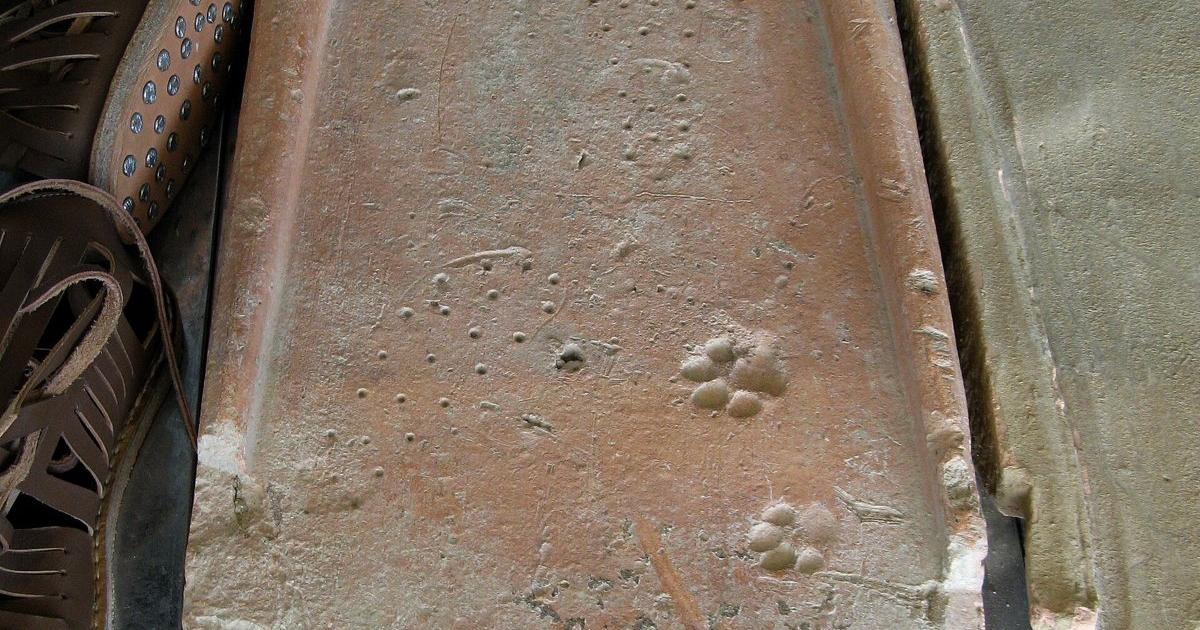
Animal tracks in ancient building materials are not limited to Anatolia. The Roman roof tile pictured above, held at MuseAl in Alba-la-Romaine in southern France, carries dog paw prints of its own, according to its Wikimedia Commons description, which dates the tile to the Roman period.
Older still are prints left on cave floors. IFLScience notes that archaeologists have found older dog paw prints in a cave in northwest Italy, where the researchers explained that the paw marks overlay human foot impressions. Reports of a child and a canine walking together 26,000 years ago show how such tracks have drawn attention long before Tavşanlı Höyük.
Dogs also appear in many other ancient settings, from dogs in ancient China to the dogs of war recorded in classical sources. The Tavşanlı Höyük prints come from a quieter setting, a building site in a Bronze Age town.
Small Traces of Daily Life
The university release says the find shows that archaeological research can uncover not only the buildings and artifacts of past civilizations but also small details of everyday life. Ersoy made the same point when he said the excavators were uncovering "these small and unexpected traces of life."
Work at Tavşanlı Höyük is continuing under Fidan's direction. For now, the brick from the burned house offers a single moment from around 4,000 years ago: a dog crossing soft clay before it dried.
How we label claims
Established: a mudbrick bearing paw prints, about 4,000 years old, was recovered from the rubble of a Bronze Age building destroyed by fire at Tavşanlı Höyük, and the ministry and the excavation team's university identify the animal as a dog. Established, as reported by the excavator to IFLScience: domestic dogs at Pınarbaşı around 15,800 years ago and dog burials with humans at Boncuklu. Unverified: whether the dog belonged to a household or was kept as a pet, and whether the burned house is linked to the Early Bronze Age III fire described in Fidan's 2021 survey paper. Unverified: IFLScience's figure that the settlement was first built around 8,000 years ago.
A Roman terracotta roof tile with dog paw prints, on display at MuseAl in Alba-la-Romaine, France. It is shown for comparison only and is not the Tavşanlı Höyük brick. (Photo by Mark Landon, CC BY 4.0, via Wikimedia Commons)
By Aris Manus
Sources
- 4,000-year-old paw prints discovered at ancient site in Türkiye, Daily Sabah with AA, October 27, 2026
- Buğrahan Ayhan, Tavşanlı Höyük kazılarında yaklaşık 4 bin yıllık pati izleri bulundu, Anadolu Ajansı, October 26, 2026 (in Turkish)
- Üniversitemizin Arkeoloji Çalışmaları Tarihe Işık Tutuyor: Tavşanlı Höyük'te 4 Bin Yıllık Keşif, Bilecik Şeyh Edebali University, October 27, 2026 (in Turkish)
- 4,000-year-old dog paw prints found at Kütahya's Tavşanlı Mound, Hürriyet Daily News
- Tom Hale, Over 4,000 Years Ago, A Dog Left Its Paw Print In This House Brick Found In Turkey, IFLScience
- Erkan Fidan, Geo-archaeological and geophysical investigation on the Early Bronze Age layers of Tavşanlı Höyük (Inland Western Anatolia), Mediterranean Archaeology and Archaeometry, 2021 (abstract consulted)
- Terracotta roof tile with dog paw prints (Alba-la-Romaine, MuseAl), Wikimedia Commons file page.jpg)