
Archaeologists have unearthed an extraordinary artifact during their excavation of the ancient Tartessian settlement of Casas del Turuñuelo in Guareña, Spain. The artifact - an incredibly rare ceremonial bronze chariot dated back to the 5th century BC - was discovered at the site during its 8th excavation campaign and represents the first of its kind ever uncovered within the Iberian Peninsula. It is believed this artifact will help guide us in understanding the enigmatic nature of one of the oldest cultures on the Iberian Peninsula. It represents a valuable indicator providing insight into the Tartessian civilization including the economic, religious, and trade network of the culture.
The discovery was announced by researchers from the Institute of Archaeology of Mérida, a collaborative institution of the Spanish National Research Council (CSIC) and the Regional Government of Extremadura. The bronze artifact has now been recovered from the site and is being classified as a singular ritualistic object. The find site of the chariot was in a ritual area identified as corridor S3, adjacent to a previously recovered bull-hide shaped altar, supporting the theory articulated by the researchers that the object was intended for dedication to some form of deity and/or to be used for ritualistic practices.
A Chariot with Mythological Elements
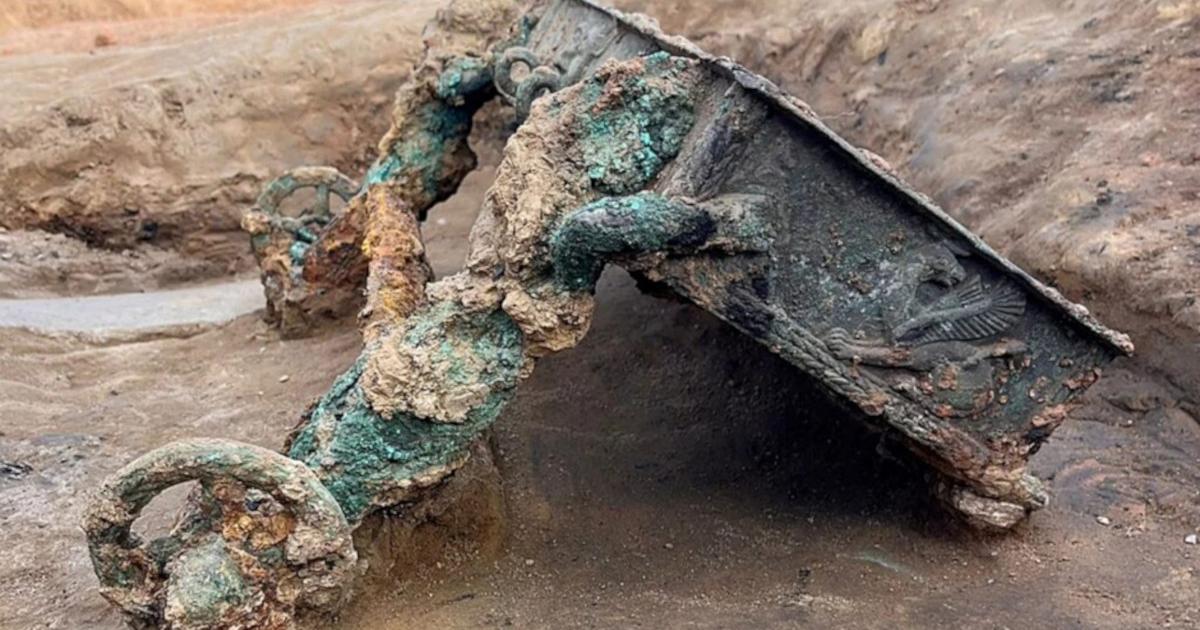
Although only a portion of the ceremonial chariot still exists (there are two wheels, one remaining axial and the inner rim of one of the wheels remaining intact), the level of decorative detail on the object is outstanding. The sophistication of the manufacturing techniques employed to produce the ceremonial chariot suggests advanced metalworking skills and the combined use of several bronze components and iron in its manufacture.
The chariot's artistic program is rich in mythological iconography. Its sides are decorated with griffins, mythical creatures with the body of a lion and the head and wings of an eagle, which have deep roots in the visual traditions of the Mediterranean and Near East.
- Lost Mass Animal Sacrifice Rituals Revealed at Tartessos Site in Spain
- 2500-Year-Old Tartessian Anthropomorphic Reliefs Revolutionize Understanding
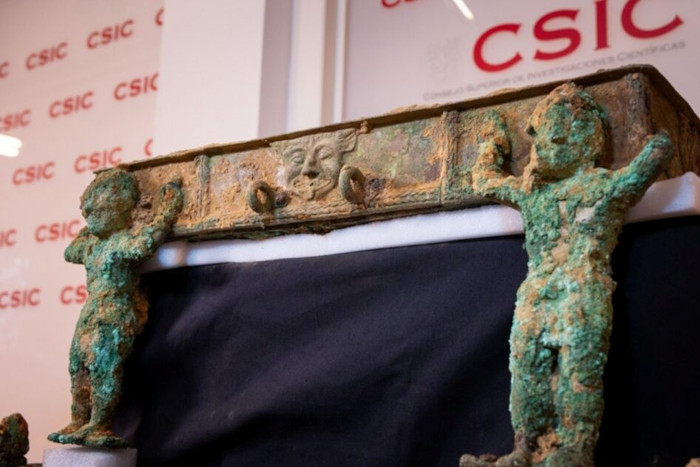
Two bearded male figures, dressed in short kilts and positioned like Atlantes, support the box base. (Ayuntamiento de Guareña)
At the front of the chariot is a horned face identified as Achelous, a river god known in Greek mythology. Interestingly, the figure is depicted with a protruding tongue, a gesture more commonly associated with gorgons. Researchers suggest this may represent a hybrid image, combining a river deity with darker, underworld associations. Additionally, two bearded male figures, positioned like Atlantes, appear to support the vehicle's body, adding further symbolic and religious significance to the artifact.
Evidence of Extensive Mediterranean Trade
The discovery of the bronze chariot strengthens the evidence for extensive commercial and cultural connections between Tartessos and other Mediterranean societies during the first millennium BC. Researchers note that the closest parallels to this ceremonial vehicle come from the ancient Etruscan civilization of central Italy. This suggests the object may have originated there or been heavily influenced by Etruscan craftsmanship, reinforcing the existence of trade networks linking Tartessos with different regions across the Mediterranean.
- Advanced 2500-year-old Construction Techniques Revealed
- Tartessos "Europe's Lost El Dorado": The Golden Kingdom of Ancient Spain
The chariot was found beside what archaeologists have identified as a banquet hall, supporting the theory that it was associated with the final ceremonial feast held before the deliberate closure and burial of the building at the end of the 5th century BC. This final act remains unexplained, but the careful burial of the site has preserved an extraordinary record of ritual and architecture.
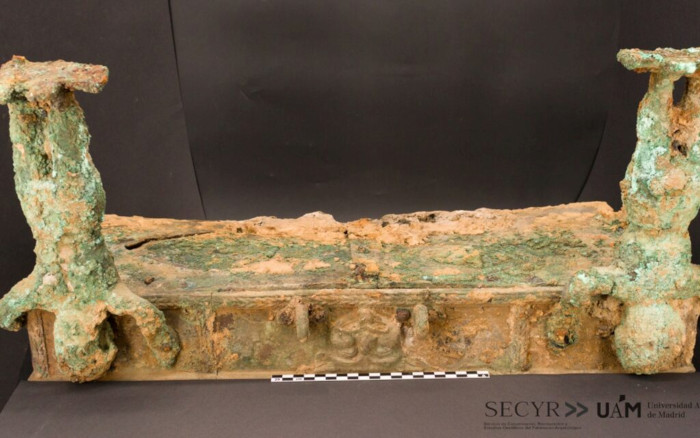
The remains of the chariot includes two wheels and part of the main box. (Ayuntamiento de Guareña)
A Wealth of Luxury Imports
The latest excavation campaign at Casas del Turuñuelo has yielded a remarkable collection of imported luxury goods alongside the bronze chariot. Among the finds are fine pottery from the Greek region of Attica, an Egyptian alabaster vessel, and intricately carved ivory objects decorated with warriors and animal and plant motifs. These artifacts provide valuable evidence of long-distance trade connections linking the Iberian Peninsula with the eastern Mediterranean.
The newly discovered bronze chariot and the wealth of luxury imports continue to transform our understanding of Tartessian society. They reveal a sophisticated culture with far-reaching commercial connections, advanced craftsmanship, and elaborate religious traditions. The chariot stands as one of the clearest indications yet that the elite of Tartessos participated in luxury exchange networks stretching across the ancient Mediterranean.
Top image: A 2,500-year-old bronze ritual chariot from Casas del Turuñuelo in Spain displayed at a CSIC press presentation. Source: Ayuntamiento de Guareña
By Gary Manners
References
Arkeonews. 2026. 2,500-Year-Old Bronze Ritual Cart Unearthed at a Tartessian Site: Archaeologists Say Nothing Like It Has Ever Been Found. Available at: https://arkeonews.net/2500-year-old-bronze-ritual-cart-unearthed-at-a-tartessian-site-archaeologists-say-nothing-like-it-has-ever-been-found/
Ayuntamiento de Guareña. 2026. Hallado en el Turuñuelo de Guareña un excepcional carro votivo de bronce, único en la península ibérica. Available at: https://aytoguarena.es/noticias/2026/06/hallado-en-el-turunuelo-de-guarena-un-excepcional-carro-votivo-de-bronce-unico-en-la-peninsula-iberica/
Greek Reporter. 2026. Ancient Bronze Chariot Found in Spain Reveals Ancient Greek Myth. Available at: https://greekreporter.com/2026/06/25/ancient-bronze-chariot-spain-ancient-greek-myth-tartessos-lost-world/
Heritage Daily. 2026. Archaeologists discover ceremonial Tartessian bronze chariot. Available at: https://www.heritagedaily.com/2026/06/archaeologists-discover-ceremonial-tartessian-bronze-chariot/158440
The History Blog. 2026. Day: June 25, 2026. Available at: http://www.thehistoryblog.com/archives/date/2026/06/25