
On the rolling hills of Suffolk, England, where grassy mounds hide the whispers of old rulers, warriors, and their dead, Sutton Hoo still utters secrets from the ground. Already famous for its breathtaking 7th-century ship burial, Sutton Hoo has proved it again. This time, it was not gold or garnets that made the secret known, but a bucket.
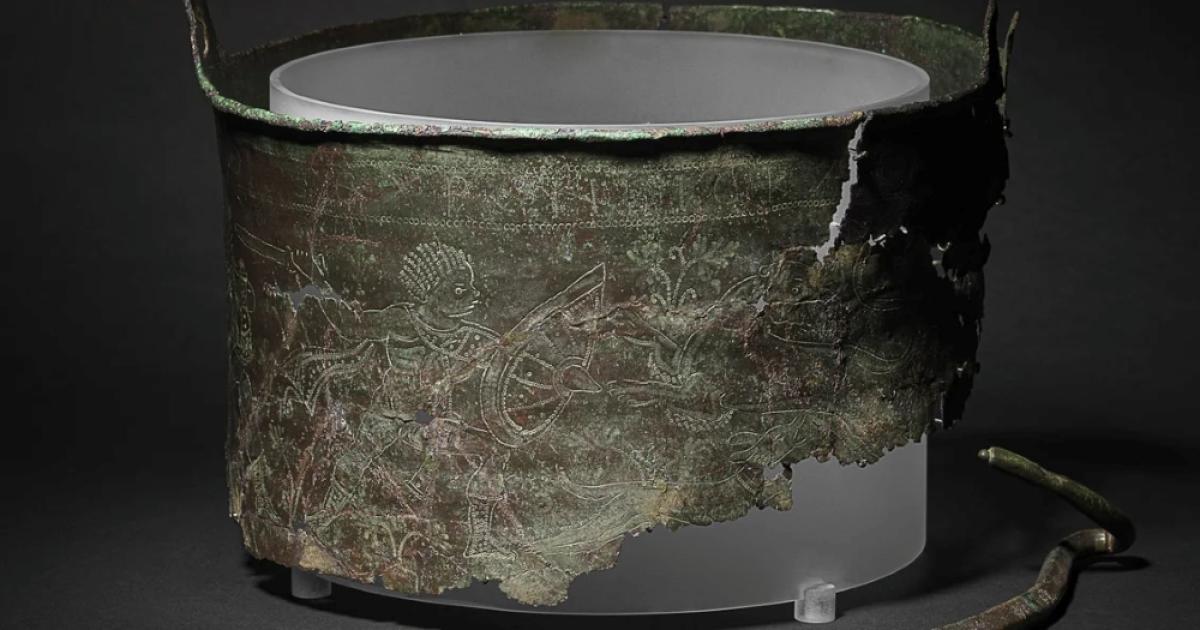
Not any old bucket, however. The Bromeswell Bucket, a 6th-century Byzantine copper-alloy bucket, beautifully decorated and inscribed in Greek, has been reinterpreted—not as an expensive wine cooler or diplomatic present, but as a cremation vessel for what seems to have been a high-ranking Anglo-Saxon.
A Byzantine Icon in a Barbarian Burial
When pieces of the bucket were originally discovered in 1986, archaeologists were baffled at the relic's origin. Additional fragments were unearthed in 2012 and once more in 2023 under Time Team excavations, a joint effort between the National Trust and FAS Heritage. The more they unearthed, the more peculiar the artifact grew, reports a statement by the National Trust.
Its representation of a lively North African lion hunt involving hounds and spearmen, and bearing the inscription: "Use this in good health, Master Count, for many happy years," made the vessel entirely incongruous in the pagan-flavored graves of East Anglia.
It came from Antioch in present-day Turkey, and it had come a long way—perhaps in the hands of traders, diplomats, or raiders. It probably arrived in the Anglo-Saxon world during the mid-6th century, a hundred years before the Sutton Hoo ship burial icon, and says a great deal about the extensive and largely unforeseen chains of contact between the post-Roman West and the classical East.
- The Magnificent Treasures of Sutton Hoo, The Final Resting Place of Anglo-Saxon Royals
- Experts Surprised By Similarities Of Sutton Hoo Lyre and Eastern Specimen
The mystery of the bucket's function remained—until now. In 2023, the bottom of the bucket was removed as a single block of soil and sent to the University of Bradford for CT and X-ray scanning. The outcome amazed scientists: concealed within were the cremated human remains of a skull fragment and talus (ankle bone) and large animal bones, probably a horse.

Reconstruction showing portions from the Sutton Hoo helmet. (Goran tek-en/CC BY-SA 4.0)
An antler comb, perhaps utilized during life for grooming or delousing—ritual or symbolic in death—was also found. The bones probably had been wrapped in a now-rotted bag and placed inside the vessel.
This was no coincidence of reuse. The Bromeswell Bucket had been ritually recontextualized, from a Mediterranean luxury item to an Anglo-Saxon funerary urn. The fact that the cremation was effected using such a foreign, luxurious artifact implies that the deceased was of high rank, if not royalty, in the Sutton Hoo society, reports the BBC.
Ritual, Identity, and the Hybridity of the Afterlife
What sort of mind converts a gift made for Byzantine aristocracy into one that is filled with ash and bone? Such a question opens a window into the densely symbolic universe of early medieval Europe. The metamorphosis of the bucket is a sign of the cultural hybridity of Sutton Hoo: a landscape of burial where paganism and Christianity danced uneasily, and where Scandinavian, Mediterranean, and Insular tradition mingled.
The fact that there was (or at least became) a horse there implies status and perhaps the anticipation of an afterlife journey—reminding one of Norse funerary rites. But the vessel itself, formal in style and inscribed in Greek, has Christian overtones from the world of the Eastern Romans. Together, they create an interesting conversation of civilizations.
Time Team's Dr. Helen Geake beautifully summed it up as "a vessel from the southern, classical world holding the remains of a very northern, very Germanic cremation." In a region renowned for ship burials and burial mounds, the Bromeswell Bucket raises the possibility of a bath-bucket burial—a ritual possibly found nowhere else in the archaeological record.

Sutton Hoo Burial Site. (Alex Healing/CC BY 2.0)
This pail was not buried casually; it was buried ceremonially, purposefully, with the dead. It was deposited, not as trash, but as a reliquary. If it signified one event, or is evidence of a now more prevalent practice lost to history, is unclear. But what it suggests is profound.
It links Anglo-Saxon elites to the cosmopolitan world of late antiquity, revealing their experience of, and aspiration for, status objects that extended far past the horizon of their island. It breaks neat stories of religious change. Pagan and Christian objects exist side by side across the Sutton Hoo site, undermining any tidy binary, according to a report published by Artnet.
- New Anglo-Saxon Cemetery Finds Compared to Sutton Hoo Hoard
- New Discovery Casts Doubt on Origins of Britain’s Sutton Hoo Helmet
Echoes Beneath the Earth
Now, Sutton Hoo is more than a burial mound, but a vibrant crossroads of cultures—a site where prestige, memory, and identity were constructed in rich material conversations. And now, through this unassuming but remarkable bucket, we catch a glimpse of an even profounder reality: that in the early middle ages, the boundary between the sacred and the profane, the local and the foreign, the living and the dead, was not just fine—it was permeable.
As digs go on into 2025, and radiocarbon testing and possible DNA analysis roll out, the Bromeswell Bucket might yet have its say. And when it does, it won't just be saying something about the past—it will be challenging what we think about the weaving of worlds lost.
“We knew that this bucket would have been a rare and prized possession back in Anglo-Saxon times, but it’s always been a mystery why it was buried. Now we know it was used to contain the remains of an important person in the Sutton Hoo community. I’m hopeful that further analysis will uncover more information about this very special burial,” concludes Angus Wainwright, National Trust archaeologist.
Top image: The Bromeswell bucket was made from copper alloy and depicts a North African hunting scene. Source: David Brunetti /U.K. National Trust
References
Chen, Min. 2025. This 6th-Century Bucket Discovered at Sutton Hoo Is More Than It Seems. Available at: https://news.artnet.com/art-world/sutton-hoo-bromeswell-bucket-not-bucket-2648124.
Cunningham, A. 2025. Sutton Hoo bucket believed to be cremation vessel. Available at: https://www.bbc.com/news/articles/cly31wdl4x2o.
Killgrove, K. 2025. 'It epitomises the strangeness of Sutton Hoo': 6th-century bucket found at Anglo-Saxon ship burial holds human cremation. Available at: https://www.livescience.com/archaeology/it-epitomises-the-strangeness-of-sutton-hoo-6th-century-bucket-found-at-anglo-saxon-ship-burial-holds-human-cremation.