
Beneath Italy's Lake Bolsena, underwater excavations have uncovered pottery and remarkably preserved ears of emmer wheat, providing new evidence about agriculture, food storage, and daily life in a prehistoric lakeside community.
Gran Carro is the Source of Remarkable Discoveries
Gran Carro Village is a submerged prehistoric settlement at the bottom of Lake Bolsena in Italy’s Viterbo province. It is a site that divers rather than shovels must explore. Divers descend into an underwater environment where preservation might be unexpected. However, the low-oxygen, sediment-covered conditions preserve organic material, like grain and wood, that would normally decompose on land. Recently, divers recovered the first known Iron Age textile fragmentin more than six decades of research on this unique settlement. According to the Soprintendenza Archeologia Belle Arti e Paesaggio per la provincia di Viterbo e per l’Etruria Meridionale, the structure of a domestic loom identified during the 2025 surveys has now been confirmed and better defined. The new evidence from fragments allowed researchers to assert that weaving activity was carried out throughout the community.
- 3,000-Year-Old Goddess Figurine Discovered in Italian Lake, With Fingerprints of Maker
- What Archaeology Tells US About Pre-Roman Cultures
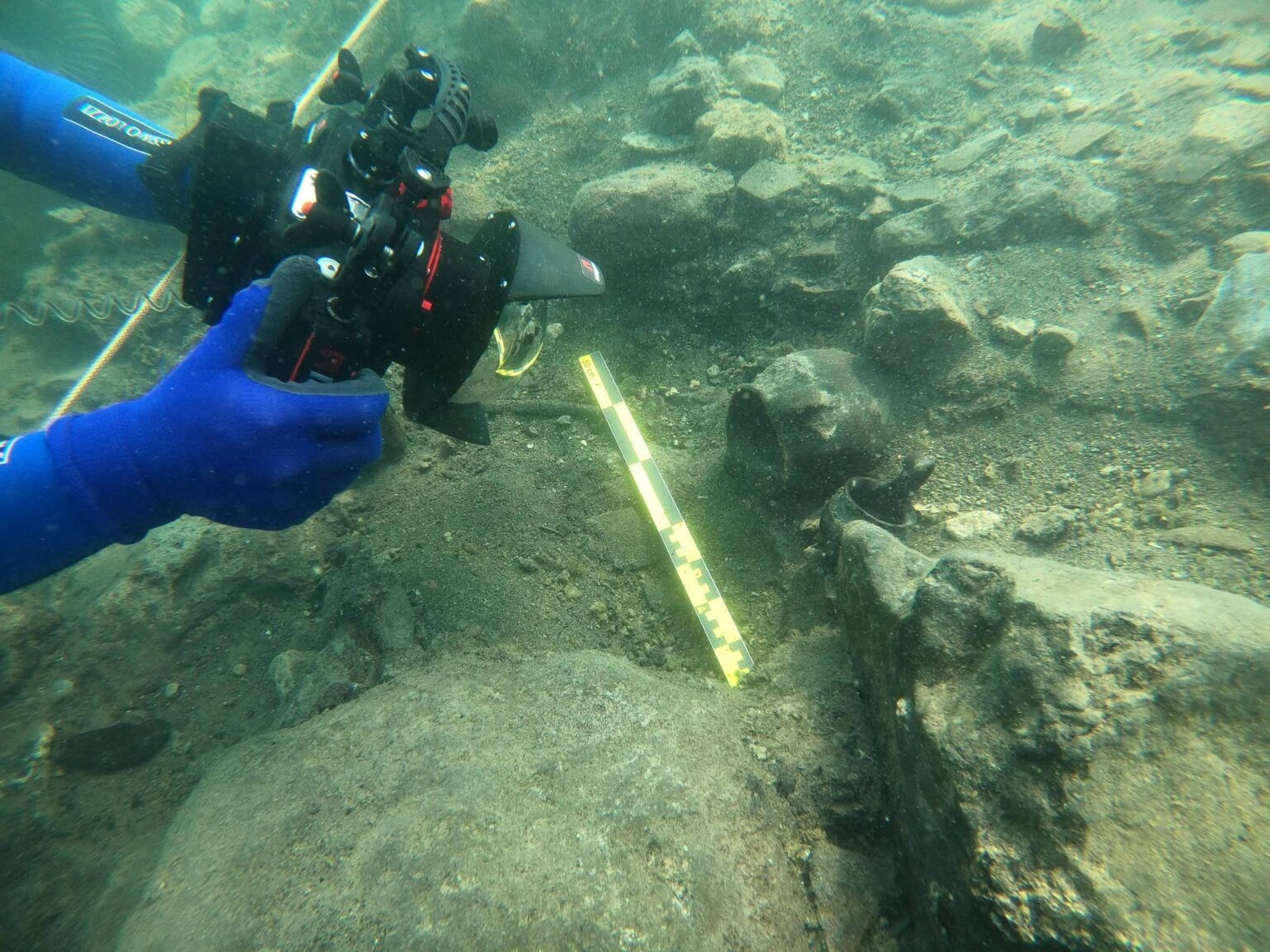
Underwater archaeological documentation at the Gran Carro settlement in Lake Bolsena, Italy, where pottery and structural remains have survived beneath the lake. (Massimo Lozzi/SABAP Viterbo and Southern Etruria, Italian Ministry of Culture/CC BY-NC-SA)
Pottery Discoveries Provide Evidence of Final Bronze Age
The archaeological focus is now on the submerged areas of Gran Carro. Divers have recovered vessels from the Final Bronze Age that add to the settlement’s chronological sequence and provide further evidence for a Proto-Villanovan/Final Bronze Age phase in the settlement area, showing that Gran Carro was occupied and developed over a longer period than previously documented. Evidence from the Gran Carro area indicates human activity extending back into the Bronze Age, while the best-documented settlement belongs principally to the Early Iron Age. Still, the settlement took a more defined shape during the Early Iron Age, between the late 10th and early 9th centuries BC, in a period associated with the Villanovan culture of central Italy. The site has been investigated since the pioneering underwater work of Alessandro Fioravanti in the 1950s and 1960s. Because of the protective sealing effects of the lake waters, the Soprintendenza describes Gran Carro as exceptional for its state of preservation. The combination of ceramics, timber, and botanical evidence offers an opportunity to reconstruct aspects of daily life, construction, and subsistence at a prehistoric lakeshore settlement.
- Untouched 2,600-Year-Old Fully Intact Etruscan Tomb Uncovered in Italy
- Etruscan Temple Unearthed In Shadow Of Tempio Grande, Vulci
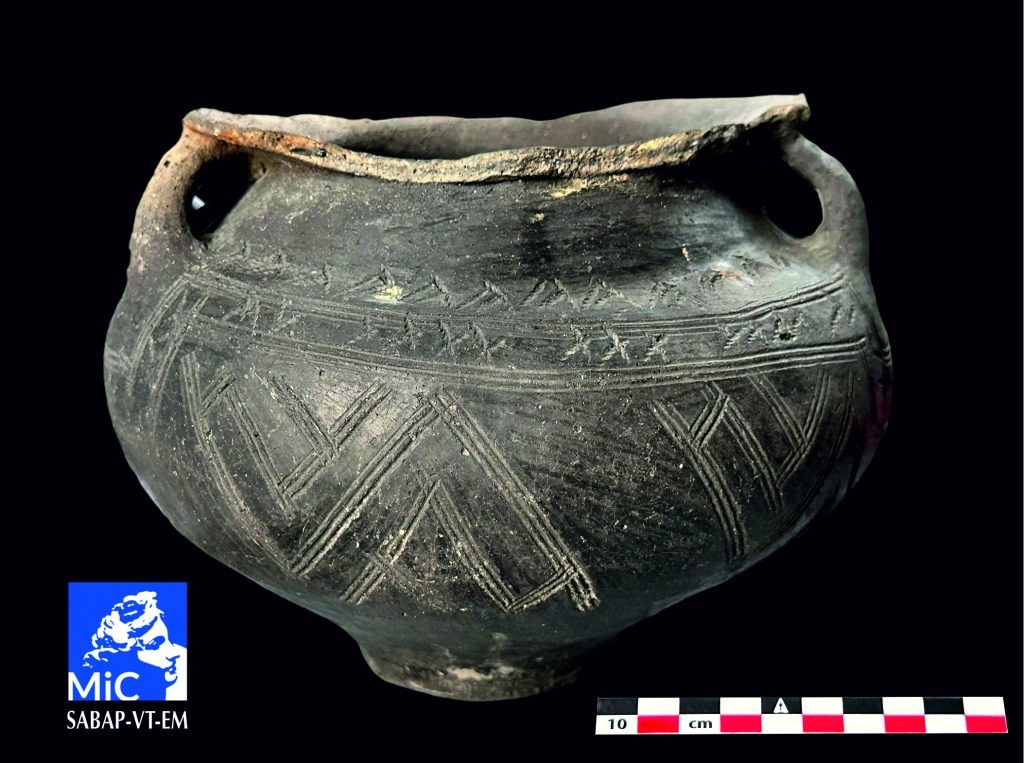
Decorated two-handled ceramic storage vessel from the submerged prehistoric settlement of Gran Carro in Lake Bolsena, Italy. The exceptionally preserved site has yielded pottery and organic remains, providing a rare glimpse into daily life approximately 3,000 years ago. (SABAP-VT-EM/Italian Ministry of Culture/CC BY-NC-SA)
The Most Significant Discoveries Come From the Mysterious Aiola Sector
The Aiola complex, a partially explored monumental structure, remains a mystery to archaeologists. It consists of a pile of stones, without structural binders, in a conical shape with an elliptical base. There is a mound of earth beneath its rocky surface, where large wooden elements have been identified beneath stones in the lower portion of the mound. Researchers plan to conduct further testing to determine whether the timbers formed part of a building, a platform, or another type of prehistoric structure, as well as the types of construction materials and techniques used. Researchers theorize that Aiola is linked to thermal springs with temperatures between 30 and 40 degrees Celsius. Additional investigations will look for similar structures in other locations in the lake. The recent exploration uncovered intact ears of emmer wheat inside pottery vessels. One unusual aspect of the discoveries was the presence of objects that closely resembled grave goods typically found in Villanovan tombs of the early Iron Age. These objects raise questions about the possible ritual or funerary significance of the deposit. Researchers are analyzing the botanical remains to investigate prehistoric agriculture, food storage, and consumption, while their archaeological context may eventually clarify whether some deposits also carried ritual significance.
Many Mysteries Await a Solution
Gran Carro is an extraordinary underwater archive of Italian prehistory, preserving evidence spanning the later Bronze Age and Early Iron Age alongside ceramics, wooden structures, textiles and botanical remains. Its long and complex development is making the site increasingly important for understanding how communities lived, worked and adapted along the shores of Lake Bolsena. The lake that eventually submerged the settlement has also helped preserve evidence that would normally have disappeared—leaving archaeologists with an unusually intimate record of life nearly 3,000 years ago.
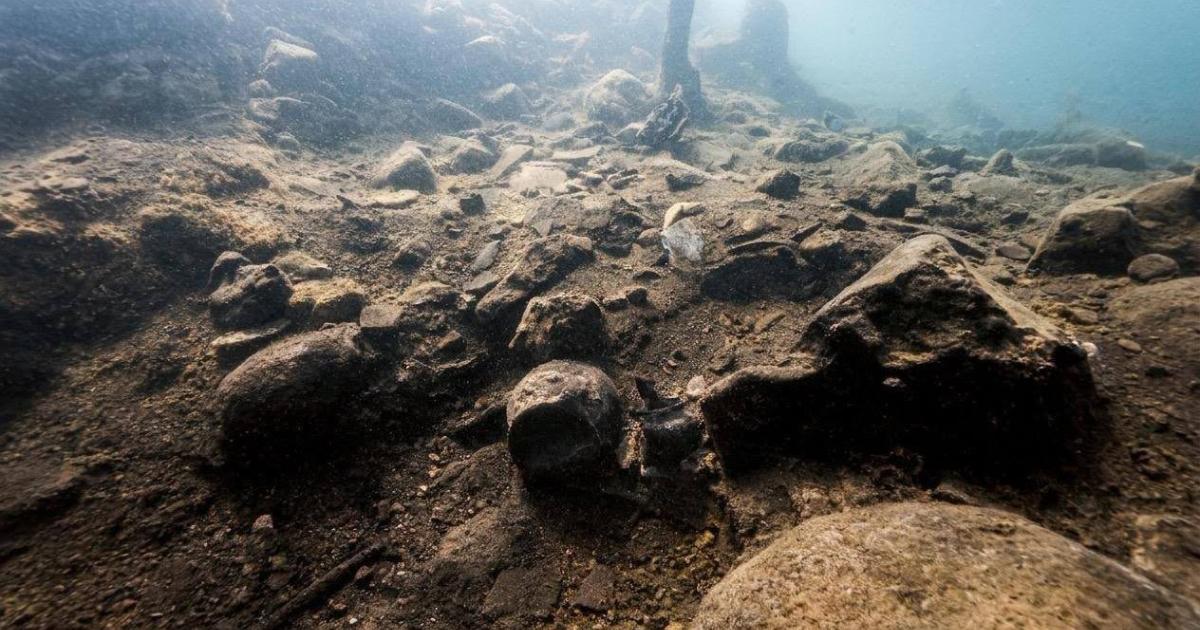
Top Image: Submerged remains of the prehistoric Gran Carro settlement beneath Lake Bolsena, Italy. Exceptional waterlogged preservation has left wooden structural elements and other evidence of buildings constructed around 3,000 years ago. Source: (Massimo Lozzi/SABAP Viterbo and Southern Etruria, Italian Ministry of Culture/CC BY-NC-SA)
By Ramsey Hardin
References
Altunas, L. August 12, 2026. “ Divers Uncover Ancient Wheat, Bronze Age Pots, and Mystery Timbers in Italy’s Sunken Prehistoric Settlement.” Arkeonews. Available at: https://arkeonews.net/divers-uncover-ancient-wheat-bronze-age-pots-and-mystery-timbers-in-italys-sunken-prehistoric-settlement/
Hassett, B. August 11, 2026. “3,000-Year-Old Spelt and Pottery Found in Submerged Italian Settlement.” Science Report. Available at:https://science.report/discover/3-000-year-old-spelled-and-pottery-found-in-submerged-italian-settlement-80276/
Milligan, M. August 11, 2026. “ Sunken Bronze Age Settlement Reveals Pottery, Ancient Grain and Mysterious Wooden Structures.” Heritage Daily. Available at:https://www.heritagedaily.com/2026/08/3000-year-old-spelled-and-pottery-discovered-in-sunken-settlement-beneath-italian-lake/158895