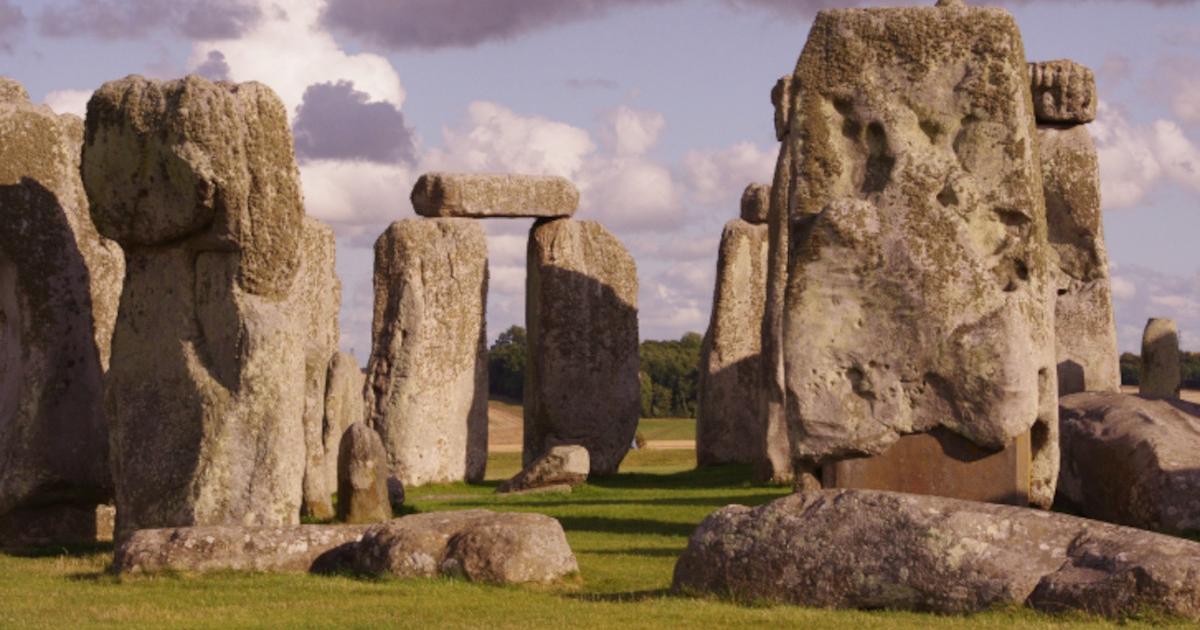

For generations, the mystical circle of Stonehenge has stood as a monument to human ingenuity, yet it has also been the center of a fierce geological debate. While mainstream archaeologists argue that prehistoric builders hauled the monument's famous bluestones across hundreds of miles, a persistent counter-theory has long suggested that nature did the heavy lifting. Proponents of the glacial transport theory argued that massive Ice Age glaciers naturally carried these exotic boulders from Wales and Scotland, depositing them on Salisbury Plain as convenient "glacial erratics" for ancient builders to collect. However, a groundbreaking new study analyzing microscopic grains of river sand has finally frozen out this theory, proving that the prehistoric builders must have transported the stones themselves.
The Microscopic Search for Glacial Clues
To test the glacial theory, a team of geologists led by Dr. Anthony Clarke from Curtin University in Australia turned their attention away from the massive standing stones and focused instead on the surrounding riverbeds. If colossal ice sheets had indeed pushed rocks from the Preseli Hills in Wales or the Orcadian Basin in Scotland down to southern England, they would have left behind a microscopic breadcrumb trail. Glaciers are notoriously messy transporters, grinding bedrock and depositing millions of microscopic mineral grains, such as zircon and apatite, along their path.
The researchers collected and analyzed more than 700 individual mineral grains from the rivers surrounding the monument on Salisbury Plain. By measuring the ratios of radioactive uranium to lead within the crystals, they were able to calculate the exact age of each grain. Since different regions of Great Britain feature distinct geological ages, these minerals act as highly specific geographical fingerprints that can pinpoint the exact origin of the sediment.
- Stonehenge Was a Project that Unified Ancient Britons, Study Claims
- New Evidence Challenges Human Transport Theory in Stonehenge Bluestones
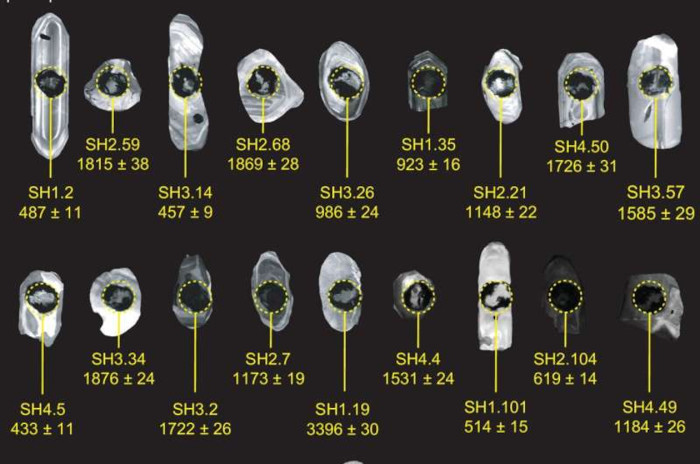
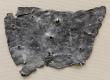
Cathodoluminescence images of zircon and apatite grains with laser ablation spots. (Clarke et al./Communications Earth & Environment)
A Local Fingerprint Millions of Years Old
The results of the mineral analysis, published in the journal Communications Earth & Environment, were incredibly clear and left no room for doubt. The researchers found virtually no mineral grains that matched the geological signatures of the Welsh bluestone quarries or the Scottish source of the famous Altar Stone. Instead, the overwhelming majority of the zircon crystals were dated between 1.7 and 1.1 billion years old, indicating they were local in origin.
Furthermore, the apatite grains analyzed were all roughly 60 million years old, reflecting local geological events rather than glacial transport. This date corresponds to a period when southern England was submerged under a shallow, subtropical sea, and the crystals' radioactive clocks were reset by the tectonic forces of the emerging European Alps. The presence of these local minerals, combined with the total absence of Welsh or Scottish glacial debris, confirms that Salisbury Plain remained completely unglaciated during the last Ice Age between 20,000 and 26,000 years ago.
- Stonehenge's Altar Stone Traced to Scotland, Has Ramifications For Prehistoric Britain
- The Silent Language of the Megalithic Builders
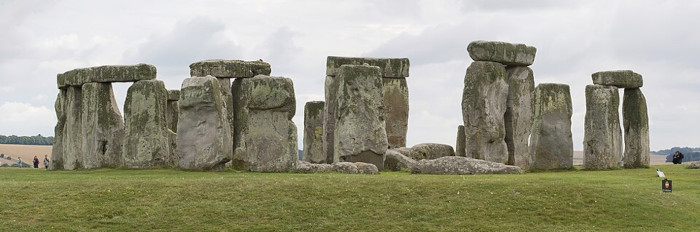
Panoramic view of Stonehenge from thew north. (Julie Anne Workman/CC BY-SA 3.0)
Prehistoric Logistics and a Connected Neolithic Society
With the glacial transport theory effectively debunked, researchers are left with the far more awe-inspiring reality: Neolithic people deliberately selected, quarried, and moved these massive stones across immense distances. While the larger sarsen stones were sourced relatively locally from West Woods, about 15 miles (24 km) north of the monument, the Stonehenge bluestones weighing up to five tons were brought from the Preseli Hills in west Wales, over 140 miles (230 km) away. Even more astonishing is the Altar Stone, a six-ton sandstone block that recent research has traced to the Orcadian Basin in northeast Scotland, more than 460 miles (750 km) from Salisbury Plain.
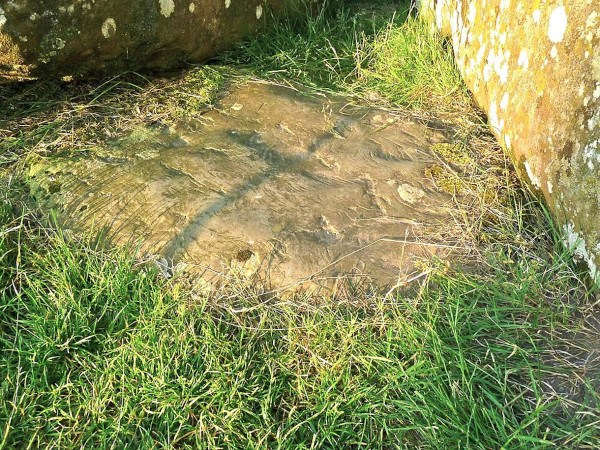
The six-ton Altar Stone lying flat within the stone circle, now thought proven to have been transported hundreds of miles by humans from Scotland. (Tanneryvillage/CC BY 4.0)
According to co-author Professor Chris Kirkland, this monumental feat of transportation points to a highly organized, cooperative, and technologically capable Neolithic society. Prehistoric builders likely utilized a combination of coastal and river waterways to float the stones on rafts, alongside overland transport using wooden sledges, rollers, and prepared pathways. The construction of Stonehenge was not a localized event but a massive collaborative effort that may have served to unite diverse farming communities across ancient Britain. By ruling out glacial assistance, these tiny grains of sand have highlighted the incredible determination and sophisticated social networks of our ancient ancestors.
Top image: Some stones at Stonehenge on Salisbury Plain in Wiltshire, England. Source: Needpix.com
By Gary Manners
References
Clarke, A. J., Kirkland, C. L., & Glorie, S. 2025. A day at the beach: a portrait of British geology through sand. Journal of the Geological Society. Available at: https://phys.org/news/2026-01-grains-sand-people-glaciers-stonehenge.html
Clarke, A. J. I., et al. 2026. Detrital zircon–apatite fingerprinting challenges glacial transport of Stonehenge's megaliths. Communications Earth & Environment. Available at: https://www.nature.com/articles/s43247-025-03105-3
Clarke, A. J. I., et al. 2024. A Scottish provenance for the Altar Stone of Stonehenge. Nature. Available at: https://www.nature.com/articles/s41586-024-07652-1
Parker Pearson, M., et al. 2015. Craig Rhos-y-felin: a Welsh bluestone megalith quarry for Stonehenge. Antiquity. Available at: https://www.cambridge.org/core/journals/antiquity/article/original-stonehenge-a-dismantled-stone-circle-in-the-preseli-hills-of-west-wales/B7DAA4A7792B4DAB57DDE0E3136FBC33