
A grooved stone pulled from the seabed off western Norway may be the oldest known anchor in the country, and possibly anywhere in the world. Divers recovered the more than 30-kilogram object from a Stone Age greenstone quarry at Hespriholmen, where people ventured into rough seas for thousands of years. The discovery is striking not only because of its age, but because it offers a rare clue to the boats and seamanship of Norway’s incredibly ancient coastal communities.
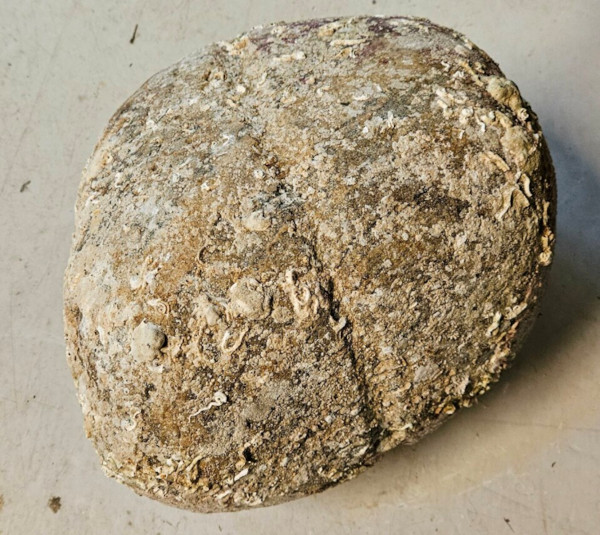
The possible anchor cleaned and dried showing the groove that indicates it may have been used as an anchor. (E. Samuelsen / Bergen Maritime Museum)
A grooved stone in dangerous waters
According to Science Norway’s report, Hespriholmen lies about five kilometers offshore from Bømlo in western Norway. The islet was a source of greenstone, a hard rock shaped into axes, and quarrying there may have begun between 5,000 and 9,000 years ago. Archaeologists first noticed the stone last year, at a depth of about 20 meters, resting on a mound of discarded quarry material.
When the team returned, they tied a rope around the groove and hauled the stone to the surface. Its weight makes a fishing-net sinker unlikely, while its balance and circular channel would have allowed a rope to hold fast. “I’m absolutely convinced that this served as an anchor,” Leif Inge Åstveit of the University Museum of Bergen told Science Norway.
- World’s Largest Stone Pillar Anchor From Archaic Period Found in the Aegean
- Rare Roman Navy Anchor Recovered Off English Coast

Arild Skjæveland Vivås from Stavanger Maritime Museum holding the anchor. (Pål Nymoen / Norwegian Maritime Museum)
Why the find matters
The interpretation remains provisional. Arild Skjæveland Vivås of Stavanger Maritime Museum told Science Norway that the object must be published and peer-reviewed before the team can be certain.
If the identification holds, it would predate the oldest reliably dated stone anchors currently known from the Bronze Age Mediterranean. Other finds show how much information a single anchor can carry: an anchor linked to Aphrodite reveals ancient beliefs about protecting sailors, while a Roman anchor recovered off England helps illuminate northern European naval activity. In Norway, the grooved stone could do something even more basic—demonstrate how people secured a vessel at a remote work site.
- Ten Shipwrecks Spanning 5000 Years of History Spotted Off Kasos
- Researchers in Turkey Identify Bronze Age Sea Route and Ancient Shipwrecks
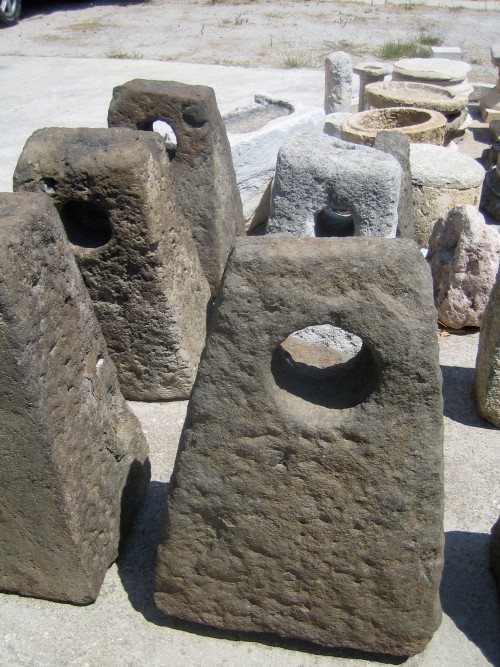
Stone anchors on display at the Hellenic Maritime Museum, Piraeus. (José M. Ciordia/CC BY-SA 4.0)
A window onto vanished boats
The stone may also help answer a long-running question about prehistoric boats in Norway. No Stone Age boat has survived from the Norwegian coast, although Danish log boats show that hollowed-out canoes were used elsewhere in northern Europe. Åstveit has suggested that skin boats, or perhaps a raft, would have been better suited to carrying firewood, enormous hammerstones and heavy greenstone blocks across exposed water.
Hein Bjerck, an emeritus professor at the NTNU University Museum who is not part of the project, told Science Norway that ordinary Stone Age boats were usually pulled onto beaches. Hespriholmen was different: crews had to approach a rocky islet in strong currents, load stone, and get safely away again. That unusual task may explain why an anchor was needed, just as Viking ship burials preserve later evidence of ropes, rigging and seafaring technology.
What happens next
The researchers are also mapping the quarry and its underwater waste using sonar and 3D modelling. Earlier estimates suggested that about 430 cubic meters of greenstone had been extracted, but the new survey may show that the total was considerably larger. Until the stone is formally studied and the results are peer-reviewed, “world’s oldest anchor” remains an exciting possibility rather than a settled record.
Top image: A stone with a groove, found in a waste heap in the sea, directly below a Stone Age quarry on Hespriholmen, an island in Western Norway. Source: Arild Skjæveland Vivås/Science Norway
By Gary Manners
References
Archaeology Magazine. 13 October 2026. Early Anchor Found Off Norwegian Coast. Available at: https://archaeology.org/news/2026/10/13/early-anchor-found-off-norwegian-coast/
Bergstrøm, I. I. 12 October 2026. May have found the world’s oldest anchor in Norway: “An incredibly exciting find”. Available at: https://www.sciencenorway.no/archaeology-culture/may-have-found-the-worlds-oldest-anchor-in-norway-an-incredibly-exciting-find/2721988
Cowie, A. 7 August 2019. World’s Largest Stone Pillar Anchor From Archaic Period Found in the Aegean. Available at: /news-history-archaeology/shipwreck-0012405
Cowie, A. 27 September 2022. Rare Roman Navy Anchor Recovered Off English Coast. Available at: /news-history-archaeology/roman-anchor-uk-0017325
Falde, N. 14 March 2024. Ten Shipwrecks Spanning 5000 Years of History Spotted Off Kasos. Available at: /news-history-archaeology/ten-shipwrecks-kasos-0020504
Lanesskog, T. 23 November 2017. Grave Findings Could Solve a Viking Age Mystery. Available at: /history/grave-findings-could-solve-viking-age-mystery-009179
Miller, M. 2016. Researchers in Turkey Identify Bronze Age Sea Route and Ancient Shipwrecks. Available at: /news-history-archaeology/researchers-turkey-identify-bronze-age-sea-route-and-ancient-shipwrecks-020525