

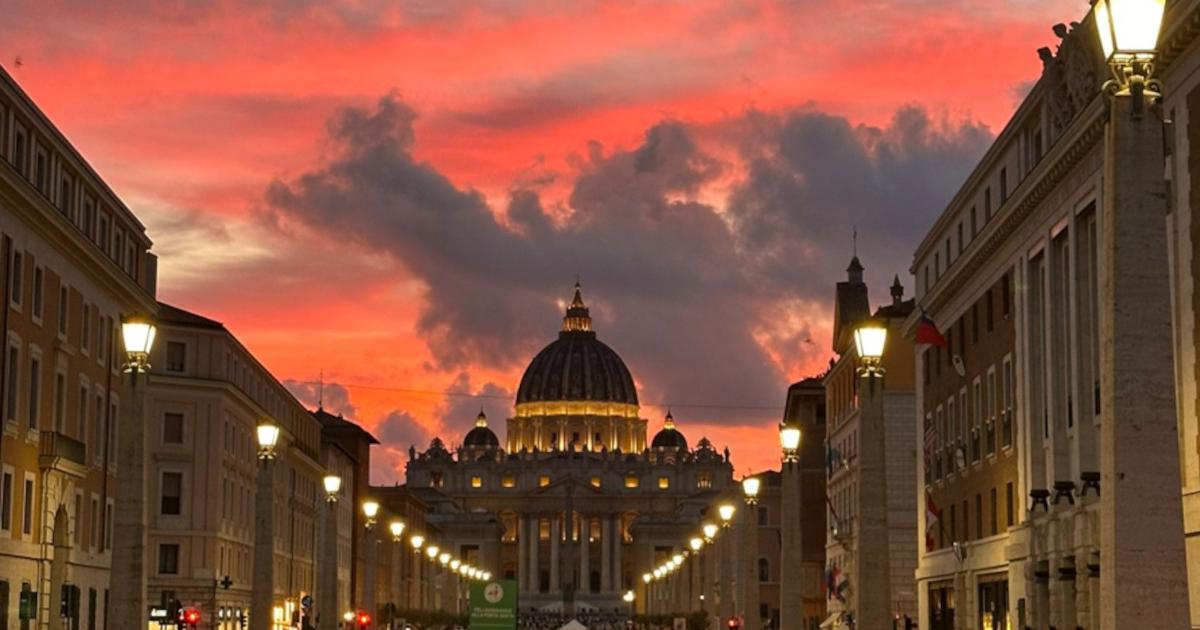

St. Peter’s Basilica is celebrating a milestone this year. The world’s most famous Church is turning 400 years old, and Catholic pilgrims from every country will journey to Rome to celebrate. One hundred and twenty years after Pope Julius II laid the Foundation Stone of the new church, Pope Urban VIII formally consecrated it as the new home of Christendom on November 18, 1626.
Towering over the eternal city of Rome, its magnificent dome now the city’s ultimate symbol, the jewel of the Vatican outlasted dozens of architects, popes, objectors, a city sacking, a split Church, and cost hundreds of millions of dollars. Built over the tomb of St. Peter, Jesus’ disciple and the first Pope, its exorbitant price tag is believed to have led directly to the Protestant Reformation. Let’s explore some fascinating birthday secrets of this amazing historical building.
Before Catholics Beautified, Charioteers Vied and Christians Died
Centuries before it became a church, the low-lying and marshy area St. Peter’s currently occupies was the home of a giant Roman chariot racing hippodrome called the Circus of Nero. To the north stood Vatican Hill on which the Emperors built their gardens. The Vatican Hill-Circus of Nero would become infamous in early Christian history.
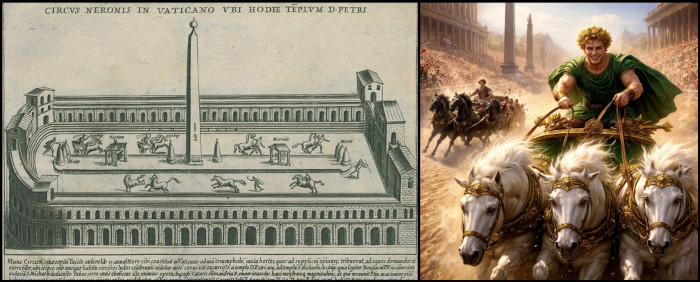
Left: Engraving of the Circus of Nero, on which later stood St. Peter’s and the Vatican. By Giacomo Lauro, 1613. Right: AI-generated image of Nero racing inside the Circus. Nero was involved in the persecution of Christians living in Rome, and it is believed both Peter and Paul died under his sadistic reign. (Public Domain)
The Circus of Nero was 530 ft long and 295 ft wide. In the center dividing the racetrack was a spina, an elevated area with ornate statues, columns and the most spectacular obelisk. This 84-ft tall, 330-ton red granite monolith had been transported to Rome from Egypt in 37 CE under Emperor Caligula. It was along this spina that criminals were crucified, many of whom were Christians. The Roman historian Tacitus describes a sadistic Nero in chilling detail in his Annals (c. 116–117 CE):
“Nero falsely accused and executed with the most exquisite punishments those people called Christians, who were infamous for their abominations.”
According to legend, sometime between 64 and 67 CE the Apostle Peter was crucified upside down on the spina of the Circus of Nero. It is likely that the obelisk was one of the final things St. Peter saw before dying. The powerful and haunting image of an upside-down Peter being crucified has been recreated many times in European art. Encircling the drum of the mighty dome of St. Peter’s are two-meter-tall Latin letters that spell out the spiritual justification for the amazing Church. Legible from far below, they read (in English):
“You are Peter, and on this Rock I will build my Church, and I will give you the keys of the Kingdom of Heaven” (Matthew 16:18).
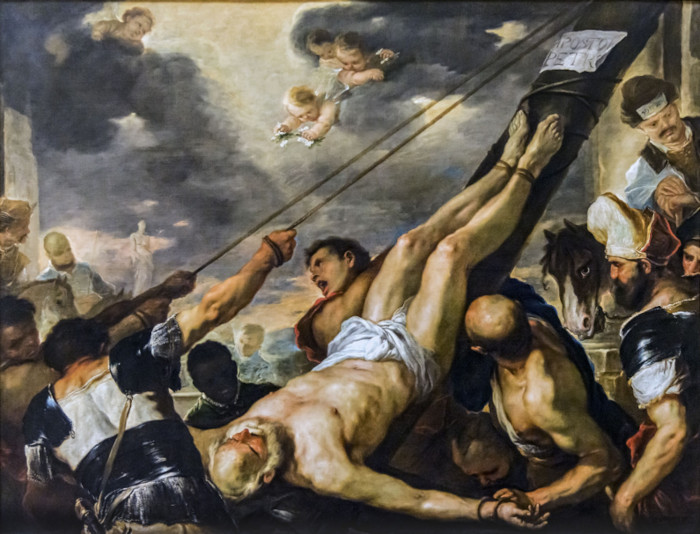
Crucifixion of St. Peter, by Luca Giordano, 1660, Gallerie dell'Accademia in Venice. (Public Domain)
I’ll Find His Bones to Make My Church
Above ground, St. Peter’s is immense, spectacular, and sublime. Underground, it offers a whole new subterranean world of archaeology, history, secrets, graves, treasures, and has two basements and the grave of St. Peter itself. Buried underneath Catholicism’s most famous Church lies a treasure even more precious than the gold, stone, and artwork above: the bones of St. Peter.
After Peter was crucified in the Circus of Nero, his body was taken outside and buried in the cemetery that lined the adjacent road, the Via Cornelia, which ran along the northern edge of the Circus. It was built on the southern slopes of the nearby Vatican Hill, which came to be called the Vatican Necropolis. Peter was buried in a simple grave called the “Poor Man’s Grave”, a small trench covered with six large tiles in the shape of a tent.
As the centuries passed, the Circus of Nero was abandoned and fell into ruin. Tombs along the Via Cornelia continued to be built, and special reverence was paid to the tomb of St. Peter. By 150 CE, early Christians had erected a monument over the Poor Man’s Grave resembling a trophy. Years later, two walls were added to the sides of the “Trophy”, and one of them is still there. This wall became covered with Latin and Greek graffiti, and it is now called the “Graffiti Wall”. When Emperor Constantine began construction of a basilica over the necropolis in 318 CE, he encased the Trophy in a box of marble and porphyry, and it served as the centerpiece of the new sanctuary.
The talented writer of this article, Jonathon Perrin, is an author and explorer. He has just released his newest book called Italy in a Year of Hope: Adventures in Rome and the Amalfi Coast. It chronicles his journey to Rome, Pompeii, Amalfi, and Vesuvius in the Jubilee Year of Hope 2025. Visit www.jonathonperrin.com for more.
Modern excavations of the necropolis began in 1940 under Pius XII, who was curious to locate the actual tomb and remains of St. Peter. By 1950, the original Poor Man’s Grave was discovered. Unfortunately, the bones found within were not from a single adult male, but contained four individuals (two men in their 50s, one man in his 40s, and an elderly woman in her 70s) plus animal bones, and could not be from Peter.
Fifteen years later, scholars found another set of bones that had been mistakenly labelled. These had originally been found in a niche in the Graffiti Wall but had been lost for years. They were from a male 60-70 years old, with a robust build and included bones from all major parts of the body except the feet. They were covered in Roman purple dye, reserved for the emperor and other high-ranking officials. Also, a small piece of the wall next to the place where the bones were found was marked with the Greek words “PETR... EN I”, meaning “Peter is within”.
According to the New York Times on June 30, 1968:
“Last week Pope Paul [VI] at a general audience attended by several thousand pilgrims announced that bones discovered in 1953 under the basilica had been identified to his satisfaction as those of the Saint [Peter].”
The bones were placed in nineteen small boxes and stored back in their original Graffiti Wall niche, where they can now be viewed by the public on a special tour of the Scavi Excavations under St. Peter’s.
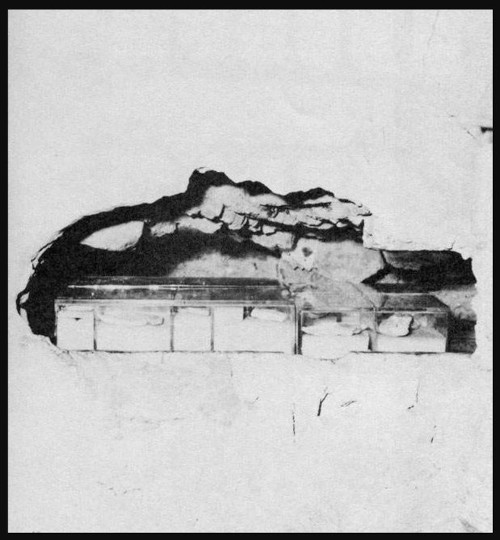
Nineteen boxes containing the supposed bones of St. Peter are kept in their niche under St. Peter’s Basilica. (photo from the Fabbrica di San Pietro). (Lonely Pilgrim)
Get to the Point
One of the greatest engineering feats of the Renaissance was associated with St. Peter’s: the moving of the Vatican Obelisk over thirteen months between 1585 and 1586. When Constantine built the first Basilica, the Obelisk wasn’t moved from its original position inside the Circus, and against all odds, it remained standing just outside the old basilica’s south wall. By 1586, it was (incredibly) the only obelisk still standing in Rome. It was then Pope Sixtus V, obsessed with rebuilding Rome, commissioned the architect Domenico Fontana to move it to the front of the church, where it could greet pilgrims.
It had always been an important feature of the Church, despite its off-center position to the south. The engineering challenges of moving a 330-ton granite monolith almost 900 feet and re-erecting it were immense, and no one had moved an obelisk in over a thousand years, but Fontana was up to the challenge.
He designed and built a working model of his new invention to present to Sixtus, a gigantic machine, half scaffolding and half crane that he called a castello (“castle”). This was accompanied by over 900 men, 140 horses, five gigantic iron levers, and 44 massive capstans to accomplish the move. On April 30, 1586, after having built his massive castello machine, Fontana commenced operations and successfully lifted the obelisk off its ancient pedestal, lowering it gently to the ground under intense silence.
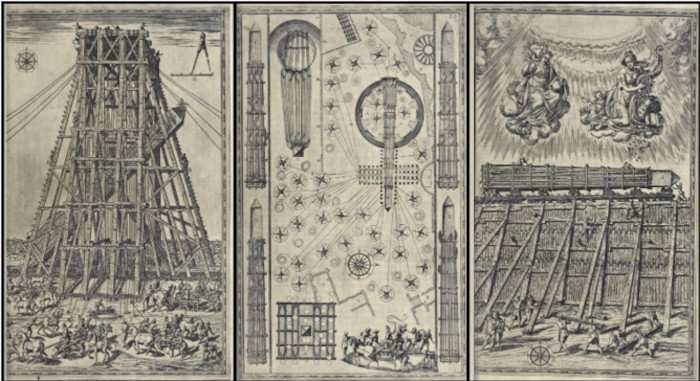
Three images from Domenico Fontana’s 1590 book on how he lowered, moved, and re-erected the Vatican Obelisk. It was called Della trasportatione dell'obelisco vaticano et delle fabriche di nostro signore Papa Sisto V. (INHA/Author Provided)
R.A. Scotti describes this event:
“At the sound of a single trumpet blare, they began to move. Whips cracked. Ropes creaked. The winches started to turn. An eyewitness reported that the wheels made such a noise that one might have thought the very earth was going to split and the sky above to open.”
For a few perilous moments all motion stopped and the ropes seemed to be giving way. A sailor shouted out Acqua alle funi! “Water the ropes!” Water was splashed across the ropes and the obelisk creaked alive. It took the entire day, but it was finally lowered to the ground just before sunset without a single scratch. Later, celebratory drums and trumpets accompanied Fontana home.
Over the following months, the obelisk was rolled on a road of earth and wood to its new home before the Church, where it was finally erected on September 10 and consecrated on the 26th, 1586. Amazingly, Fontana himself recorded the entire procedure in his book Della trasportatione dell'obelisco vaticano et delle fabriche di nostro signore Papa Sisto V, published in 1590. It was one of the greatest engineering feats of the Renaissance and the first modern obelisk-raising in history.
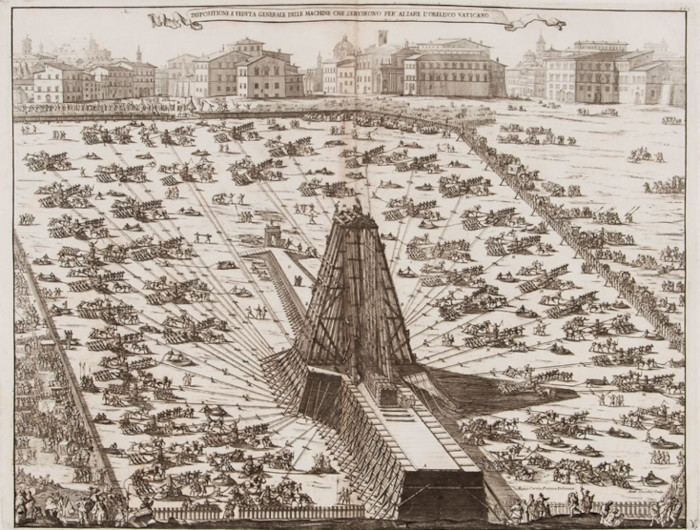
Construction site of the Vatican Obelisk in St. Peter’s Square, from Carlo Fontana’s1694 book Il Tempio Vaticano e la sua origine. (Niccola Zabaglia (1664-1750), Public domain)
The (White) Elephant in the Room
Maybe the strangest thing buried at St. Peter’s isn’t the remains of Peter, but of an albino elephant named Hanno. He was given to the extravagant Pope Leo X in 1514 as a coronation gift from King Manuel of Portugal, who hoped to secure future trading concessions in India and build general goodwill. At the time, Portugal was rapidly expanding their trading empire into the rich spice trade of the east, and Manuel was seeking Papal help and financing. An exotic pet such as Hanno was to be the perfect gift to entice the new Pope who “had everything”.
No elephant had been seen in Italy since the halcyon days of the Roman Empire, and the entire country was eager to get a glimpse of Hanno. Called Annone, anglicized to “Hanno”, he had come from India via Portugal, and was now marching his way 70 miles to Rome. Scotti describes:
“Hanno arrived at the Vatican wearing two pairs of red shoes identical to the Pope’s and genuflected three times. Leo was enchanted.”
With a silver tower perched on his back, Hanno trumpeted three times in the air, and then sucked water into his trunk and sprayed it down on everyone assembled, including Leo himself, drawing laughter and applause.
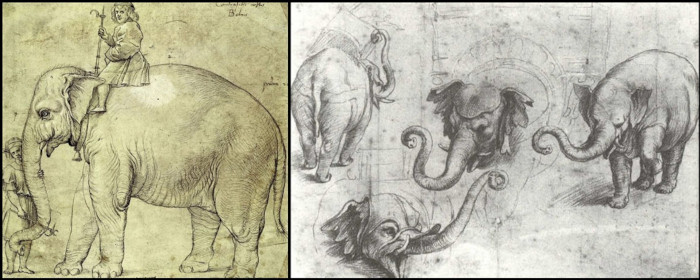
Left: The Elephant Hanno, ink on paper, by Raphael, 1516. (Raphael/Public domain). Right: Study of Hanno, ink on paper, by Raphael (or Giulio Romano), 1516. (Raffael or Giulio Romano/Public domain)
Hanno became a symbol of Rome, and Leo’s new favorite pet. He had a special building built for him next to St. Peter’s in the Vatican Gardens, where the people of Rome could visit him each weekend. Sadly, Hanno only lived to seven. In 1516, he started having trouble breathing and was in distress. Doctors determined that he was constipated. They prescribed a gold-enriched suppository, but instead of restoring him, it quickly killed him, greatly distressing all of Rome.
Hanno was largely forgotten until the winter of 1962, when workers installing a new heating and cooling system in the Vatican courtyard dug up a large tooth and fragments of a giant jawbone. Smithsonian Historian Emeritus Silvio Bedini published The Pope’s Elephant in 1997, the most thorough study to date of the elephant that lived by St. Peter’s. Bedini revealed the bones were from Hanno, bringing this unique animal back into focus again.
Leo wrote in his epitaph to Hanno:
“Under this great hill I lie buried / Mighty elephant which the King Manuel
Having conquered the Orient / Sent as captive to Pope Leo X.
At which the Roman people marvelled / A beast not seen for a long time,
And in my brutish breast they perceived human feelings.”
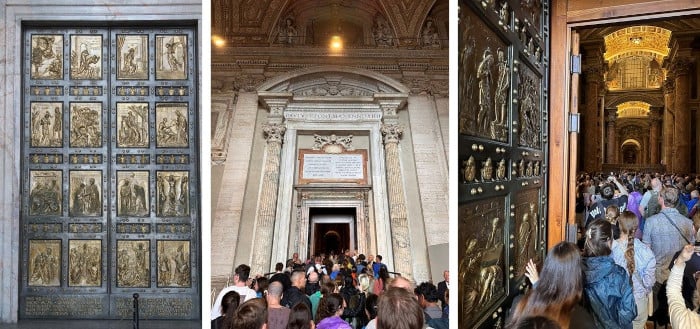
The Holy Door of St. Peter’s. Designed by Vico Consorti and cast by Ferdinando Marinelli Artistic Foundry of Florence, it is the northernmost entrance of Saint Peter’s. It will next be opened in 2033. Left: Detail of the door panels; by Fallaner. (Fallaner/CC BY-SA 4.0)
Knockin' On Heaven's Door
The Porta Santa (Holy Door) of St. Peter’s Basilica is a bronze door sculpted by Vico Consorti in 1949, featuring sixteen scenes of mercy and forgiveness. It is also called the “Door of the Great Pardon” because its panels portray scenes of sin and redemption through God’s mercy. Only during a Jubilee year is this special door opened to allow pilgrims to enter the Church, symbolizing the passage to God’s grace. I was fortunate enough to enter the Holy Door in the Jubilee Year of 2025.
The ceremony of opening the Jubilee Door dates back to Pope Boniface VIII in 1300, who established that the ceremony would be repeated every 100 years. Afterwards, Clement VI reduced the period to every 50 years, Urban VI to 33 and Paul II to 25. Following the 2025 Jubilee, the Door was sealed internally by ~3,200 bricks. It will remain sealed until 2033, when it will be opened during a special anniversary commemorating the death of Jesus 2000 years ago.
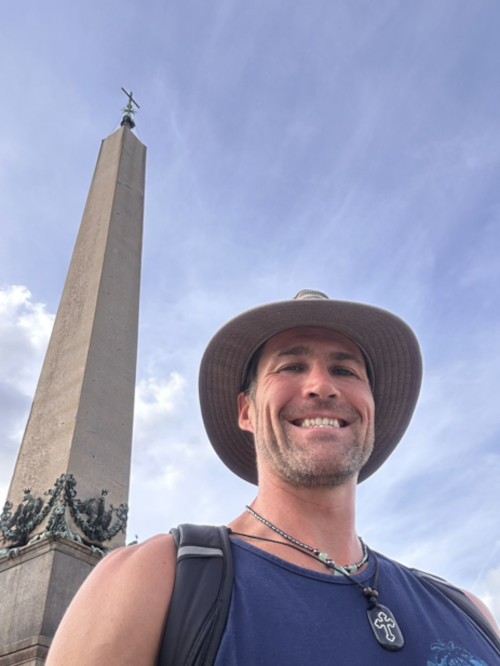
The author, Jonathon Perrin beside the Vatican Obelisk. (Author supplied)
Build a Church, Split a Church
The glaring profligacy and reckless extravagance of the Catholic Church had become acute by 1500. When an Augustinian friar named Martin Luther visited Rome in 1510, he witnessed firsthand the corruption of the Roman Church. He was shocked by the clergy’s immorality and their commercialization of relics. He famously described Rome as a “sea of iniquity”, characterized by nepotism, simony, and the general commercialization of faith.
One particularly egregious example of this irreligiosity is cited of the Pope’s banker, Agostino Chigi. Scotti recounts: “Lofted in the air by brawny servants, Agostino Chigi’s gold dinner plates sailed across the garden like discuses. Glowing for an instant in the torchlight, they hung over the river, then, one by one, began to drop into the black water, each one hitting with a flat thud. “Save the servants the work of cleaning up,” the host quipped … Pope Leo loved spectacles. This was entertainment for a pope who had everything, from dwarfs to entertain him with ribald antics to his own zoo.” (Chigi had earlier spread nets over the river bottom.)
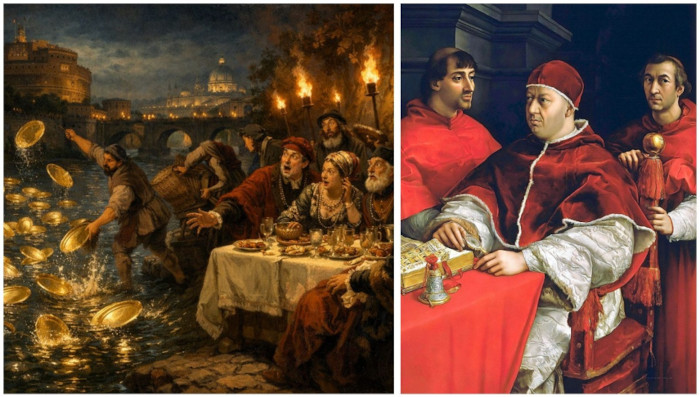
Left: The famous 1519 dinner party hosted by the Pope’s banker, Agostino Chigi. To excite Pope Leo X and his entourage, Chigi had servants toss gold plates into the river (a net allowed him to later recover the plates). These type of extravagant displays helped foster the Reformation in Europe. AI-generated by author. Right: Portrait of Pope Leo X; by Raphael (1517-1518). (Public domain)
These were the early years of the building of St. Peter’s, and its construction and the future Reformation seem inexorably intertwined. To finance the building of the Basilica, Leo X relied on something that seems foreign to the spirit of Christ: a historic plenary indulgence issued in March, 1515. Thus St. Peter’s only came to fruition on the backs of thousands of people who gave up their hard-earned money in the belief that they might skip their time in purgatory if only they contributed to the new Church.
In return for a monetary donation, an official church letter would be issued saying that a pardon had been paid for all that person’s sins. Even people who had died and who were suffering in purgatory could be instantly freed if a living person paid for an indulgence in their name. Leo employed a particularly inflammatory salesman called Johann Tetzel, a German Dominican friar and the Grand Commissioner for indulgences in Germany. Tetzel invented the first commercial jingle: When a coin in the coffer rings, a soul from purgatory springs.
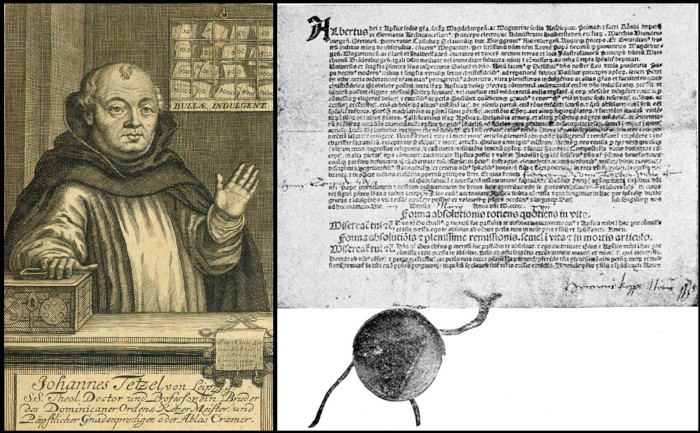
Left: Johann Tetzel, a German Dominican friar and the Grand Commissioner for indulgences in Germany. (Public domain) Right: Letter of indulgence for the building St. Peter’s Church at Rome made out for the widow Katharina von Trebra and her sons, Hans and Konrad in the name of the archbishop of Mainz on March 3, 1517, signed by the notary public Heinricus Kappe. With seal attached. By Johann Michael Reu. (Public domain)
The sale of indulgences was similar to a modern pledge drive, but incorporated spiritual promises that ultimately alienated many, including Luther. It became a major point of contention during the Protestant Reformation. Luther’s Ninety-five Theses were posted on the door of the Castle Church in Wittenberg in 1517, protesting the idea of selling spiritual gifts. He particularly detested the new Church of St. Peter’s and the corruption it symbolized.
While indulgences still exist in the Roman Catholic Church today, they are purely spiritual, as the practice of selling them was abolished in 1567. Unfortunately, by then, the damage was done and the Protestant Church had been born, splitting the Catholic Church over what should have been its greatest icon of unification.
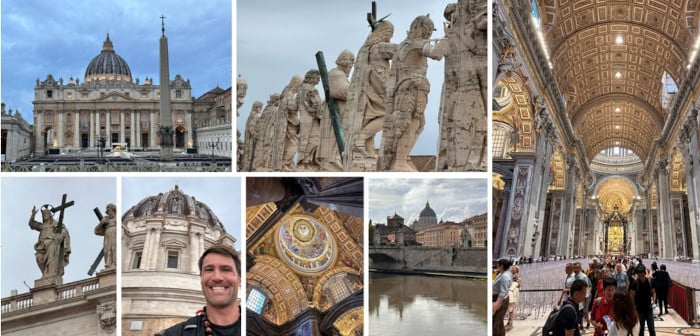
Montage of photos of St. Peter’s Basilica, celebrating her 400th birthday in 2026. (By author).
Birthday Invitation
If you are lucky enough to visit St. Peter’s in 2026, on its 400th Birthday Celebration, you will be able to access new digital tools to better explore this stunning edifice. These include AI-powered translation tools for Church Masses, a Smart Pass booking system to manage crowds, and a “digital twin” 3D model of the entire Basilica that anyone can explore from home.
Perhaps no building on Earth is as rich in history, scandal, personality, triumph of art and architecture, corruption and crowning achievement as St. Peter’s. It is a museum, a treasure trove, a cemetery, an archaeological site, and also a sacred space to millions of pilgrims. It represents two millennia of succession beginning with Peter, and comes closer than any building to bridging the physical and immaterial, the mundane and transcendental, and the human and divine. It elevates the soul and inspires the exact feelings of wonder and awe anticipated by its creators.
Top image: Looking down the grand boulevard the Via della Conciliazione, leading to St. Peter’s Basilica. In 2026, this church celebrates her 400th Birthday. Source: By author
By Jonathon Perrin
Jonathon Perrin is an author and explorer. He has just released his newest book called Italy in a Year of Hope: Adventures in Rome and the Amalfi Coast. It chronicles his journey to Rome, Pompeii, Amalfi, and Vesuvius in the Jubilee Year of Hope 2025. Visit www.jonathonperrin.com for more.
References
Bedini, Silvio, The Pope’s Elephant, Penguin Books, New York, 1997.
Explore St. Peter's Basilica - 3D Guided Tour of St. Peter’s Basilica, (https://virtual.basilicasanpietro.va/en/explore-the-basilica).
Fontana Carlo, Il Tempio Vaticano e la sua origine, 1694.
Fontana, Domenico, Della trasportatione dell'obelisco vaticano et delle fabriche di nostro signore Papa Sisto V, In Roma: Appresso Domenico Basa, 1590, (https://archive.org/details/gri_33125008662708/page/n5/mode/2up).
Holy Door, (https://www.iubilaeum2025.va/en/giubileo-2025/segni-del-giubileo/porta-santa.html).
Kurti, Richard, “Rebuilding St Peter’s in Renaissance Rome”, In Historia, July, 2025, (https://historiamag.com/rebuilding-st-peters/).
Laskow, Sarah, “A 16th Century Pope Buried His Pet Elephant under the Vatican”, In Atlas Obscura, October, 2015, (https://www.atlasobscura.com/articles/a-16th-century-pope-buried-his-pet-elephant-under-the-vatican).
Leo, John, “Religion; The Bones of St. Peter”, The New York Times, June 30, 1968 (https://www.nytimes.com/1968/06/30/archives/religion-the-bones-of-st-peter.html).
Scotti, R. A. Basilica: The Splendor and the Scandal: Building St. Peter’s. Plume, New York, 2007.
Storoni, Paola B. Unusual Guide to the History, the Secrets, the Monuments and the Curiosities of St. Peter’s Basilica. Rome: Newton & Compton, 2000.
Tombetti, Pierluigi, “Peter’s Tomb: A Mystery That Stretches from Rome to Jerusalem and Back,” In Ancient Origins, November 11, 2020, (/myths-legends-europe/saint-peters-tomb-0014524).
Vicchi, Roberta. The Major Basilicas of Rome. Florence, Scala, 1999.
Welford, John, “A White Elephant: An Unwanted Gift: Given by the king, it often brought ruin to the recipient”, In Medium, February, 2022 (https://medium.com/@johnwelford15/a-white-elephant-an-unwanted-gift-344b6c637308).






















