
Saint Francis of Assisi (born Giovanni di Pietro di Bernardone, c. 1181 – October 3, 1226) is one of the most venerated figures in history. Born in Assisi, Italy, to a wealthy cloth merchant, he lived a carefree youth before experiencing a profound spiritual conversion. Renouncing his wealth and family inheritance, Francis embraced a life of poverty, humility, and devotion to Christ. He founded the Franciscan Order, emphasizing the Gospel's call to love, peace, and simplicity.
Known as the patron saint of Italy, animals, and the environment, St. Francis is celebrated for his connection to all of creation, famously referring to animals and natural elements as his brothers and sisters. His legacy of compassion, peacemaking, and identifying with the marginalized continues to inspire millions worldwide. In this illuminating interview with Richard Marranca, Friar Daniel Quackenbush, who lives in Assisi, talks about the extraordinary life and enduring impact of St. Francis, exploring his transformation, his revolutionary view of creation, and the profound mysteries surrounding his journey.
How did a wealthy merchant's son transform into a man who renounced material possessions?
The Bernardone Family were not a part of the noble class. His father, a very successful cloth merchant, was a part of the emerging middle class. This wealth brought power and commoners revolted vs. the nobility. (eg. Assisi-Perugia war which Francis fought in) Francis may have recognized the dark side of wealth for that reason; as his conversion matured, however, he wished to identify with the poor Christ (Bethlehem and Calvary).
- St. Francis of Assisi: The Transformation from Spoiled Rich Kid to Saint
- Saint Francis's Remains to Be Used in Sacred Ritual After 800 Years
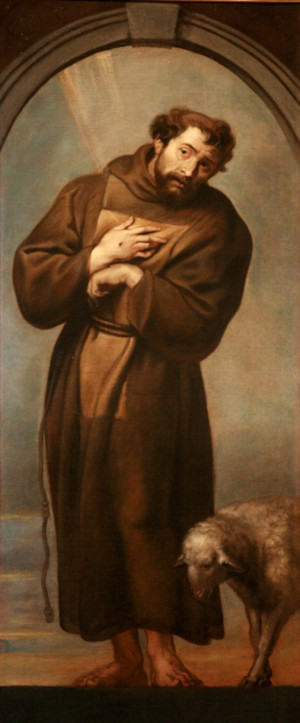
Saint Francis of Assisi. (Workshop of Peter Paul Rubens/CC BY-SA 2.0 FR)
What did God mean when he told Francis to 'repair my house'?
If you go to La Verna where Francis received the Sacred Stigmata, you will find a plaque with words from JPII during his visit: “In a real way, the Church was reborn with St. Francis” (or some similar words). He was called to bring new life, new zeal to the Church. In fact, the Franciscan movement has been one of the greatest evangelical movements in the history of the Church – bringing the gospel to the cities and towns of the world. Initially, of course, Francis misunderstood and began to follow the divine directive by physically restoring dilapidated churches… symbols of the spiritual condition of the Church.
How did his view of creation change the way humanity looks at animals?
Difficult to answer that with certainty, but when we talk about Francis being our ‘universal brother’, that includes his respect for all of creation, which he claimed as brother and sister. The Canticle of the Creatures (or of Brother Sun), the first poem that we know of written in the Italian language, gives witness to Francis’ fraternal love for animals and all of Creation.
Can you tell us some of the stories about St. Francis and his relationship with animals?
I’ll tell you one, the one that is depicted in fresco twice in the Basilica: his preaching to the birds as he and the other friars, itinerant preachers, approached the nearby town of Canara. He told the friars that he was with that he wanted to preach to the birds. Dozens of birds came down around him and acted as if they were truly listening to him - touching his tunic, contorting their necks - when basically he told them of the blessing God bestowed upon them by their capacity to fly and the way he fed them; therefore they should continue to praise God and bring joy to people’s hearts by their beautiful song.
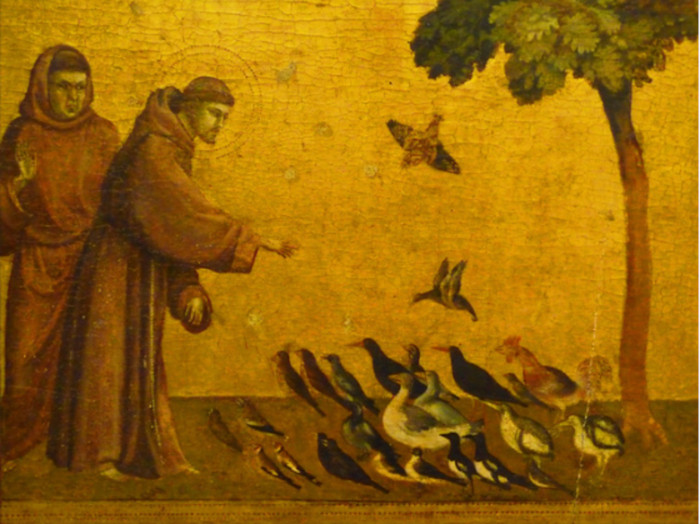
Detail of St Francis of Assisi preaching to the birds, from Giotto di Bondone. (Steven Zucker/CC BY-NC-SA 2.0)
What lessons can we learn from Francis's journey to the Sultan during the Crusades?
Francis marched off with the 5th Crusade not to fight (he hoped to join the 4th Crusade as a soldier, but received the ‘call’ to return to Assisi), not to fight, but hoping to bring peace, by proclaiming the gospel of peace with respect and love. It is in our rule that friars can preach to the ‘infidels’ (think Muslims), but to do so with respect; OR they can simply live among the Moslem people and preach by giving example of a holy lifestyle.
What is the significance of the stigmata?
“The lover became the Beloved”, as St. Bonaventure put it. They represent a physical, supernatural sign that Francis lived the New Testament’s charge to die to self in order to live for Christ. When he received the stigmata on Mt. La Verna in 1224, possibly the eve of the Exaltation of the Cross and Memorial of the Sorrowful Mother (Sept. 14-15), during his annual fast in honor of St. Michael Archangel, he apparently had asked for two things: to feel some of the love that Jesus carried in his heart that compelled him to embrace crucifixion for us and to feel some of the pain that he actually suffered on the cross. Francis would often look at the Crucifix and weep and lament: “Love is not loved; Love is not loved!” He tried to love Jesus, as Jesus loved him; the Stigmata speak to that reciprocal love.
- Ireland’s Franciscan Friars: Men in the Middle of a Divided Society
- Cryptic Crosses, Mystery Medallions and Enigmatic Relics in Christian Churches
Giotto, St. Francis of Assisi Receiving the Stigmata, c. 1295-1300, from Giotto di Bondone. (Steven Zucker/CC BY-NC-SA 2.0)
Did Francis invent the live Nativity scene?
No, he didn’t invent it; he could have been inspired by St. Bernard of Clairvoix’ writings on it (sorry no references). He did write to P. Honorius III for permission, because some theatrical presentations in churches had become profane, i.e. very secular. It is attributed to Francis and the friars, however, as cultivating that wonderful devotion at Christmas time. The friars propagated the devotion extensively. Francis was very caught up in meditating on the stark poverty of the surroundings for Jesus’ birth.
How did Francis help shape the modern Italian language?
As mentioned above, the Canticle of the Creatures, was written in the Italian language, the first poem that we know of in that emerging language (confirmed for me by a professor of Italian language who passed through here a few years ago); of course Dante is considered the ‘father of the Italian language’. The friars probably preached in Italian too, though this region had many dialects and the friars traveled to many foreign lands as well.
Who was St. Clare, and how did she shape the Franciscan movement?
A beautiful girl, inside and out, who secretly left her noble family on Palm Sunday Evening 1212 (that year seems to be the consensus over 1211). She met with the friars down at the Porziuncola, where her hair was shorn and she received a rough tunic in replacement of her fine clothing. She was shuttled off to a Benedictine Abbey in the valley, but eventually moved into the Church of San Damiano, where she lived until she died, almost 40 years later. She founded the Poor Ladies of Assisi with Francis, now called the Poor Clares. Richard … so much more can be said about her. I’ll just leave it at this: she and her sisters represent the cloistered contemplative wing of the Franciscan movement.
How does the Franciscan Order thrive over 800 years?
It is an evangelical movement: “This is the rule and life of the Friars Minor - TO LIVE THE GOSPEL OF OUR LORD JESUS CHRIST. Jesus is the Risen Lord, Richard! He lives forever! His Gospel is forever relevant!”
Can you tell us why Pope Francis named himself after St. Francis? And can you comment on the Green Encyclical (Laudato si)?
Giorgio Bergoglio was an attentive pastor in Buenos Aires to the people in the slums there, when he was their Cardinal Archbishop. The moment he was elected to the papacy, the Brazilian Cardinal leaned over to him and said, “Don’t forget the poor!” He immediately thought of Francis of Assisi, il Poverello, the ‘little poor man.” I have heard that when a new pope is elected, we should pay attention to the first line of his first encyclical. For Pope Francis it was “Laudato Si, Signore”, Praise to you, my Lord … quoting the first line of St. Francis’ Canticle of the Creatures.
It has been a long time since I read that encyclical letter. I don’t think that I am a good source for an objective commentary. Obviously, its theme is the good stewardship of Mother Earth. My one disappointment with it is that it doesn’t highlight the ultimate raison d’etre of this world, which, according to the thought of St. Thomas Aquinas, is the human person. In a world that slaughters unborn children by the millions, it is hard to expect God’s blessing upon us and it is ultimately He who made and sustains this world. Other measures to mitigate the deterioration of our environment, our human effort will have miniscule effects compared to what God can do; the world is much too complex for us to maintain. That said, we are still called to be good stewards of creation; again, the pinnacle of all of God’s creative work is the human person, made in His image.
Archaeology Extra
What does it mean that the basilica is on the former execution site called Colle dell'Inferno (Hill of Hell)?
This area was a former garbage dump and the place where criminals were executed; in fact, it was called the ‘Colle dell’Inferno’. When Pope Gregory IX commissioned Brother Elias, Francis’ successor, to build this Basilica ‘in honor of Jesus and his humble servant Francis of Assisi’, he also charged him to change the name to the Hill of Paradise, la ‘Colle del Paradiso’.
What archaeological methods were used during excavations of the crypt? Can you tell us about the burial vault?
The excavation for the crypt chapel, which was done by the friars in secret and at night, must have been accomplished with very modest, quiet tools, requiring great patience and perseverance (my conjecture only). The first task was to relocate the sarcophagus; and then design and excavate the crypt.
The present sarcophagus, visible over the tabernacle and altar of the crypt chapel, is Francis’ original burial vault.
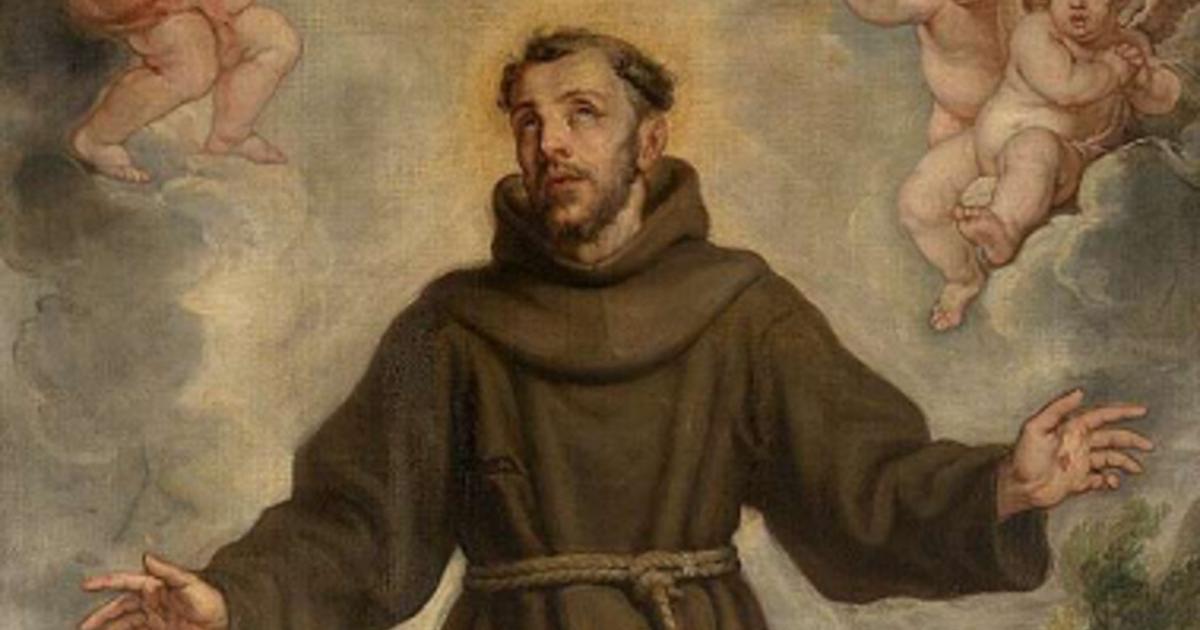
Top image: St Francis of Assisi by Philip Fruytiers. Source: The Royal Museum Of Fine Arts Antwerp/ Public Domain
By Richard Marranca, Ph.D.