
At 2:52 in the afternoon local time on Wednesday, October 28, two heavy stone faces changed hands at the National Gallery of Australia in Canberra. According to Xinhua, the gallery handed them over to China's National Cultural Heritage Administration (NCHA). Each head was once part of a full-length statue of a court official, carved around a thousand years ago to stand beside the road leading to an emperor's tomb.
The two pieces are the head of a civil official from Yongchang Mausoleum and the head of a military official from Yongyu Mausoleum, both from the Northern Song dynasty, which CGTN dates to 960 to 1127. Both mausoleums lie in Gongyi, in central China's Henan Province. The reports from the day are detailed about the objects and the ceremony. However, they say very little about how the heads came to be in Canberra. So what do the sources actually say?
Two Heads, Two Emperors
The civil official's head is the heavier of the pair. Xinhua's Chinese language report, citing collection records the gallery published earlier, gives its height as 70 centimeters and its weight as 223 kilograms. The military official's head is 68 centimeters tall and weighs 132 kilograms. According to the gallery, as relayed by Xinhua in English, both are made of limestone and come from Henan Province.
Yongchang is the tomb of Taizu, born Zhao Kuangyin (927 to 976), who founded the dynasty, according to the heritage guide Park of China. Yongyu, the same guide says, belongs to Shenzong, born Zhao Xu (1048 to 1085), who died in 1085. The guide also says the figures changed over time, so that from the early tombs of Yong'an and Yongchang to the late tombs of Yongyu and Yongtai "the figures become slimmer and more lifelike, showing how the style changed."
That places the two returned heads at the early and late stages of the cemetery's history. The civil official belonged to the tomb of the dynasty's founder, who died in 976, while the military official was carved for an emperor who died roughly a century later. Global Times describes the pair as "representative examples of Song Dynasty stone carving art."
A Cemetery Guarded by Stone
The Northern Song dynasty had nine emperors. Park of China explains that two of them, Huizong and Qinzong, were carried off by the Jin and died in the north. The other seven are buried at Gongyi, together with Zhao Hongyin, the founder's father, who was honored as an emperor after his death. That gives eight imperial tombs, a group the guide calls "seven emperors, eight tombs."
The Henan provincial government puts the number of surviving stone carvings above ground at 1,027, spread over a protected area of 189.04 square kilometers. It says the cemetery is known as an "open-air stone carving museum on the ground" and that it holds the tombs of seven Northern Song emperors, their empresses, relatives and notable generals and ministers. CGTN describes the Gongyi tombs as "part of China's largest and relatively well-preserved group of Northern Song imperial tomb sculptures, known for their exquisite craftsmanship and diverse forms."
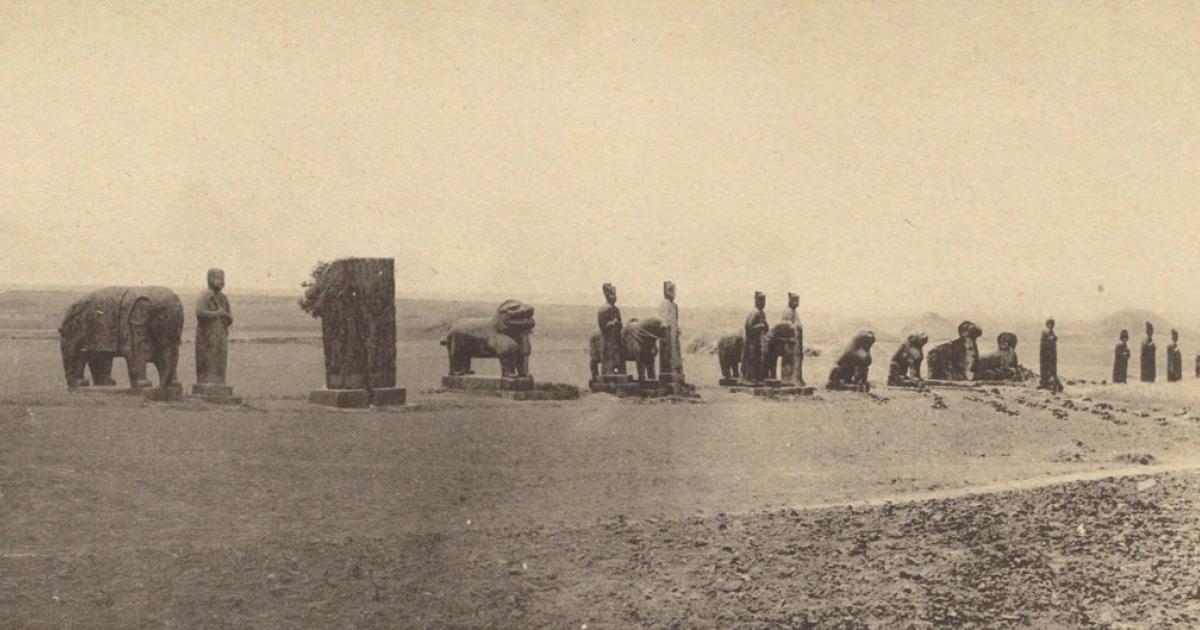
The statues line a ceremonial avenue called a spirit way, which runs outside the south gate of each tomb. Park of China lists the order of the procession from south to north: "pillars, elephants with their keepers, auspicious birds, the mythical jiaoduan, horses with grooms, tigers, rams, foreign envoys and civil and military officials, with lions and guardian generals at the gates." Global Times sums up the cemetery's sculpture as "human figures and auspicious beasts noted for their rich forms and fine carving."
Tombs Built in a Hurry
The Song tombs were made under unusual pressure. According to Park of China, a Northern Song emperor did not build his own tomb while he was alive. Work began only after his death, and ritual required the burial to take place within seven months, so the tombs are "far smaller than those of the Tang or Ming."
The site also follows a geomantic rule tied to the imperial surname. The guide explains that the surname Zhao called for ground high in the southeast and low in the northwest, so the burial mound stands at the lowest point of each precinct. That is the reverse of the usual Chinese pattern of a tomb set against a hill.
The cemetery has suffered before. Park of China says that after the fall of the Northern Song "the tombs were plundered by Jin troops and by the puppet regime of Liu Yu." All the buildings above ground disappeared, the guide adds, "leaving each tomb with only its mound and stone sculptures." Most of the stone, it says, came from the hills of Yanshi to the west.
How the Return Came About
The case for the return was built in China, where, according to Xinhua's Chinese report, the NCHA worked with the Ministry of Public Security and with Henan's heritage and police departments to investigate and assemble evidence. In 2025 the NCHA submitted a memorandum to the National Gallery of Australia asking for the two heads back, which formally began the claim.
The same report lists three frameworks behind the return. The first is the 1970 UNESCO Convention. The second is an intergovernmental memorandum of understanding on cultural heritage protection that China and Australia signed in 2009. The third, as Xinhua describes it, is a policy on due diligence and provenance research that the National Gallery of Australia published in 2021.
However, none of the reports consulted for this article says how or when the heads left China, who removed them, or how and when the gallery acquired them. The gallery has not given those details in any of the coverage. The reports also do not describe the evidence the investigators assembled.
The Ceremony in Canberra
Xinhua's Chinese report names the officials who attended the handover and gave speeches. They were Tang Wei, deputy head of the NCHA, Liu Jinsong, China's ambassador to Australia, and Nick Mitzevich, director of the National Gallery of Australia. Representatives of Australia's Department of Foreign Affairs and Trade and of the federal arts department also took part.
According to the same report, the Chinese side said that returning relics to their countries of origin protects cultural heritage and respects the cultural rights and feelings of each nation's people. The Australian side said that a return is more than the transfer of an object and reflects respect for cultural heritage, responsibility and international partnership. The Chinese side called the return an important result of the two countries' joint work under international conventions, and the Australian side said it would help deepen relations and support continued cooperation on heritage protection. No direct English quotations from the speeches appear in the sources.
The two heads join a run of returns to China that Xinhua listed alongside its report. On September 17, 2026, the United States returned 64 Chinese cultural relics and paleontological fossils. On May 16, 2025, the Smithsonian's National Museum of Asian Art returned volumes II and III of the Zidanku Silk Manuscript. On November 9, 2024, a total of 56 relics came back from Italy.
Back to the Fields of Gongyi
None of the sources says where the two heads will be kept or displayed, or whether they will be placed back on the statues they came from. It is not yet clear whether the bodies of the two officials still stand on the spirit ways at Yongchang and Yongyu.
What the sources do describe is a cemetery that is watched closely today. In a 2025 report from Gongyi, the Henan provincial government visited Yongyu Mausoleum, where a protection station staff member named only as Mr. Bai told the provincial reporters, "Yongyu Mausoleum has 52 stone statues. We patrol and inspect these relics every hour, and the mausoleum area is guarded 24 hours a day." The same report describes the tombs as having "long merged with villages and farmland," where wheat and corn grow among the stone figures.
How we label claims
Established: the date, time and place of the handover, the two mausoleums, the Northern Song date, the material, heights and weights given in the gallery's records, the 2025 NCHA memorandum, and the 1970 UNESCO Convention, 2009 memorandum and 2021 gallery policy framework, all as reported by Xinhua, CGTN and Global Times. Established: the layout and history of the Gongyi cemetery as described by the Henan provincial government and Park of China. Unverified: when, how and by whom the heads were removed, how and when the gallery acquired them, what evidence the investigators assembled, where the heads will go next, and whether they will be reattached to their statues.
The spirit way of Yongxi Mausoleum, tomb of Emperor Taizong, at Gongyi, photographed by Sekino Tadashi in 1918. The returned heads came from Yongchang and Yongyu, two other tombs in the same cemetery. Neither of the returned heads appears in this photograph. Photo by Sekino Tadashi, via Wikimedia Commons, public domain.
By Aris Manus
Sources
- Australia returns two Northern Song Dynasty sculpture heads to China, CGTN, October 28, 2026
- Australia returns two cultural relics to China, CGTN, October 28, 2026
- Chen Xi, Australia returns two Song Dynasty statue heads, representative relics of stone carving art, to China, Global Times, October 28, 2026
- Australia returns 2 cultural relics to China, Xinhua, October 28, 2026
- Timeline: Major Chinese cultural relics returned from overseas in recent years, Xinhua, October 28, 2026
- Wang Jialin and Qi Zijian, 澳大利亚向我国返还2件流失文物 (Australia returns 2 displaced cultural relics to China), Xinhua, October 28, 2026 (in Chinese)
- During the wheat harvest, this treasure town in Henan can no longer stay hidden, The People's Government of Henan Province, June 16, 2025
- Northern Song Imperial Tombs, Park of China