A Family of Royal Servants
Bryan came from a family who had served the Crown for generations. His grandfather Sir Thomas Bryan was Chief Justice of the Common Pleas in the reigns of Edward IV, Richard III and Henry VII. It is not surprising then that his son, Bryan’s father, Sir Thomas Bryan of Ashridge, Hertfordshire, followed his father into service and became knight of the body to Henry VII and Henry VIII who knighted him in 1497 for his part in the suppression of Cornishmen who marched on London. He would later become vice-chamberlain to Katherine of Aragon, Henry VIII’s first queen.
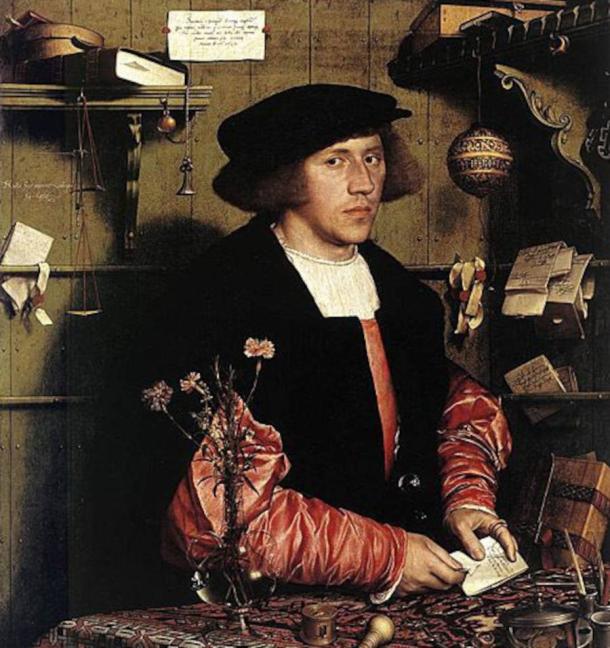
Sir Francis Bryan. (Alchetron).
Sir Francis’ mother Lady Margaret Bryan, nee Bourchier, was descended from the Plantagenet king Edward III through her great grandmother Anne of Woodstock, Countess of Buckingham. After her mother’s second marriage to Thomas Howard, 2nd Duke of Norfolk, Margaret was raised with her half siblings including Elizabeth Howard, the mother of Anne Boleyn and this connection would link her son Francis Bryan to both Anne Boleyn and Catherine Howard, two of Henry’s later queens. She also committed herself to royal service as a lady-in-waiting to Katherine of Aragon and would become governess to Henry VIII’s children.
Early Life and Education
Bryan’s parents married around 1487. His birthdate is obscure but we can narrow it down to somewhere between 1490 and 1496 in the early years of their marriage. A first son Thomas died young but Francis as well as two daughters, Margaret and Elizabeth, would survive to adulthood. The children probably grew up at Marsworth Manor, near Cheddington, in Buckinghamshire, not far from the border with Hertfordshire, a property left to their father in their grandfather’s will, who had owned the manor and the surrounding land since 1489.
There had been a moated manor house at Marsworth since 1328, once granted by King Edward III to his shield-bearer, Thomas Cheney, ancestor of the Cheneys of Drayton-Beauchamp. It had been updated by the time it came to the Bryans and as well as the manor there were outbuildings, gardens and a fish pond. It was a country retreat away from the trials of court life and an idyllic place to grow up.
As was normal children would often be raised in another household and it is possible that Bryan was sent to the household of Sir Thomas Parr of Kendal, Westmoreland, in Northamptonshire as he would later refer to him as his special patron. Sir Thomas Parr was also descended from Edward III and his family too had served their sovereigns. Parr was made a Knight of the Bath around the time of Henry VIII’s coronation and was close to the new king. His home place, Kendal Castle, was in a state of disrepair and so the Parrs chose to live in Blackfriars, London, from 1512. Sir Thomas would become the father of another of Henry’s queens, Katherine Parr, who was born at this time.
Through all his connections Francis Bryan was well and truly linked to life at the Henrician court. We know little of his education. Parr believed, as did Thomas More, Henry’s councillor and a known humanist and philosopher, that boys and girls should be educated together and Lady Maud Parr, a well-educated lady herself, would later be responsible for running the royal school at court which taught French, Latin, philosophy, theology and the Classics. Lady Parr was fluent in French and taught all her children to read and write at a young age so we can assume that Bryan was also given a solid education during his time in their household of which he had fond memories.
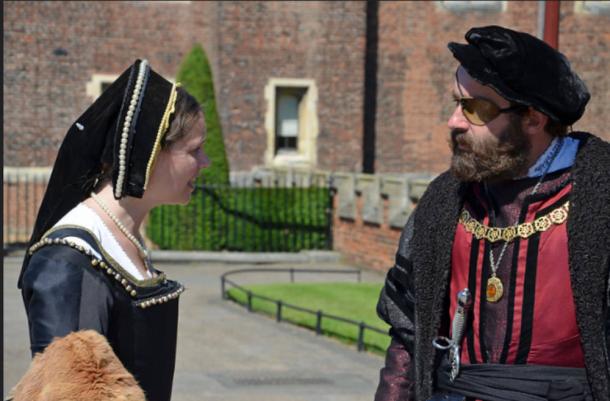
During a historical reenactment, 'Anne Boleyn' and 'Sir Francis Bryan' argue about the Reformation at Hampton Court Palace. (Art de Cade/CC BY-SA 2.0).
Introduction to Court Life
Wood’s Athenae Oxonienses indicates Bryan went to study at Oxford University but the date given in its companion volume Alumni Oxonienses 1500–1714 sees him attending in 1522 by which time Bryan would have been at least in his mid-twenties and serving the king. Boys typically entered the college between the ages of fourteen and seventeen. We do know however that Bryan was well educated and had learnt French as his diplomatic and military career will show.
Bryan would later say that he came to Henry’s court ‘very young’. Whether through his mother or his patron, he must have been at court frequently. Soon he was part of a close group of friends that the young king had gathered around him – his ‘minions’ who included Charles Brandon, Thomas Grey, Thomas Knyvett, Henry Guildford and Nicholas Carew. His sisters Margaret and Elizabeth would also attend court at an early age and both would marry the king’s companions.
Margaret was the first to marry being the eldest and around April 1512 she wed Henry Guildford, son of Sir Richard Guildford. It must have been a court affair as the king’s sister Mary gave the couple a gift of 6s. 8d. Henry gave them manors in Byner, Lincolnshire, and Hampton-in-Arden, Warwickshire but they made their home at Benenden in Kent and later Leeds Castle.
War with France
This was the young king’s heyday, full of the pleasures of what life could bring from jousting, dancing, hunting, masques and pageants. With his band of brothers around him Henry was determined to shake off the shackles of his last years with his father when it was said he was kept as close as a girl and well-guarded. But he was also determined to wage war on France – England’s ancient enemy since 1066 – in his sights from the moment he was crowned. The Venetian ambassador had described Henry as magnificent, liberal and a great enemy of the French and his minions would all take roles in the coming hostilities.
On 17 November 1511, Henry signed the Treaty of Westminster with King Ferdinand II of Aragon (Katherine of Aragon’s father), which was an agreement to attack France by the end of April 1512, and war was duly declared on Henry’s enemies. In August 1512, Edward Howard, the new Lord Admiral, attacked the French fleet near Bertheaume Bay. Howard headed a flotilla of twenty-five English warships in Henry’s prized new ship, the Mary Rose, closely followed by Sir Thomas Knyvett and Sir John Carew in the Regent and Charles Brandon and Sir Henry Guildford in the Sovereign.
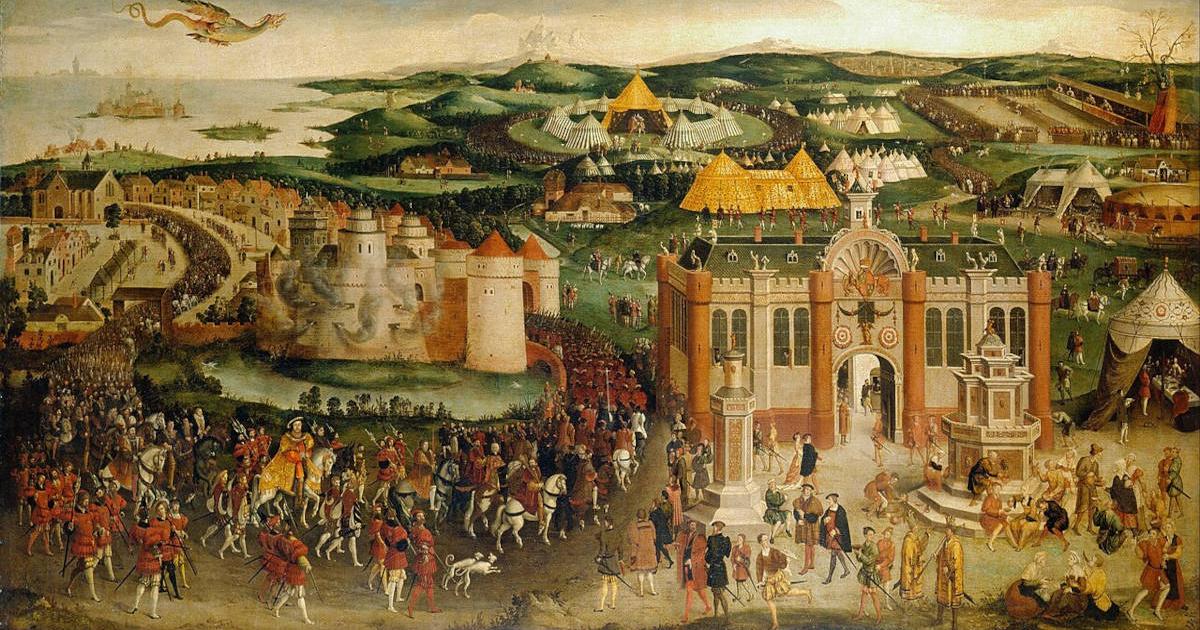
Top image: The Field of the Cloth of Gold, oil painting from 1545 in the Royal Collection at Hampton Court. Henry VIII on horseback approaches at bottom left for summit meeting with Francis I of France in 1520.
Source: Public Domain.
Sarah-Beth Watkins is the author of 14 books, the latest of which is ‘Lady Katherine Knollys: The Unacknowledged Daughter of King Henry VIII.’ She has been a freelance writer for over 20 years, writing for magazines and websites on a wide range of topics. More commonly known for her history books, Sarah is also passionate about Druidry and nature spirituality. She is a member of the Order of Bards, Ovates and Druids and is a qualified life coach, NLP and CBT practitioner. She has also trained as a pranic healer.