
The ocean floor is a realm of eternal darkness, holding secrets that often challenge our understanding of history and science. Among the most hotly debated underwater mysteries of the 21st century is the Baltic Sea Anomaly. First detected by sonar, this bizarre, circular formation resting on the murky seabed sparked massive global interest and immediate speculation. Could it be a sunken extraterrestrial spacecraft, an elaborate natural hoax, or perhaps a relic of a forgotten human civilization?
When the first grainy sonar images emerged, the shape was instantly compared to the Millennium Falcon from Star Wars. The internet exploded with theories ranging from crashed UFOs to secret World War II anti-submarine devices. Yet, as modern marine geologists and archaeologists continue to map the depths of the Baltic basin, a far more complex and grounded truth is beginning to surface. The reality of what lies beneath the waves may not involve aliens, but it is no less fascinating.
- Nearly 11,000-Year-Old Megastructure Is Oldest Ever Found in Europe
- The Unsolved Mystery of the Baltic Sea Anomaly
Discovering the Baltic Sea Anomaly
The story began in 2011 when the Swedish treasure-hunting team, Ocean X, was scanning the seabed for old shipwrecks. Instead of a wooden hull, their sonar pinged a massive, strangely geometric object resting at a depth of roughly 295 feet (90 meters). The structure measured an impressive 200 feet (61 meters) in diameter and appeared to be elevated off the seabed on a pillar-like formation. It featured rigid lines, apparent right angles, and what looked like a drag mark or runway trailing behind it.
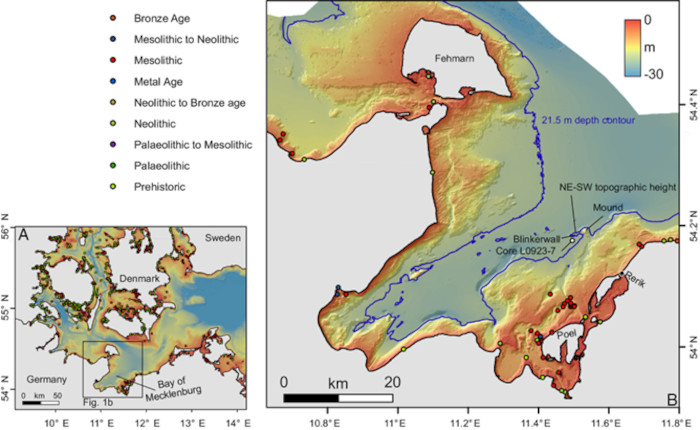
Overview map of the Western Baltic Sea. Bathymetric data taken from the Global Multi-Resolution Topography (GMRT) synthesis. (Geerson et al./CC BY-SA 2.5)
Diving down to investigate the object proved incredibly difficult due to the freezing, pitch-black conditions of the Baltic waters. When divers finally reached the structure, they reported equipment malfunctions and a total loss of visibility, adding fuel to the supernatural fire. However, they managed to recover stone samples from the site. These samples were dark, burnt-looking rocks that seemed entirely out of place on the sandy bottom of the ocean.
Despite the initial hype, the scientific community remained highly skeptical of the extraterrestrial claims. Experts pointed out that the Baltic Sea is notoriously difficult to scan accurately. The unique salinity gradients and temperature shifts in the water can severely distort sonar readings, often making natural geological formations look artificial. As more data was collected, the mystery began to shift from the realm of science fiction back into the realm of natural science.
Geological Reality or Alien Artifacts?
Recent studies have provided crucial insights into how perfectly circular or highly anomalous structures can form naturally on the ocean floor. A 2023 geological review by Li et al. demonstrated that various biological and geological processes, such as fluid expulsion and gas venting, can create incredibly precise geometric shapes in the seabed. When combined with the unique glacial history of Northern Europe, the "spaceship" theory begins to sink rapidly.
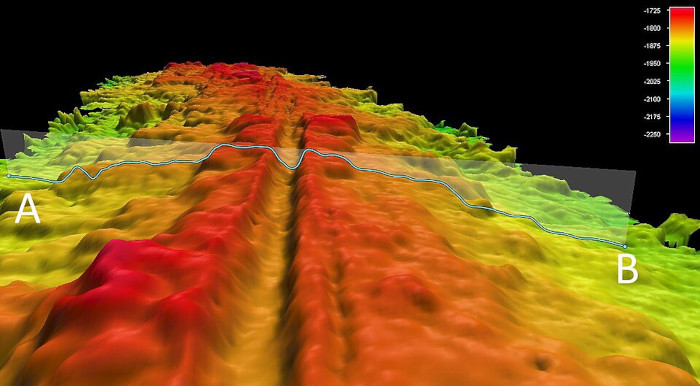
Example of a high-resolution multibeam echosounder bathymetry scan (Western Galapagos Rift) revealing complex seabed morphology. Recent studies utilizing this exact advanced sonar technology in the Baltic Sea have proven that the ocean floor is heavily littered with bizarre, naturally occurring moraines that easily trick standard scanning equipment. (NOAA Photo Library/CC BY 2.0)
During the last Ice Age, massive glaciers carved their way across the region, grinding rocks and trapping volcanic debris within the ice. As the ice melted around 9000 BC, it deposited these massive, out-of-place boulders, known as glacial erratics, into the newly formed Baltic Sea basin. The dark, metallic-looking stones recovered by Ocean X were identified by geologists as basalt and granite, common materials deposited by retreating glaciers.
Furthermore, a 2024 study by Feldens utilizing high-resolution multibeam echosounder bathymetry mapped the complex glacial morphology of the Baltic Sea. The research confirmed that the seabed is littered with bizarre, naturally occurring moraines and deposited rock formations that can easily trick standard sonar equipment. The Baltic Sea Anomaly is widely considered by geologists to be a remarkable, yet entirely natural, glacial deposit rather than a crashed alien vessel.
The Stone Age Megastructures Connection
While the anomaly itself might be a natural rock formation, the idea of finding massive, artificial structures at the bottom of the Baltic Sea is not actually fiction. In early 2024, an astonishing discovery shattered our understanding of ancient European history. Researchers led by Jacob Geersen published findings in the Proceedings of the National Academy of Sciences (PNAS) detailing a massive, 11,000-year-old artificial stone wall found entirely submerged in the western Baltic Sea.
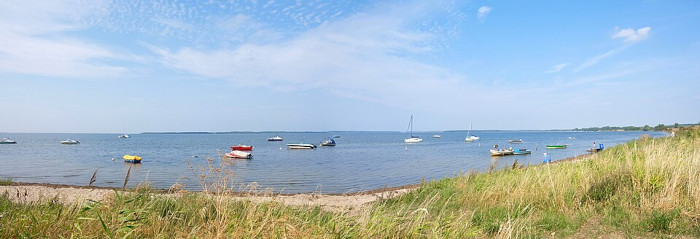
The coast of the Bay of Mecklenburg in the southwestern Baltic Sea. Just off this shore lies the submerged landscape where archaeologists recently discovered the 11,000-year-old Stone Age megastructure, a remnant of a time when the entire basin was dry land. (CC BY-SA 4.0/Jasmin Flad)
This incredible megastructure, stretching nearly 3,200 feet (975 meters) long, was constructed by Stone Age hunter-gatherers long before the region flooded. It was built using thousands of carefully placed stones to create a drive lane for hunting reindeer herds. This revelation proves that the Baltic basin was once a dry, populated landscape where ancient humans actively engaged in monumental construction projects. The discovery of genuine submerged megastructures completely changes the context of the region. It highlights why marine archaeologists are so eager to scan the seabed, even if they occasionally chase shadows like the famous anomaly. While we may not have found an ancient spaceship, we have found definitive proof that the sunken landscapes of the Baltic hide the lost architectural achievements of our earliest ancestors
Unraveling the Mysteries of the Deep
Ultimately, the phenomenon serves as a powerful reminder of how easily our imaginations can be captured by the unknown. The blurry sonar scans allowed people to project their wildest sci-fi fantasies onto a pile of glacial rocks. Yet, the rigorous scientific method, utilizing advanced bathymetry, geological sampling, and peer-reviewed analysis, has slowly chipped away at the myth to reveal a more grounded reality.
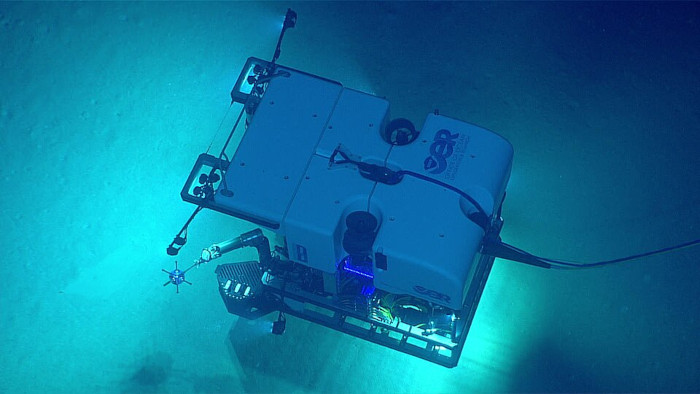
A remotely operated vehicle (ROV) equipped with high-powered lights and cameras is descending into the uncharted depths. As this technology continues to map the ocean floor, marine archaeologists are bound to uncover more sunken mysteries, whether they be natural geological wonders or genuine artifacts of lost civilizations. (NOAA Ocean Exploration & Research from USA/CC BY-SA 2.0)
Nature is entirely capable of creating shapes that appear designed, and the chaotic forces of the Ice Age left behind a seabed that continues to confuse even modern technology. However, as the genuine discovery of the Stone Age megastructure proves, the truth hidden in the deep ocean is often far more fascinating than any internet hoax. The waters of Northern Europe remain a vital frontier for historical exploration.
Even if the Baltic Sea Anomaly is just a fascinating trick of glacial geology, it succeeded in drawing global attention to the uncharted depths. As remote-operated vehicles and advanced multibeam sonar continue to map the ocean floor, we are bound to uncover more sunken mysteries. Whether those mysteries turn out to be natural wonders or genuine artifacts of lost civilizations, the deep sea will never stop surprising us.
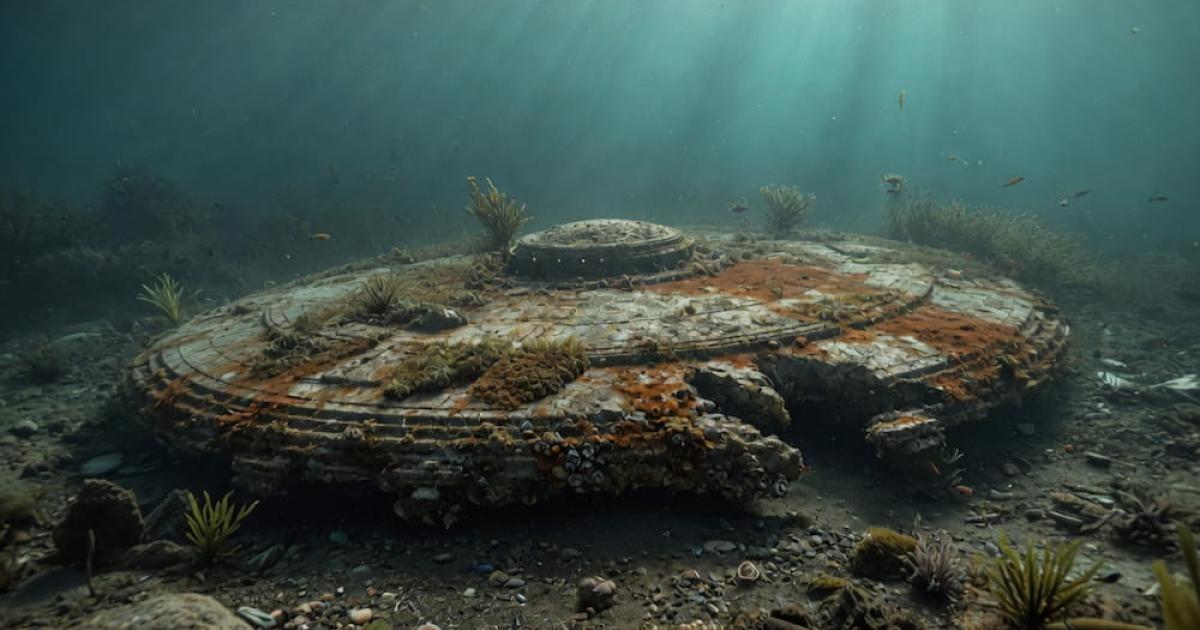
Top Image: This photorealistic illustration depicts the mysterious circular object on the Baltic Sea floor, heavily encrusted and eroded as if it has rested there for millions of years. The image is an artistic rendering based on descriptions and scans from the Ocean X expedition.
FAQs
What is the Baltic Sea Anomaly? It is a 200-foot (61-meter) circular rock formation discovered on the floor of the Baltic Sea in 2011 by a treasure-hunting team. Its strange shape, resembling a science-fiction spaceship on sonar, led to widespread speculation that it was a sunken UFO or an ancient artificial structure.
Did scientists prove the anomaly is an alien spaceship? No. Geologists and marine scientists have concluded that the structure is a natural geological formation. It is highly likely a glacial erratic, a massive deposit of rocks, including basalt and granite, left behind by melting glaciers at the end of the last Ice Age.
Are there real ancient structures at the bottom of the Baltic Sea? Yes! In 2024, scientists discovered a massive, 11,000-year-old artificial stone wall stretching nearly 3,200 feet (975 meters) underwater in the western Baltic. It was built by Stone Age hunter-gatherers to corral reindeer before the sea levels rose and flooded the region.
References
Feldens, P., et al. 2024. High-resolution multibeam echosounder bathymetry reveals complex glacial and post-glacial seabed morphology in the Baltic Sea. Nature Scientific Reports, 14, 75054. Available at: https://www.nature.com/articles/s41598-024-75054-4
Geersen, J., et al. 2024. A submerged Stone Age hunting architecture from the Western Baltic Sea. Proceedings of the National Academy of Sciences (PNAS), 121(8), e2312008121. Available at: https://www.pnas.org/doi/10.1073/pnas.2312008121
Li, Y., et al. 2023. Formation of circular structures on the seabed: A review of geological and biological processes. Frontiers in Earth Science, 11, 1170787. Available at: https://www.frontiersin.org/journals/earth-science/articles/10.3389/feart.2023.1170787/full