
When archaeologists in Constanța lifted a small clay rooster out of a child's grave this week, they found that it still held the pieces that once made it rattle. The toy had been buried with a very young child around 1,800 years ago, in a stone sarcophagus that was still sealed when it was found.
The discovery was made by specialists of the Museum of National History and Archaeology Constanța, known as MINAC, on Romania's Black Sea coast. The museum dates the burial to the 2nd or 3rd century AD, and its team has given the child a name, "Băiețelul de la Tomis," the Boy of Tomis.
A grave beside the road to Histria
The sarcophagus came to light during preventive excavations in the Flămânda area of Constanța, according to the museum's own announcement of October 27, 2026. The grave lies at the northern edge of the necropolis of ancient Tomis, the city that stood where Constanța is today. At the press conference, Constantin Băjenaru, who coordinates the research, placed it about 1.5 kilometers from the ancient city, close to an ancient road that linked Tomis with Histria, Ziua de Constanța reports.
Tomis also has a place in Roman literary history. World History Encyclopedia notes that the poet Ovid was banished to Tomis in 8 CE and that he died there in exile in 17 CE.
The museum says that Băjenaru and his colleague Cătălin Nopcea first noticed on October 22 that an intact sarcophagus might be in the ground, after which it was cleared and moved to one of the museum's premises. One quote from museum director Delia Roxana Cornea, carried by Antena 3 CNN, names the second archaeologist as Cătălin Dobrinescu, while the museum and AGERPRES name Nopcea.
Opening the stone box
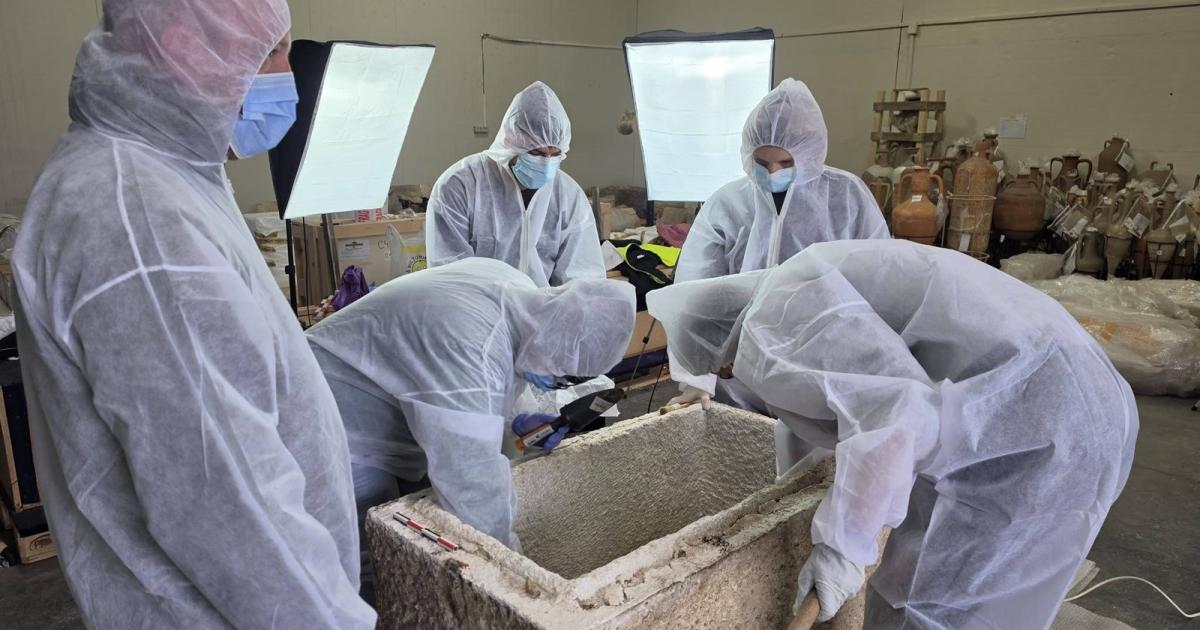
On Tuesday, October 27, conservators, restorers and archaeologists from the museum gathered to open the sarcophagus. Europa FM reports that the opening was broadcast live on social media.
According to Ancientist, Băjenaru explained that two lead clamps had held the stone lid in place and that mortar sealed the joint between lid and box. Ziua de Constanța gives the sarcophagus a length of a little over one meter.
Inside lay a wooden coffin, and the flowers placed with the child had survived as well. "The wood of the coffin is extraordinarily well preserved, almost intact," Cornea said, in remarks to Ziua de Constanța that Antena 3 CNN carried (translated from Romanian). Ancientist reports that the coffin still shows dovetail joints between its panels. The researchers also found the shroud that wrapped the child, and Radio România Constanța reports that the child's hair had survived very well.
The museum lists flower garlands among the grave goods, and Ancientist describes arrangements of folded leaves, some packed into small bundles shaped like cubes. The plants have not yet been identified.
Băjenaru told AGERPRES that a child's sarcophagus is something the museum had never had before. "The sarcophagus is a small one and this is a rare discovery. Because small sarcophagi, used for the burial of children, are very rare, we have not had anything like this until now," he said (translated from Romanian).
Toys, a coin and two bullae
Among the grave goods are two clay toys, and one of them is a rooster. Archaeologist Ana Hamat told Ziua de Constanța that the toys keep painted details, which rarely survive over time, and Ancientist adds that these include eyes and eyebrows.
The rooster held one more surprise. "What you will not see in the pictures is that the little rooster still keeps its rattle pieces," Hamat said (translated from Romanian). Another ancient toy that can still make its sound is a 4,000-year-old rattle that still rattles, found in Siberia.
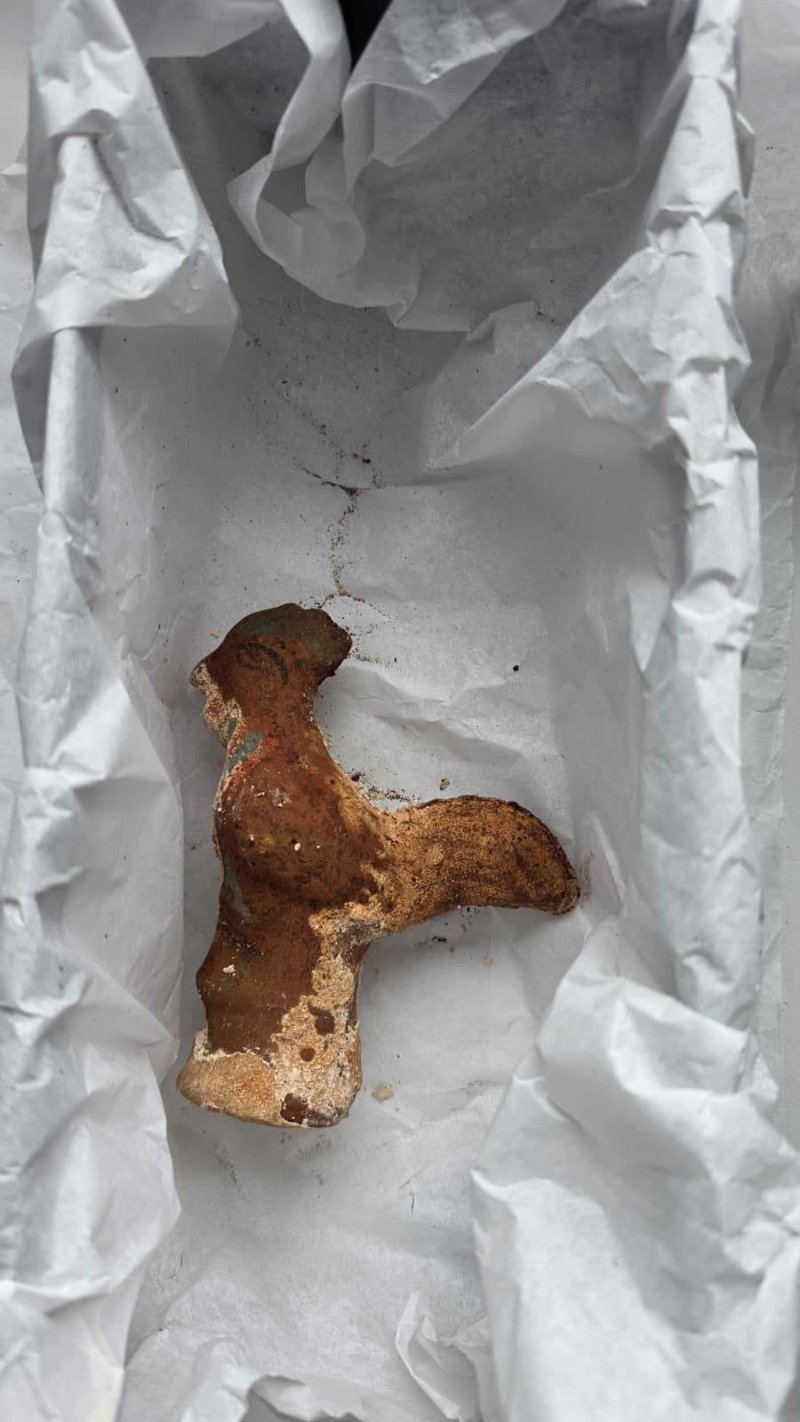
The clay rooster toy from the sarcophagus, resting on tissue paper after it was lifted out. Photo: MINAC Constanța (Muzeul de Istorie Națională și Arheologie Constanța)
However, the second toy is described in slightly different ways. Cornea called it a small cart. A voice heard at the opening, as reported by Europa FM, called it a little horse, and Ancientist describes a small horse on wheels, with one wheel detached.
Cornea spoke of "the classic toys that were placed in children's graves" (translated from Romanian). Readers can find more background in an older piece on the toys and games of ancient children.
The museum's first post on the find, quoted by Antena 3 CNN, also lists a coin and several personal ornaments. Ziua de Constanța reports two small bronze bracelets, sized for a child's arms. They were found beside the body and not on the arms, so the team wants to learn whether the child wore them in life or whether they were bought for the burial.
Then there are the two bulla pendants, reported by Ziua de Constanța and Ancientist. A bulla was a small amulet that Roman children wore around the neck. Smith's Dictionary of Greek and Roman Antiquities, published in 1875, says it was at first worn only by patrician children and later by all children of free birth and that it was laid aside with the bordered toga and dedicated to the household gods. Hamat told Ziua de Constanța that the bulla served as a protection and that it spoke of the child's status as a citizen of the city.
A boy, and how young?
The bullae are central to the team's view that the child was a boy. As the lid came off, a voice in the room said, according to Europa FM, "I can't believe it, a little horse and a rooster! It is almost certainly a little boy" (translated from Romanian). Cornea, speaking the same day, said only that the team believes it is a boy's grave and has named him for now.
However, the age of the child is less settled. Antena 3 CNN reported on October 27 that the museum's preliminary research pointed to a child of 4 to 5 years. A day later, Ziua de Constanța carried that same figure but also reported early estimates, based partly on the size of the sarcophagus, of possibly 2 to 4 years. The rattle pushed the team's thinking younger. "When we brought out the rattle pieces, we realized that this is a very small child," Hamat said (translated from Romanian). She was also plain about the limits. "We do not yet know the exact age of the child," she said (translated from Romanian). An anthropological study should give a firmer answer.
A family plot?
Băjenaru believes the location says something about the child's family. He told AGERPRES that the grave sits near other burials his team has excavated across from the find spot, and that a special brick tomb found in the same area four or five years ago had been destroyed by a pit dug in the interwar period. Putting the pieces together, he said, "confirms for us that we are in an area that was very probably assigned to an important family" (translated from Romanian).
At the press conference, according to Ziua de Constanța, Băjenaru said that in the Roman period burial plots were allocated and later sold as permanent graves. Earlier work in the same cemetery has turned up Roman tombs found beneath a hospital site in Tomis.
What happens next
Cornea described the inventory as what could be seen "at first sight" and said deeper analyses would follow (translated from Romanian). Ziua de Constanța reports that the team plans to examine the teeth and bones and, if the biological material allows, to run DNA analyses. They also hope to find clues to the cause of death, which is not known.
Some of the questions concern the unusually good preservation of the burial. Ancientist and Ziua de Constanța report that Băjenaru raised the possibility of a process resembling mummification, and that a resin may have helped preserve the textiles. Both ideas still have to be tested. Hamat said that if the flowers are analyzed, "we will also have the season in which he was buried" (translated from Romanian).
Ziua de Constanța reports that the finds will be compared with similar discoveries at Tomis and elsewhere in the Roman world, such as another Roman child's coffin. Hamat also told AGERPRES what lies ahead for the child. "This little child from Tomis will be looked after very, very well, and in the future will probably also be displayed, when the analyses are finished" (translated from Romanian).
How we label claims
Established: the find spot at the northern edge of the Tomis necropolis, the opening on October 27 and the press conference on October 28, 2026, the sealed sarcophagus and coffin, the garlands, toys, coin, bracelets and bullae, and the museum's dating to the 2nd or 3rd century AD. Unverified: that the child was a boy, which rests on the bullae and the museum's preliminary reading. Disputed: the child's age, since the team's preliminary estimates range from 2 to 5 years and the anthropological study is still to come. Unverified: that the plot belonged to an important family. Unverified: the cause of death and the child's identity.
Museum specialists in protective suits at the opened small stone sarcophagus from the northern edge of the Tomis necropolis, at the museum in Constanța on October 27, 2026. Photo: MINAC Constanța (Muzeul de Istorie Națională și Arheologie Constanța)
By Aris Manus
Sources
- Descoperire arheologică importantă la Constanța: un sarcofag roman intact, aparținând unui copil, Muzeul de Istorie Națională și Arheologie Constanța, October 27, 2026
- Constanța: Sarcofag roman al unui copil, găsit intact, descoperire de excepție pentru patrimoniul arheologic, AGERPRES, October 28, 2026
- Un sarcofag roman intact a fost descoperit în Constanța, Antena 3 CNN, October 27, 2026
- Constanța: Sarcofagul unui copil din perioada romană, găsit de cercetători, Europa FM, October 27, 2026
- Băiețelul de la Tomis, descoperire arheologică emoționantă la Constanța, Ziua de Constanța, October 28, 2026
- Descoperire arheologică excepțională la Constanța: Sarcofagul intact al unui copil din Tomisul roman, Radio România Constanța, October 27, 2026
- 1,800-Year-Old Roman Child's Sarcophagus Found Intact With Toys in Romania, Ancientist, October 29, 2026
- Ovid, World History Encyclopedia
- Bulla, in William Smith, A Dictionary of Greek and Roman Antiquities, John Murray, London, 1875, via LacusCurtius