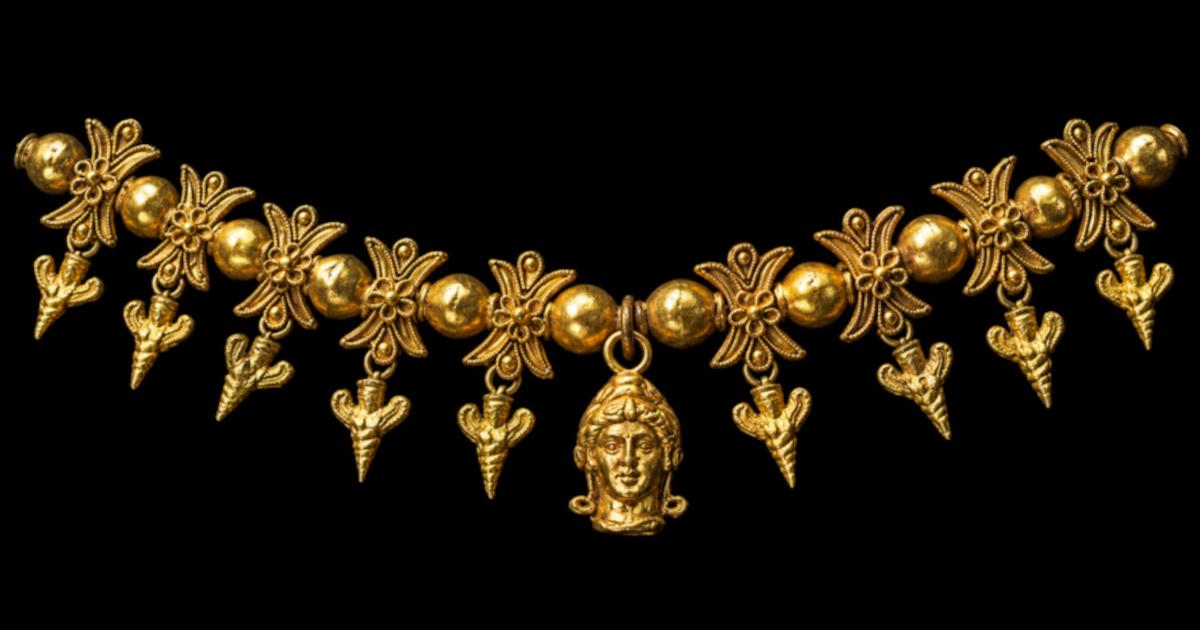

A 2300-year-old Scythian gold necklace found in a grave in southern Ukraine could depict a meeting of myths: in the center is an Amazon-like woman and she is surrounded by women depicted as bees. The necklace has been known to archaeologists for many years, but researcher Mikhail Treister has carefully analyzed the tiny pendants hanging from the necklace and came up with an original and precise explanation for their odd anatomy. If his hypothesis is proven right, the necklace will connect the Black Sea steppe with the Greek jewelry tradition and the cult of Artemis in Ephesus.
Scythian Gold Necklace from an Elite Tomb
The Oguz Kurgan, located close to Nyzhni Sirohozy, in the Kherson region was one of the monuments built for the Scythian elite in the 4th century BC. The North Tomb of this kurgan has a burial of a noble woman, called a Bosporan princess, but so far there is no evidence of her name or her marriage to a Scythian. The burial is dated around 350-340 BC or 330-320 BC, contemporaneous with other richly furnished Scythian burials. The necklace has 84 hollow gold beads as well as lotus-shaped dividers, floral rosettes, and numerous tiny figures arranged around a three-dimensional female head that measures just 0.9 cm in height.
- The Amazons: The Real Female Fighters Dispelling Myth & Legend
- Reconstruction of Golden Woman, the Ancient Scythian Princess of Kazakhstan
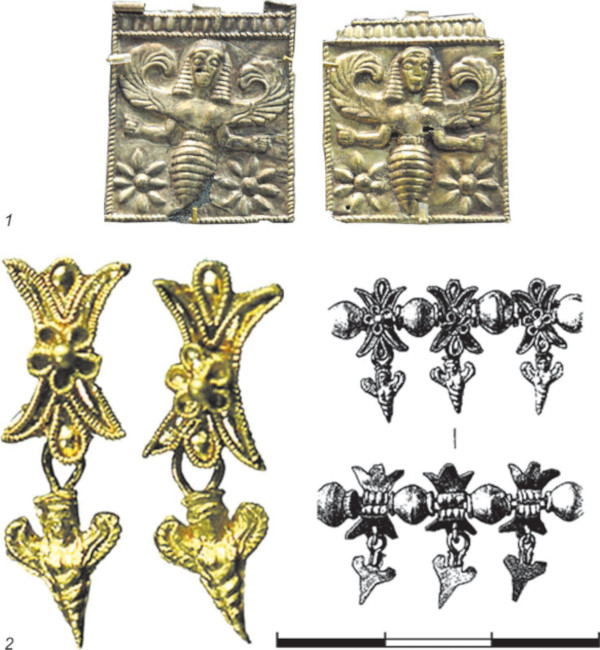
Electrum plaques from ancient Rhodes compared with pendants from the Oguz Kurgan, highlighting the bee-like bodies behind the new interpretation. (After M. Yu. Treister, Drevnosti Bospora 31 (2026))
Why the Pendants Look Like Bee-Women
Previous scholars regarded the 34 figures and two fragments as sirens or snake-legged goddesses. However, Treister zeroes in on their lower bodies, which connect into a conical ridge, with no visible legs, a structure he considers similar to an insect's abdomen. Thus, he describes the figures as bee-women and traces their ancestry to the ornaments from Rhodes and Melos, dated back to the 7th century BC, which makes them three centuries older than the gold Scythian necklace. Such a survival would fit the pattern of Greek and Scythian artists borrowing, preserving and recasting imagery across the Black Sea.
- Golden Sword Found in Young Scythian Warrior’s Grave
- Long Hidden Scythian Treasure Site Located at Ceremonial Spring in Poland
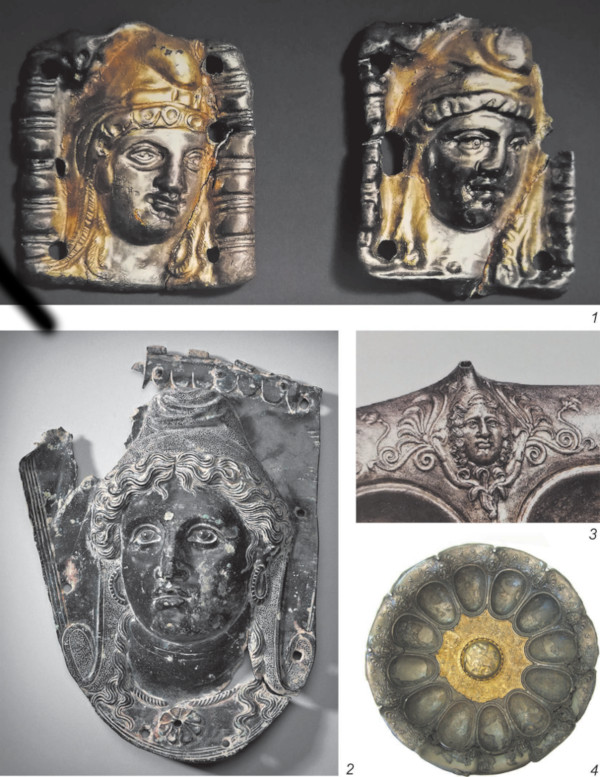
Comparative Amazon heads in ancient metalwork, including plaques, a cuirass element and a silver bowl. (After M. Yu. Treister, Drevnosti Bospora 31 (2026))
An Amazon at the Center
The central head adds another puzzle. Its folded headgear appears to be a Phrygian cap, an attribute Greek artists gave to Amazons. That does not prove the pendant portrays one, but it makes the reading clearer than the older description of an unidentified woman, especially when set beside Amazon figures on Greek vases and metalwork. Archaeological discoveries of armed Scythian women (and even a warrior girl) have shown why Greek stories of Amazons cannot be dismissed as fantasy, though myth and the reality are one and the same thing.
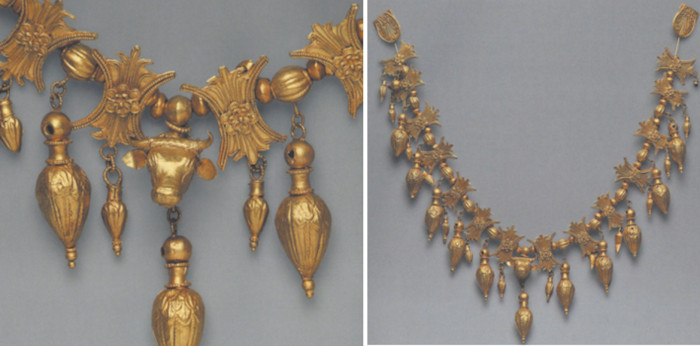
The Karagodeuashkh gold necklace, considered the closest compositional parallel to the Oguz example. (After M. Yu. Treister, Drevnosti Bospora 31 (2026))
Artemis Links the Images
Treister proposes that the representations are linked by the figure of Artemis of Ephesus. Amazons were featured in the narratives of Ephesus, while the bee is a typical symbol of Ephesian imagery. An earring from Nymphaion depicts Artemis, who is represented by a doe and a bee.
There is evidence to show that Ephesian Artemis was worshipped around the Cimmerian Bosporus in the fourth century BC, thus reinforcing Treister’s claims, and a necklace from Karagodeuashkh indicates that the item was made in a Bosporan workshop. Although the study states that the necklace is not proven to be the cult object, it explains how both the Amazon and the bee-women could share the same representation.
The necklace was made for a woman at the highest level of Scythian society, not as a Greek curiosity, making it an important piece. Its maker joined symbolism separated by geography and centuries into a personal object carrying status, protection or religious meaning. The result is less a solved riddle than a record of ideas travelling between Aegean sanctuaries, Bosporan workshops and the steppe.
Top image: Gold necklace from the North Tomb of the Oguz Kurgan, with its central female head, lotus dividers and suspended pendants. Source: After M. Yu. Treister, Drevnosti Bospora 31 (2026), via Arkeonews
By Gary Manners
References
Altuntaş, L. 9 September 2026. 2,300-Year-Old Gold Necklace from a Tomb in the Oguz Kurgan Reveals an Amazon and Mysterious Bee-Women. Available at: https://arkeonews.net/2300-year-old-gold-necklace-from-a-tomb-in-the-oguz-kurgan-reveals-an-amazon-and-mysterious-bee-women/
Grablevsky, A. May 2024. Gold, Griffins, and Greeks: Scythian Art and Cultural Interactions in the Black Sea. Available at: https://www.metmuseum.org/essays/scythian-art
Liesowska, A. 17 June 2020. Warrior Burial Is Scythian Amazon Girl No Older Than 13. Available at: /news-history-archaeology/scythian-amazon-girl-0013867
Treister, M. Yu. 2026. Gold Necklace with Pendants from the North Tomb of the Oguz Burial Mound. Drevnosti Bospora, Vol. 31, pp. 281–297. Available at: https://doi.org/10.25681/IARAS.2026.978-5-94375-501-9.281-297