

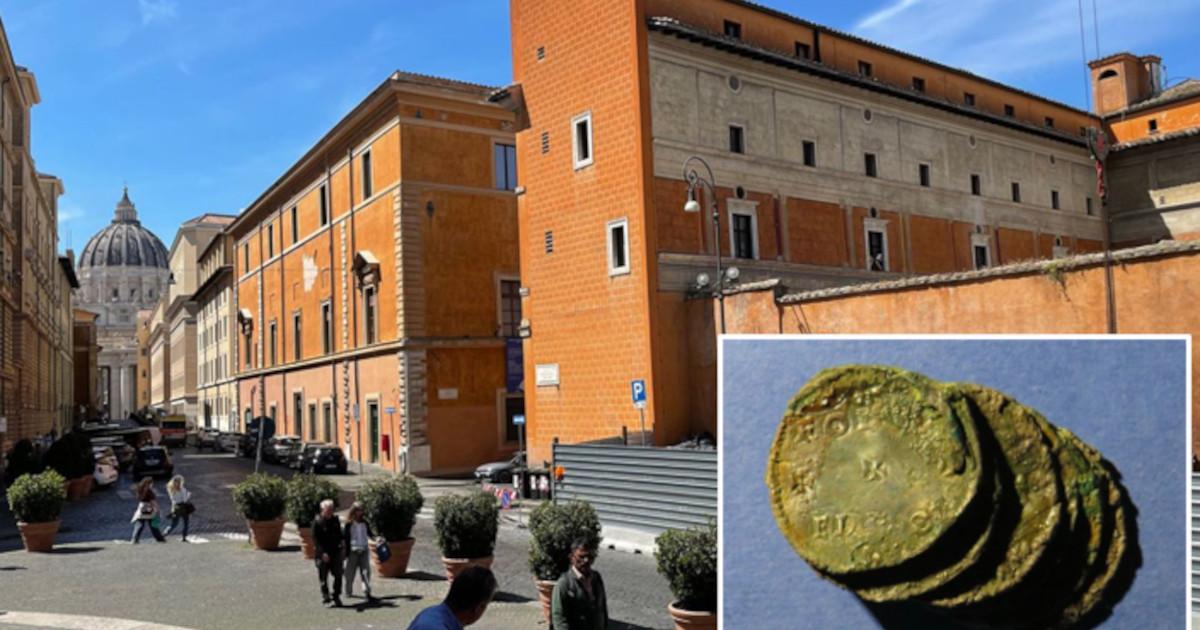

For roughly a thousand years, a fist-sized clump of silver pennies sat undisturbed in a rubbish pit near the Vatican, overlooked and unremarkable. Now those corroded coins have achieved something no medieval manuscript could: they have proved that a busy English neighborhood genuinely existed a short walk from St Peter's Basilica. Archaeologists excavating beneath the garden of the Palazzo della Rovere have identified twenty Anglo-Saxon coins — the first material evidence of the Schola Saxonum, the "English quarter" of early medieval Rome.
A Hoard of Everyday Money, Not Royal Treasure
This group is comprised of 1.5 ounces of silver coins. These coins were minted in England over about the forty years that spanned the kingship of Edward the Elder (899-924 AD) and the kingship of his son and grandson, Æthelstan (924-939 AD) and Eadred (946-955 AD). They have been traced back to mints across East Anglia, Kent, London and the West Midlands.
Fourteen coins were found together in two ancient rubbish pits containing several coins that had fused together after having been buried for more than a thousand years. The other coins were scattered in the nearby area, along with ten Roman and Italian 10th century coins, and other objects that show evidence of leather working, bone working and metal working across an area of about 3,000 square meters which is about half of a soccer pitch.
What distinguishes it from the typical buried hoard is the fact that there are no signs of a treasury and that the silver coins were not melted.
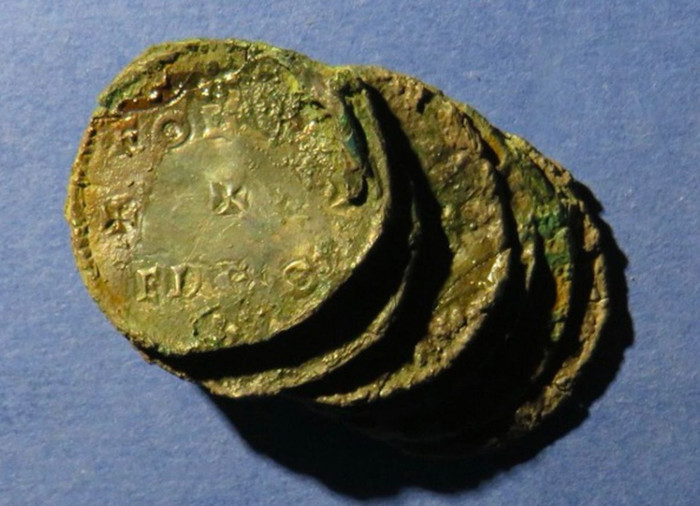
Two fused groups of Anglo-Saxon pennies recovered from the excavations of the Palazzo della Rovere (Cecilia de Leone / University of Cambridge) University of Cambridge
A Working Community, Not Just a Pilgrim Hostel
"The coins aren't pretty but they have a lot to say," said Rory Naismith, Professor of Early Medieval English History at Cambridge.
"More Anglo-Saxon coins from this period have now been found in Rome than papal coins. This sounds bizarre, but it's telling us that a very large amount of money was flowing in from England at this time."
His co-author Francesca Tinti, Professor of Medieval History at the University of the Basque Country, described the moment as long-awaited.
"Before this big discovery, we never had any material remains of the English quarter in Rome," she said. "We've been hoping this moment might come for most of our careers."
The individual halfpenny is very informative. For instance, small coins are known to show evidence of trade taking place in locations where many low-value transactions occurred, which perfectly matches the shops and workshops discovered during the excavations. According to Naismith, there might have been hundreds of people residing here in what he refers to as "a miniature Anglo-Saxon town" on the banks of the River Tiber. This would entail a community of Anglo-Saxon craftsmen and traders who were producing goods and trading them, not just resting between their visits to the city's holy places.
- King Offa of Mercia: A Ruthless Anglo-Saxon Hellbent on Conquest
- Why was Alfred the Great One of Only Two Kings Named 'the Great'?
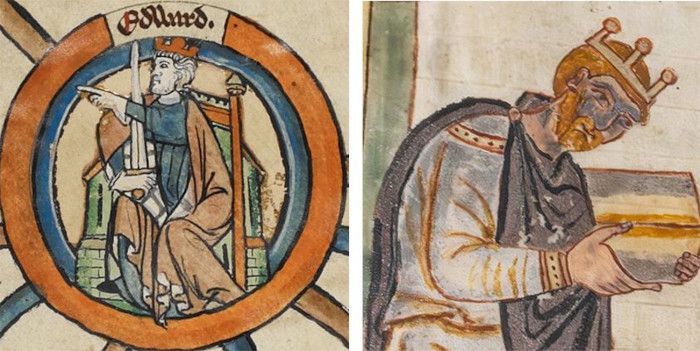
Portraits of Edward the Elder (British Library) and his son Æthelstan (The Parker Library, Corpus Christi College, Cambridge), whose coinages appear among the Roman finds (British Library / Parker Library) University of Cambridge
Special Treatment from the Pope?
One of the most curious consequences concerns money. Papal documents of that period only refer to the papal coin, while in other sources, we read of foreign visitors preparing to exchange their currencies on their way to Rome. For example, a ninth-century Frankish abbot expressed concern over the need to change currency before his trip.
However, English coins are found across working and domestic sites, with no signs of conversion into local currency. Naismith and Tinti argue that the English enjoyed advantages but do not show any proof of obtaining a formal exemption – except for Asser, Alfred the Great's biographer, who informs that Pope Marinus I exempted Schola Saxonum from "every tribute and toll". Although it does not prove the currency exemption, the subsequent issue of coins by Alfred's descendants cannot be disregarded.
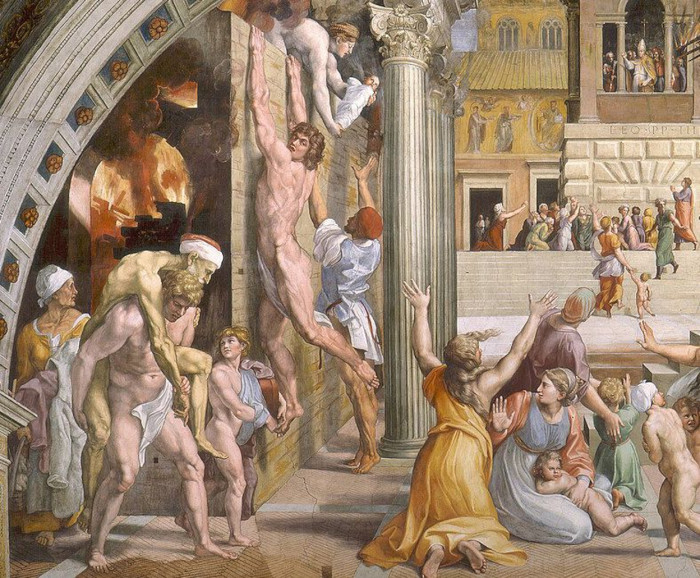
Detail of Raphael's "The Fire in the Borgo" (1514), depicting the blaze that swept the Borgo, the district that contained Rome's English quarter (Vatican Museums / CC BY 2.0)
A Relationship That Reached Far Beyond Pilgrimage
The English presence beside St Peter's was no accident. Pope Gregory I sent a mission to the English in the late sixth century, and devotion to Rome deepened from there. Offa of Mercia instituted an annual payment of 365 gold pieces to keep candles burning in Roman churches in the late eighth century, and Alfred the Great sent regular alms. By the 10th century, the practice that became Peter's Pence linked English households directly to Rome, while King Canute travelled to the city in 1027 to negotiate benefits for pilgrims.
Written sources had long placed the English in this quarter, and even recorded that Burgred, the exiled king of Mercia, was buried in its church after the Vikings drove him from England. What was missing was physical proof of daily life — the workshops, the customers, the coins in circulation. That gap has now closed.
Medieval Rome still remembers the community in its street names: the Lungotevere in Sassia takes its title from the Saxons, and the Santo Spirito in Sassia hospital continues a charitable tradition once offered to English visitors. The new finds show that this "Little England" was not a footnote of royal diplomacy, but a working neighborhood where people lived, traded and spent their own money for generations.
Top image: The Palazzo della Rovere in Rome, with the dome of St Peter's Basilica visible in the background, close to where the Anglo-Saxon coins were excavated. Source: University of Cambridge
References
Archaeology News Online Magazine. 2026. Anglo-Saxon coins found near the Vatican point to a thriving English community in early medieval Rome. Available at: https://archaeologymag.com/2026/10/anglo-saxon-coins-found-near-the-vatican/
Arkeonews. 2026. Anglo-Saxon Coins Found Near the Vatican Reveal Rome's Lost 'Little England'. Available at: https://arkeonews.net/anglo-saxon-coins-found-near-the-vatican-reveal-romes-lost-little-england/
The Times. 2026. Anglo-Saxons got special treatment in Rome's 'English quarter'. Available at: https://www.thetimes.com/uk/history/article/anglo-saxons-coins-rome-english-archaeology-rv2vt3qzt
University of Cambridge. 2026. When in Rome: The first material evidence of the Schola Saxonum suggests Anglo-Saxon expats received special treatment in Rome's "Little England". Available at: https://www.cam.ac.uk/stories/anglo-saxon-expats-in-romes-little-england





















