
For centuries, Sardinia's colossal stone towers stood over the Mediterranean landscape like silent markers of a bygone era. Now, a groundbreaking interdisciplinary study has revealed that these massive Bronze Age monuments, known as nuraghi, were not simply abandoned when societal changes swept the island. Instead, they were dramatically transformed into sacred centers of ritual and worship during the Early Iron Age.
A new study published in the journal Open Archaeology, led by Dr. Silvia Amicone of the University of Tübingen in collaboration with the local heritage authority, the Soprintendenza Archeologia, Belle Arti e Paesaggio, has unearthed compelling evidence of this spiritual evolution. Focusing on the complex site of Nuraghe Barru in south-central Sardinia, the team discovered a sealed well-cistern and a trove of votive offerings, including a spectacular 94-centimeter bronze sword. These findings demonstrate that ancient towers remained central to the island's spiritual and social life long after their original construction.
The Enigma of the "Island of Towers"
Sardinia is famously known as the "island of towers," home to nearly 7,000 surviving nuraghi built by the mysterious Nuragic civilization between 1700 and 1100 BC. These impressive corbelled stone domes have long sparked debate among archaeologists, with theories suggesting they served as defensive fortresses, elite residences, or territorial markers. However, during the transition to the Early Iron Age (circa 1200 to 800 BC), Sardinian society underwent a massive transformation, marked by the rise of dedicated sanctuaries and sacred wells across the island.
- 5 Must See Megaliths of the Mysterious Nuragic People
- The Mysterious Nuragic Civilization of Sardinia
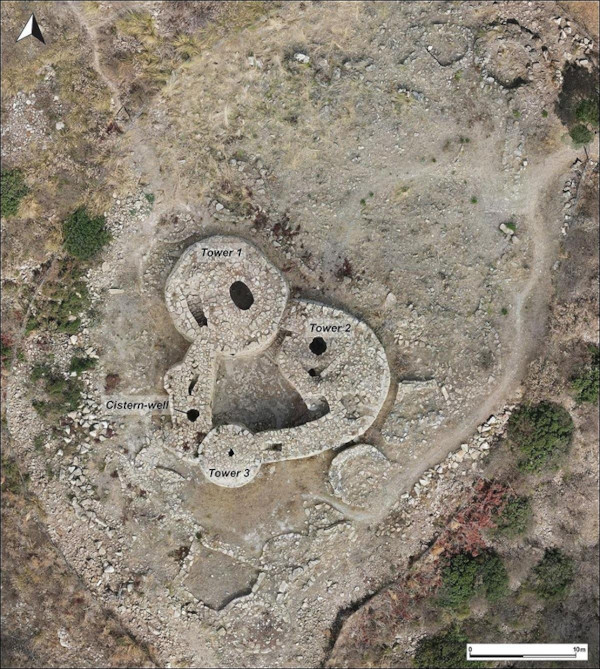
The Nuragic complex of Barru with the location of the cistern-well. The multi-towered nuraghe is surrounded by predominantly circular huts. (Amir Ahmadpour and Lars Heinze/University of Tübingen)
This societal shift led researchers to wonder whether the ancient towers had lost their significance in the face of new religious practices. The excavations at Nuraghe Barru provide a resounding answer to the contrary, showing that certain towers were repurposed as active temples where local communities negotiated identity, memory, and power. As Dr. Gianfranca Salis, scientific director of the ongoing excavations for the Soprintendenza, put it: "It was an active center during the Iron Age, where ritual practices and social identities were expressed in a period of transformation."
A Sealed Well and Sacred Sacrifices
The most dramatic discoveries occurred within the western wall of the Nuraghe Barru complex, where archaeologists under the direction of Dr. Chiara Pilo uncovered a carefully sealed cistern-well. At the bottom of this deep structure, the team found a deliberate deposit of smashed ceremonial pottery, including a rare four-handled vessel, a miniature amphora, and several askoid jugs used for pouring liquids. Crucially, these ritual vessels were accompanied by animal and human skeletal remains.
Once these offerings were deposited, the well was formally closed with heavy limestone slabs. This sequence of events strongly suggests a structured, symbolic ritual rather than a casual disposal of waste. Dr. Pilo stated that the finds point "rather to an episode of ritual actions than to randomly discarded objects," adding that "the building itself was also changed by this."
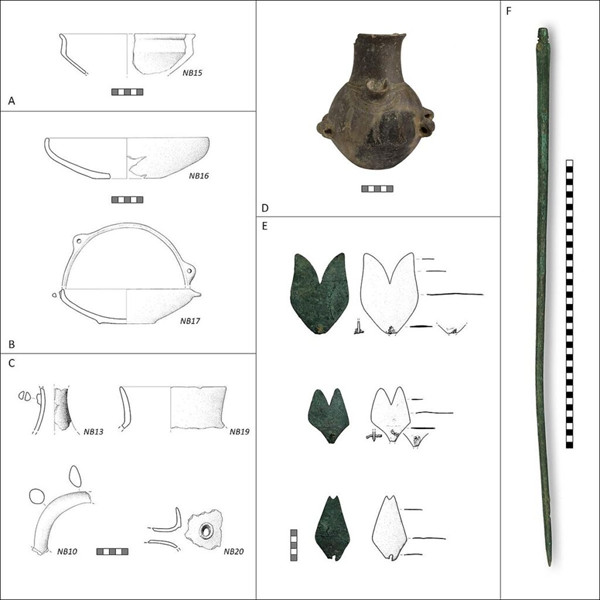
Ceramic and metal artifacts recovered from the site, including the rare four-handled vessel and bronze offerings. (University of Tübingen)
Near the sealed well, along a staircase leading to the upper level of the tower, researchers discovered further sacred offerings. These included a beautifully preserved 94-centimeter bronze sword, three razor-like bronze blades, and a copper conglomerate. Following the deposition of these precious metal objects, the staircase was blocked with stone, permanently sealing access to the upper floor and physically transforming the ancient monument into a sealed repository of sacred memory.
- Santu Antine, Sardinia: A Megalithic House Built for a King?
- Master Architects of Sardinia: The Sacred Well of Santa Cristina
Votive Weapons and Island-Wide Networks
To understand the origin of these artifacts, the international team combined traditional archaeology with advanced material science. Portable X-ray fluorescence (pXRF) analysis of the bronze sword revealed it was made of a copper-rich, low-tin alloy. This specific composition is characteristic of Nuragic votive swords, which were never intended for actual combat but were instead crafted purely for symbolic, ceremonial purposes. Notably, it is only the second intact votive sword ever found inside a nuraghe, making it an exceptionally rare find.
| Artifact Type | Material Composition | Intended Function | Provenance |
| Votive Sword | Copper-rich, low-tin bronze | Symbolic / Ritual offering | Local manufacture |
| Razor-like Blades | Copper-rich bronze alloy | Ceremonial / Continent-style | Local manufacture |
| Four-Handed Vessel | Fine clay with non-local minerals | Ceremonial liquid serving | Non-local (Sardinia) |
| Miniature Amphora | Clay with non-local minerals | Symbolic dedication | Non-local (Sardinia) |
Furthermore, petrographic analysis of the pottery from the sealed well revealed that the vast majority of the vessels were not made from local clay. Instead, they were transported from various geological regions across Sardinia, some from more than 40 kilometers away. This reveals that Nuraghe Barru was not an isolated rural outpost, but rather a major hub in an extensive, island-wide network where people, goods, and religious ideas circulated. The razor-like bronze blades also bear resemblance to objects found on the Italian mainland during the Early Iron Age, hinting at Mediterranean Bronze Age exchange networks that stretched far beyond Sardinia's shores.
Ultimately, the discoveries at Nuraghe Barru demonstrate that as Sardinia transitioned into the Iron Age, communities did not simply discard their ancestral heritage. Instead, they actively reused and reinterpreted these monumental stone towers, weaving them into a new spiritual tapestry that celebrated their past while navigating the challenges of a rapidly changing Mediterranean world. As Professor Karla Pollmann, Rector of the University of Tübingen, observed, the study "shows once again that interdisciplinary research approaches provide a wealth of complementary information that allows us to create impressively comprehensive pictures of past worlds."
The Nuragic civilization left behind a legacy that continues to surprise researchers. The evidence from Nuraghe Barru adds to a growing body of discoveries — from the Giants of Mont'e Prama to the bronze figurines found across the island — that paint a picture of a sophisticated, spiritually rich society whose story is still being written.
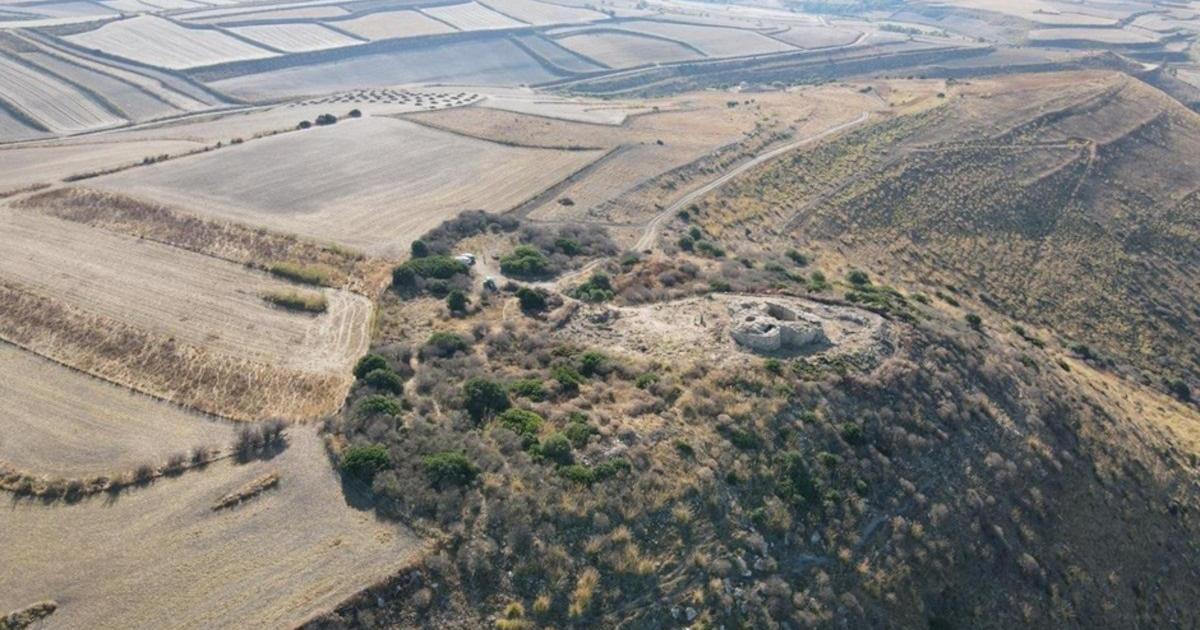
Top image: Aerial view of the Nuraghe Barru site in central-southern Sardinia. Source: Lars Heinze/University of Tuebingen
By Gary Manners
References
Amicone, S., V. Tiezzi, M. Broisch-Höhner, K. P. Freund, L. Heinze, L. F. Morandi, G. Salis, and C. Pilo. 2026. Ritual and Connectivity in Nuragic Sardinia: An Interdisciplinary Study of Ceramics and Metalwork from Nuraghe Barru. Open Archaeology, vol. 12, no. 1. Available at: /ancient-technology/baghdad-battery-0078
Arkeonews. 2026. A Sealed Well and Bronze Sword Reveal the Iron Age Transformation of a 3200-Year-Old Sardinian Tower. Available at: https://arkeonews.net/a-sealed-well-and-bronze-sword-reveal-the-iron-age-transformation-of-a-3200-year-old-sardinian-tower/
Eberhard Karls Universität Tübingen. 2026. Sardinian Bronze Age towers repurposed as sacred sites in the Iron Age. Available at: https://idw-online.de/en/news870335
La Brújula Verde. 2026. Findings at Nuraghe Barru Reveal That Bronze Age Towers in Sardinia Functioned as Cult Centers in the Iron Age. Available at: https://www.labrujulaverde.com/en/2026/05/findings-at-nuraghe-barru-reveal-that-bronze-age-towers-in-sardinia-functioned-as-cult-centers-in-the-iron-age/