
Researchers have confirmed that stone from Henry VIII's Sandown Castle, which had been lost from history, was used in the Victorian extension constructed at Dover Castle. Dr. Christopher Moore has developed an argument for the reuse of masonry from the castle during construction of the wing added to Constable’s Gate in 1883-1884 through the use of both architectural analysis and archival research.
Sandown Castle, located on the Kent coast, was one of the three 'castles of the Downs,' which were built by King Henry VIII in 1539-40, as a part of the Device Forts Program which was designed to provide protection from the threat of invasion by France and Imperial powers. Deal Castle and Walmer Castle were also part of that program and have remained relatively intact to the present day; however, Sandown Castle was unable to withstand the combination of the elements and the erosion of the area surrounding it. By the mid-19th century, Sandown Castle had reached such a poor state of repair due to coastal erosion that the castle was almost completely demolished, and its remaining stones were sold off for building materials.
Dr. Moore discovered a report from 1883 that documents the transportation of stones from Sandown to Dover. This report supports the conclusion that the stones were being used specifically for the construction of the extension to Constable's Gate. In fact, evidence found in the structure still standing at Dover corresponds with the account in the 1883 report and supports the conclusion that Tudor stone was used in the 19th-century structure.

Engraving of the castle in 1853. (John Leech (1817-1864). (Public domain)
Parts of a Lost Fortress Live On
“This sheds light on how Dover Castle’s 19th-century works incorporated masonry from an earlier Tudor fortress,” Dr Moore said.
“Sandown Castle is best known as a casualty of coastal erosion, but the documentary trail and the surviving fabric show that parts of it lived on at Dover Castle and at other sites across East Kent.”
Further research has identified additional locations where Sandown stone was reused, including Eastry Union Chapel, works at Walmer Castle, and the abutment of Deal’s second pier. These fragments demonstrate how elements of the lost fort remain embedded in everyday buildings and structures that people pass without realizing their Tudor origins.
The discovery offers a tangible link to a fortress that once stood as a key element of England’s coastal defenses. When visitors stand beside the Victorian extension at Constable’s Gate, they are in the presence of stone that once formed part of Henry VIII’s coastal stronghold before the sea claimed most of it.
- Traces of Henry VIII’s Lost Tudor Palace Found Beneath Chelmsford School
- Meet the Tudors - A Brief(ish) History of the Tudor Dynasty
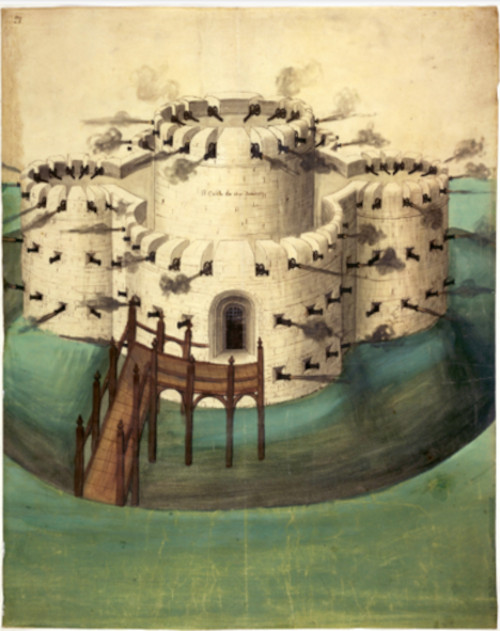
A 1539 early design for either Sandown or nearby Walmer Castle. (Public Domain)
Preserving Hidden Tudor Heritage
Dr Moore co-founded The Henrician Archaeological Research Foundation (HARF) with Dr Manolo Guerci. The charity focuses on uncovering and preserving lost Early Modern architecture, particularly sites eroded by the sea or demolished. Dr Guerci praised the work as an example of academic research that advances knowledge while enhancing public understanding of a well-known site.
“When you stand beside the Victorian extension at Constable’s Gate and realize that parts of its masonry came from Sandown Castle – a fort Henry VIII built and the sea later claimed – it sends chills down your spine,” Dr Moore said. “It’s a tangible connection across centuries of history.”
The research, supported by the University of Kent and carried out with the cooperation of English Heritage, invites visitors to Dover Castle to look more closely at its later buildings. What appears purely Victorian may contain hidden layers of Tudor history, quietly surviving in plain sight.
The history of Sandown Castle demonstrates that Coastal Defenses are susceptible to environmental damage but can and have been recycled as building materials for later use. Although the majority of the structure has been lost due to erosion from the Atlantic Ocean or was destroyed by land movements, there remains a large quantity of stone from the castle that forms an integral part of the built environment of Kent today.
The find adds a new chapter to the long history of Dover Castle and keeps the memory of Sandown alive through the very fabric of later buildings.
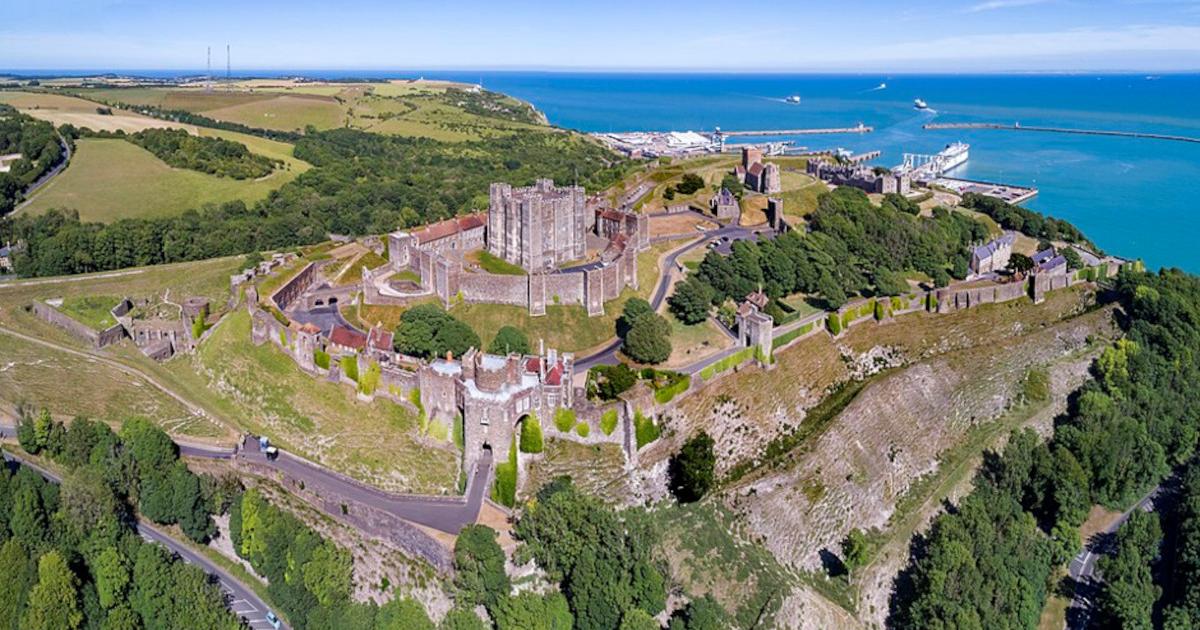
Top image: Ariel view of Dover Castle, including areas around Constable’s Gate where the Victorian extension incorporates reused stone. Source: Chensiyuan/CC BY-SA 4.0
By Gary Manners
References
Moore, C. 2026. Research findings on Sandown Castle masonry at Dover Castle. University of Kent. Available at: https://www.kent.ac.uk/news/creativity-culture-and-heritage/38330/hidden-in-plain-sight-new-evidence-links-henry-viiis-lost-castle-to-dover-castle
Historic England. Sandown Castle, Deal listing. Available at: https://historicengland.org.uk/listing/the-list/list-entry/1005147
English Heritage. History of Dover Castle. Available at: https://www.english-heritage.org.uk/visit/places/dover-castle/history-and-stories/