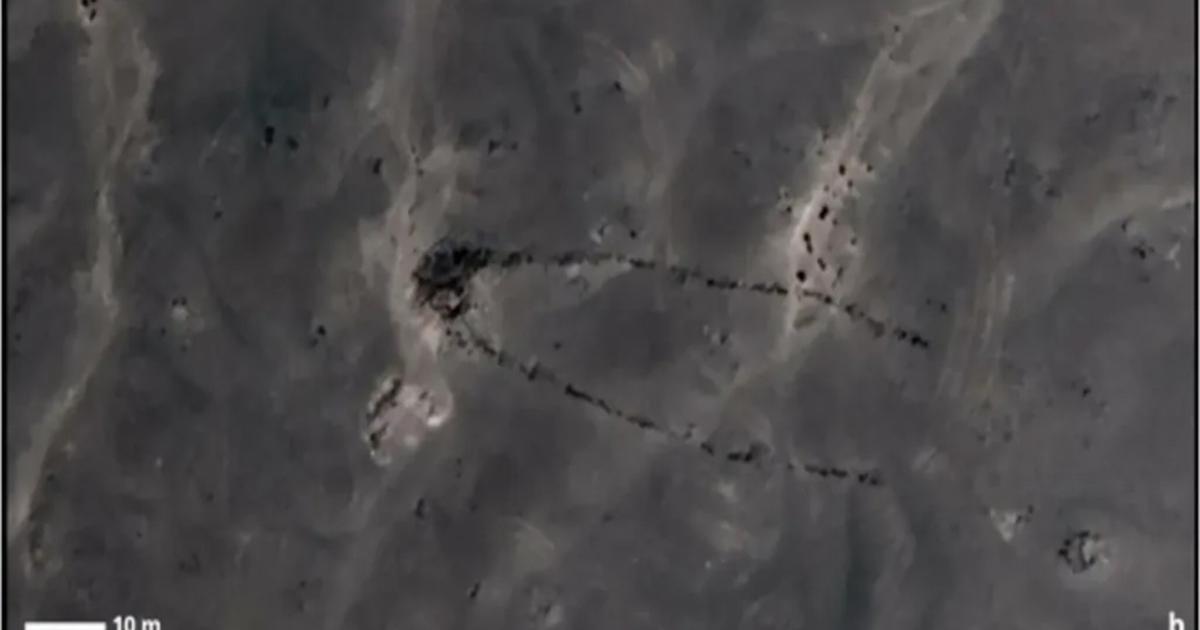

An antennae tumulus stretching 54.5 meters across Western Sahara has yielded something archaeologists have long lacked: a securely dated burial. A team excavating at Wadi Lawash el Telli found a single individual beneath the stones and placed the interment between 4,417 and 4,100 calibrated years before present, as reported by Arkeonews. The result finally anchors one of the Sahara’s most distinctive funerary monuments in time—and opens a closer look at who built it and why.
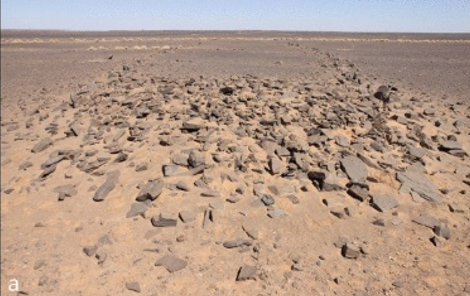
The funerary monument, with tumulus in the foreground and ‘antennae’. (Soler et al., African Archaeological Review)
A Strange Monument in a Harsh Landscape
The structure combines an oval mound with two long lines of limestone slabs extending eastward like antennae. Its mound measures about 12.5 by 10 meters and rises no more than three meters, while the full monument reaches 54.5 meters across the gravel plain. The builders used local Devonian limestone without mortar, and most of the blocks were small enough to be moved by one person.
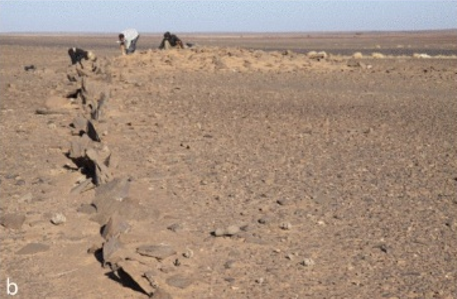
Close-up of the southern rock antenna. (Soler et al., African Archaeological Review)
The antennae follow an orientation of roughly 102 degrees from geographic north. Similar alignments have encouraged discussion of possible astronomical intentions, but the researchers stress that no celestial function has been demonstrated at Lawash el Telli. In a region where Saharan megalithic traditions remain difficult to date, the excavated burial provides firmer evidence than shape or orientation alone.
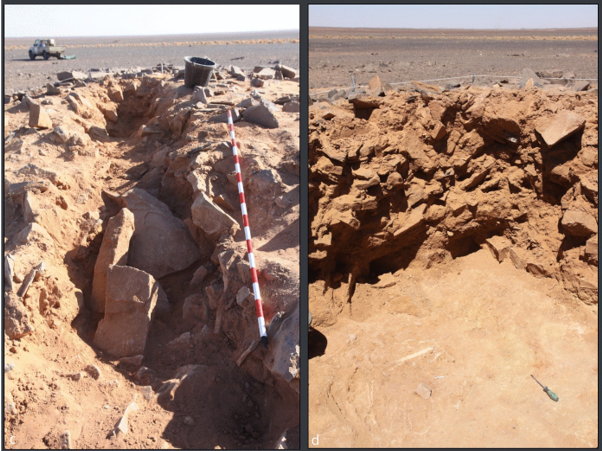
Excavation stages of the Lawash el Telli funerary monument. (Soler et al., African Archaeological Review)
Burial Beneath the Stones
The team excavated only part of the mound, leaving much of the monument intact. Beneath an outer scatter of slabs, they found a second structure made from large limestone pieces that protected the human remains. There were no signs of later disturbance or reuse, giving the researchers an unusually clear view of the original burial.
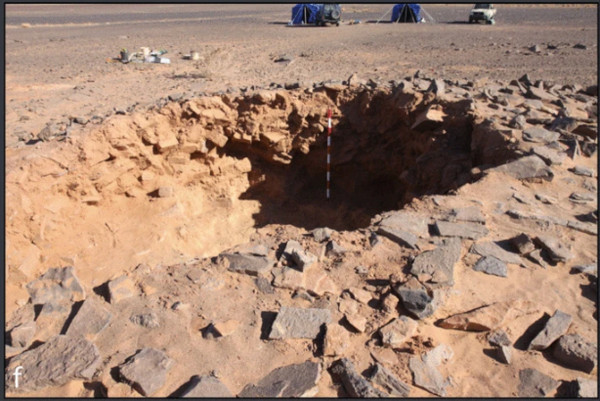
The excavated inner burial space. (Soler et al., African Archaeological Review)
The individual had been laid on their back along a north–south axis, with the head facing south and the legs folded to the west. Dental wear suggests an age of about 25 to 35 years, although the poor condition of the skeleton prevented a reliable determination of sex. The only objects were four annular beads made from ostrich eggshell, a modest assemblage that resembles the personal ornaments found elsewhere in Atlantic Sahara prehistory.
The finds also fit into a wider story of changing mortuary practices. Just as prehistoric barrows elsewhere turned graves into visible landmarks, communities across the Sahara invested in stone monuments that marked the dead within a difficult landscape. Other Sahara burial discoveries show that monument building was not limited to one region or one funerary tradition.
- Hundreds of 4,000-Year-Old Mass Graves Found Hidden in the Sahara Desert
- Neolithic Burial Mound Uncovered Near Stonehenge
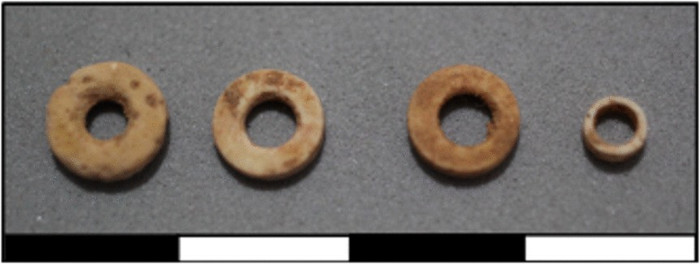
Four annular beads made from ostrich eggshell were the only artifacts recovered from the burial. (Soler et al., African Archaeological Review)
A New Chronology for Saharan Tombs
The study by Joaquim Soler and colleagues, published in African Archaeological Review, provides the first absolute dates for an antennae tumulus in the Atlantic Sahara. Two radiocarbon results from the individual’s bones produced a consistent calibrated range of 4,417 to 4,100 years before present. That places the monument at the end of the Late Neolithic sequence of Western Saharan stone funerary constructions, overlapping with crescent-shaped tombs.
The dating matters because stone monuments are widespread across the region, yet human remains are often badly preserved and grave goods are scarce. It gives archaeologists a reference point for comparing other tombs, including the stone circles and burial mounds of Africa. It also shows why apparently simple structures can carry important historical information when excavation, anthropology and scientific dating are combined.
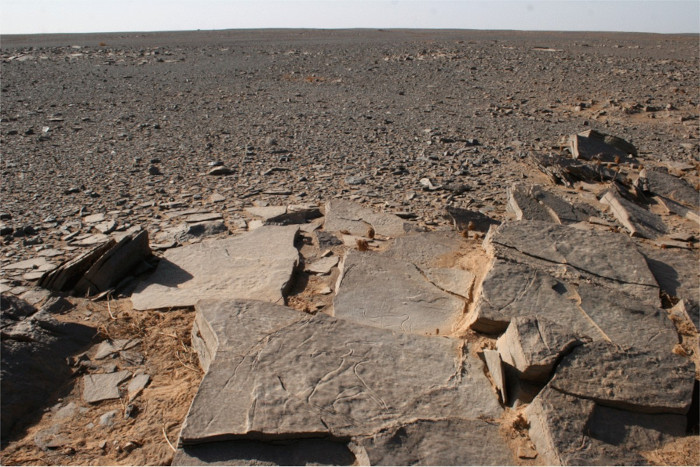
Engraved slab from the Sluguilla Lawash rock-art complex near the monument, depicting a bovine and an ostrich. (Soler et al., African Archaeological Review)
Less than a kilometer away, the Sluguilla Lawash complex contains about 2,068 engraved figures spread along 27 kilometers of wadi. The researchers do not claim that the rock art and the antennae tumulus were made by the same people, but their proximity makes the landscape especially significant. For now, the 54-meter antennae tumulus stands as a rare, dated example of how Late Neolithic communities in the Western Sahara built a lasting place for the dead.
Top image: Aerial view of the excavated monument (tumulus, antennae and satellite stone mound). Source: Soler et al., African Archaeological Review
By Gary Manners
References
Buyukyildirim, O. 2026. Mysterious 54-Meter-Long Stone Monument Discovered in Western Sahara Reveals 4,400-Year-Old Burial. Available at: https://arkeonews.net/mysterious-54-meter-long-stone-monument-discovered-in-western-sahara-reveals-4400-year-old-burial/
Soler, J., Ventura, H., Rufí, I., Coromina, N., Revelles, J., Saña, M., Moll, L. and Soler, N. 2026. Chronology and Funerary Practices Associated with Antennae Tumuli in Western Sahara. Available at: https://doi.org/10.1007/s10437-026-09666-8