

A sacred ibis (Threskiornis aethiopicus) during the high-alpha phase of landing. (photograph by Stefano Gozzoli, reproduced with permission/Time & Mind)
The finding published in Time and Mind indicates the importance of colors and light over shapes. Scholars faced the problem of answering the question regarding why the two animals have been chosen together. While the ibis, with its crescent-shaped beak and striking black-and-white feathers, seemed a fitting symbol for a moon god, the baboon's connection was far less obvious. Adding to the enigma, the hamadryas baboon was not native to Egypt, yet hundreds of baboon mummies have been found in temples and tombs, indicating a massive effort to import and revere them.
- Sacred Egyptian Baboons Suffered in Captivity, Finds Study
- Holy Bin Chickens: Ancient Egyptians Tamed Wild Ibis for Sacrifice
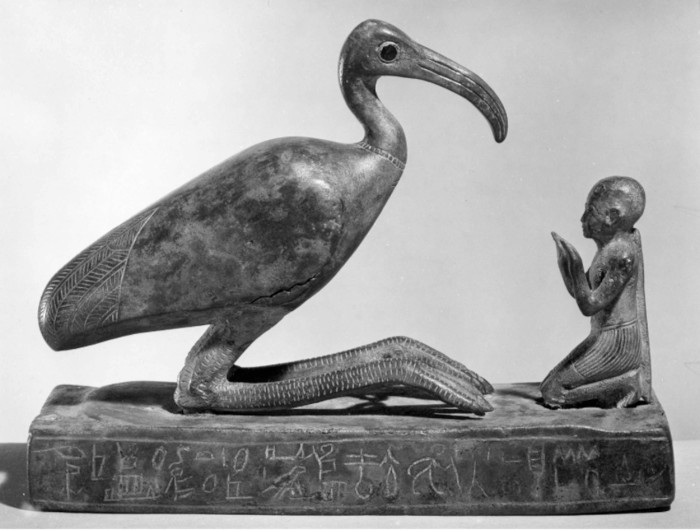
Statue of Thoth-ibis and devotee on a base inscribed for Padihorsiese. (MET/Public Domain)
The Science of Spectral Reflection
To put their hypothesis to the test, a team of researchers from the University of St Andrews and Dartmouth University employed spectroscopy. This technique measures the specific frequencies of light waves reflected by an object, providing an objective analysis that avoids the cultural biases inherent in human color perception.
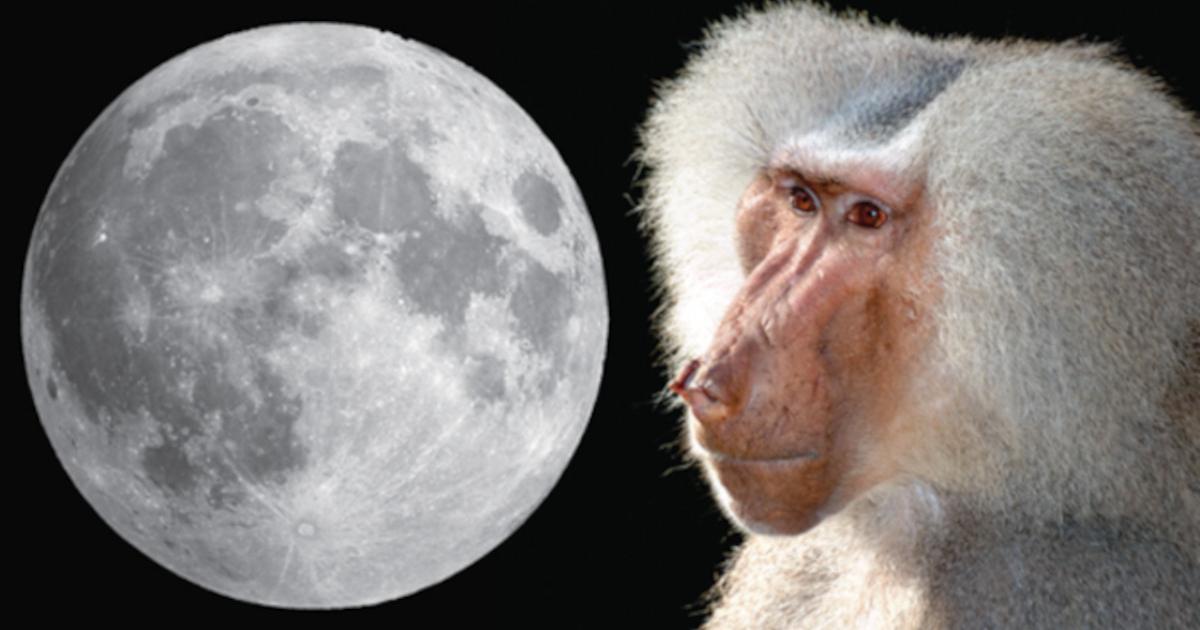
The researchers analyzed twelve baboon specimens housed at the American Museum of Natural History in New York. They compared the irradiance spectrum of the baboons' fur, as well as the feathers of the sacred ibis, with the spectrum of moonlight. The results were striking: the silver-gray hair of the hamadryas baboon and the white plumage of the ibis matched the spectral profile of moonlight almost exactly.
Interestingly, when they tested the olive baboon (another species known to the ancient Egyptians) it did not produce the same moonlight-like reflection. This suggests a highly specific and intentional selection process by the ancient priests.
Linguistic Clues and Lunar Luminosity
The findings align perfectly with recent linguistic research regarding Thoth's name. Scholars have traced the origins of the Egyptian name for Thoth to ancient North African terms meaning "bright" or "white thing."
Lead author Catherine Hobaiter, a primatologist at the University of St Andrews, emphasized that this choice was far from random.
"Ancient Egyptians were familiar with at least three species of ibis, but they chose the white one to embody Thoth," she noted. "They were also familiar with two species of baboon, along with vervet monkeys and patas monkeys, but again they chose the silver-white species."
The hamadryas baboon exhibits extreme sexual dimorphism, with mature males developing prominent, highly reflective silver-white capes of fur around their shoulders and cheeks. This extreme brightness, the researchers suggest, explains why this specific species and sex were chosen to manifest the lunar deity.
- Baboon Skull Could Lead to the Long Lost Land of Punt
- Anubis, Egyptian God of the Dead and the Underworld
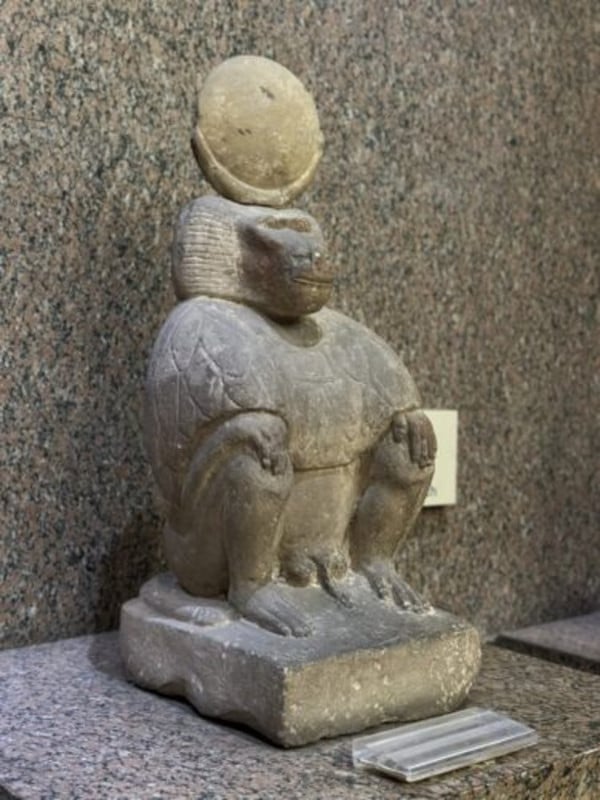
Statue of Thoth as baboon. (Catherine Hobaiter/University of St Andrews)
A Unique Perspective on Nature
This study offers a rare glimpse into the minds of the ancient Egyptians and their profound connection to the natural world. While other deities were often associated with animals possessing obvious symbolic traits - such as the jackal for Anubis, reflecting its presence near burial grounds, or the cow for Hathor, symbolizing motherhood - Thoth's association with two entirely different animals was unique.
Furthermore, the Egyptian veneration of baboons stands in stark contrast to much of the rest of Africa, where the primates are frequently viewed as pests and crop raiders. The fact that the Egyptians went to such lengths to import these animals from regions like the Land of Punt underscores the deep religious significance attributed to their moonlight-colored fur.
Through careful observation of their environment, the ancient Egyptians recognized a shared luminous quality in the sacred ibis and the hamadryas baboon, elevating them both to the status of divine messengers of the moon god.
Top image: Photographs of (a) the lunar nearside and (b) an adult male sacred baboon, Papio hamadryas. Source: Photograph by André Karwath, and reproduced under a CC BY-SA 2.5 license/Time & Mind
By Gary Manners
References
Dominy, N. J., et al. 2026. Moonlight and the apotheosis of sacred baboons. Time and Mind. Taylor & Francis. Available at: https://www.tandfonline.com/doi/full/10.1080/1751696X.2026.2696260
IFLScience. 2026. Why Is The Egyptian God Thoth Depicted As An Ibis And A Baboon? The Answer Could Lie In The Brightness Of The Moon. Available at: https://www.iflscience.com/why-is-the-egyptian-god-thoth-depicted-as-an-ibis-and-a-baboon-the-answer-to-the-baboonification-could-lie-in-the-brightness-of-the-moon-84163
University of St Andrews News. 2026. Moon baboon: New insight into the mind of ancient Egyptians. University of St Andrews. Available at: Moon Baboon – new insight into the mind of ancient Egyptians | University of St Andrews news