A recent excavation near the village of Borimechkovo in Bulgaria’s Pazardzhik region unearthed the remains of a Late Roman village that was suddenly consumed by fire in the mid-fourth century AD and subsequently abandoned. The unexpected discovery offers an extraordinary glimpse into a community that was frozen in time by disaster more than 1,600 years ago.
The site was uncovered during a precautionary excavation ahead of the construction of a gas pipeline. These digs exposed a stunningly well-preserved collection of artifacts, buildings, and evidence of daily life as it was experienced by members of the Roman/Bulgarian community residing in the Roman province of Thrace. The fire that ravaged the settlement left behind collapsed mudbrick walls and layers of ash, which actually helped preserve the scene of destruction as it was at the moment of its abandonment.
A Catastrophic Fire and a Vanished Settlement
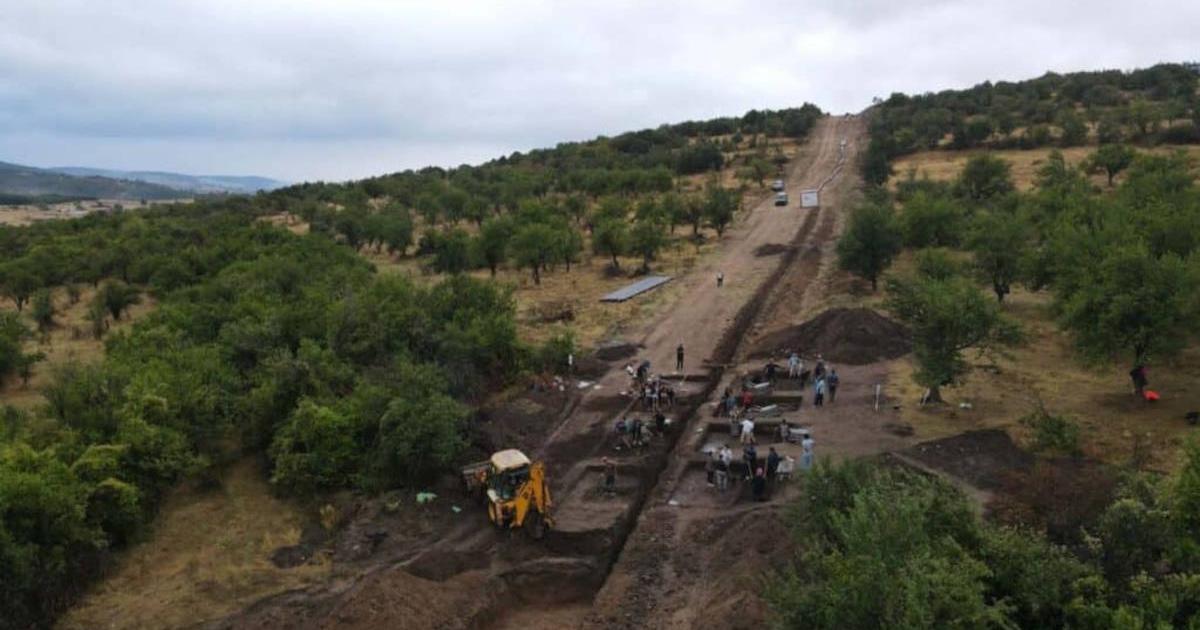
The excavation spanned approximately 47,000 square feet (4,400 square meters) on an elevated terrace west of Borimechkovo, close to a small stream. This strategic location in the western Sredna Gora mountain range, which is rich in natural copper deposits, would have made it an attractive site for a settlement focused on mining and agriculture (typical preoccupations of the Roman Empire in the fourth century).
- The Mysterious Thracians: Unveiling Their Unique Culture and Legacy
- The Rise and Fall of the Mighty Bulgars and the First Bulgarian Empire
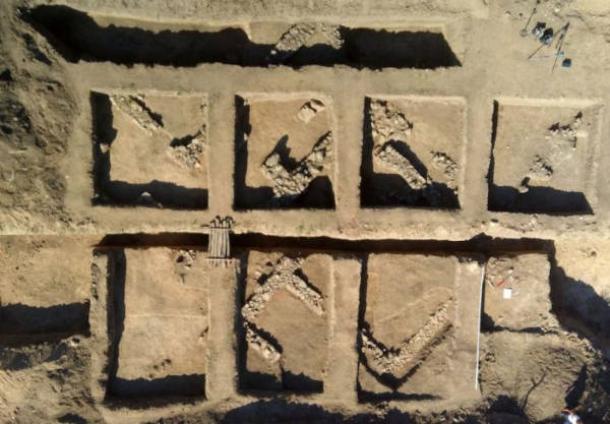
Overhead view of excavation site of the two buildings unearthed at the Bulgarian Roman village. (Sirma Alexandrova/ Bulgarian Journal of Archaeology).
According to its discoverers, the village belonged to the late Roman era and met its abrupt end in that same time frame.
“Analysis revealed a single-layer settlement dating from the late Roman period, ending abruptly with a fire dated no earlier than 347 AD based on coin evidence,” wrote lead archaeologist Sirma Alexandrova from the Bulgarian Academy of Sciences, in an article about her team’s finds published in the Bulgarian Journal of Archaeology.
The remains of residential structures were uncovered, which featured stone foundations, mudbrick walls, and interior courtyards. Roof tiles, storage pits, and domestic items provided insight into the community’s way of life. Within the excavation area, two distinct buildings were identified, both constructed with medium-sized stone foundations bound with mud, supporting mudbrick walls. Roofing materials, including tegulae and imbrices, were also found. Large storage jars known as pithoi were positioned along interior walls, and were likely used for food and wine storage.
Building I, partially exposed, appeared to contain at least three rooms, while Building II had two distinct sections. Artifacts from the burned layer included seven Roman coins, two of which date to the reign of Constantius II (347–355 A.D.), helping to establish a time frame for the site’s destruction. Additionally, a separate hoard of six silver coins and jewelry, dating back to 249 AD, was discovered near the surface in an area that had been disturbed by agricultural activity.
The archaeological team concluded that after the devastating fire, Roman officials had chosen not to rebuild. “The fire resulted in preserved in situ destruction, indicating buildings were abandoned and never reconstructed,” the study stated.
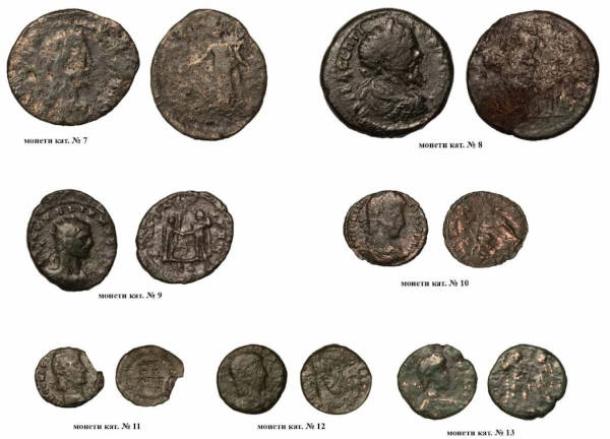
Some of the Roman coins excavated at the site. (Sirma Alexandrova/ Bulgarian Journal of Archaeology).
Roman Rule and Thracian Traditions
Although the settlement was part of the Roman Empire, evidence suggests that its inhabitants maintained cultural ties to their Thracian heritage. The ceramics recovered from the site included both Roman-style tableware and handmade vessels that displayed distinctive touches of Thracian craftsmanship.
- Massive Cache of Roman Coins and Gems Found in Ancient “Magical City”
- Ancient Thrace: A Melting Pot of Cultures and Conquests (Video)
“Handmade ceramics indicated continuity with traditional Thracian pottery styles,” Alexandrova noted, “suggesting the inhabitants belong to the Thracian ethnic group.”
During this period, the region was a part of the province of Thrace, where Roman governance coexisted with enduring local traditions, resulting in a settlement where peaceful coexistence was apparently the norm.
The village’s location made it a hub for economic activity, as it overlooked the surrounding landscape from its elevated position. Its sudden destruction was not an isolated event, but rather a reflection of the broader instability that plagued the Roman Empire during the fourth century, when both internal decline and external threats proved problematic. Historians suggest that Gothic incursions, which intensified during this period as Rome struggled to defend its borders, may have played a role in the settlement’s fiery demise, as the Goths were known to torch the settlements they destroyed.
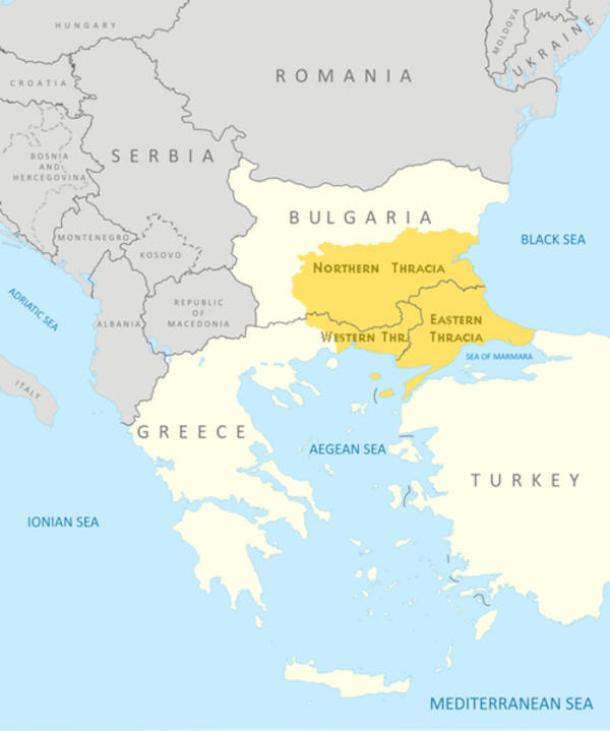
Map showing the territory of Thrace in Roman times, overlapping with borders of modern-day southeastern European countries. (Пакко/CC BY-SA 3.0).
Treasures Left Behind in a Doomed Village
Among the most intriguing discoveries was the cache of silver coins and jewelry, possibly concealed in haste as the disaster unfolded. While found in a disturbed layer near the surface, these artifacts seem to hint at the desperate measures taken by residents as they faced impending danger.
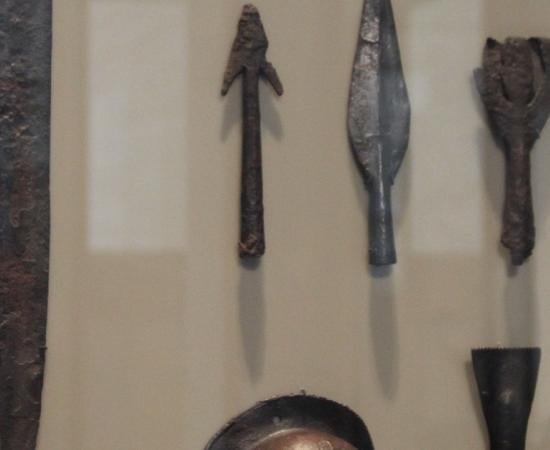
Other finds during the excavations for the gas pipeline included arrowheads, needles, chains, buckles, a silver lunula, and various personal belongings, painting a picture of everyday life in the unnamed village before catastrophe struck. The presence of loom weights, spindle whorls, and ceramic storage vessels indicated a self-sufficient community engaged in textile production and food preservation.
Although the Roman village was never rebuilt, the site was not entirely forgotten.
“Despite the site's limited excavation area, evidence of later disturbances from antiquity to modern treasure hunters indicates ongoing activity,” Alexandrova wrote. “Additionally, coins dating to the fifth century and an earlier iron fibula suggest that habitation in the area persisted before and after the mid-fourth century fire, reinforcing the site’s historical importance within late Roman Thrace.”
Buried for more than 1,600 years, this lost Roman village is now shedding light on a turbulent era of European history, revealing fascinating details about the daily lives of its inhabitants, whose world was turned upside down when their village was suddenly invaded and their homes consumed by flames.
Top image: Aerial photo of the excavation site on the terrace where the ancient Roman village was constructed.
Source: Sirma Alexandrova/ Bulgarian Journal of Archaeology