

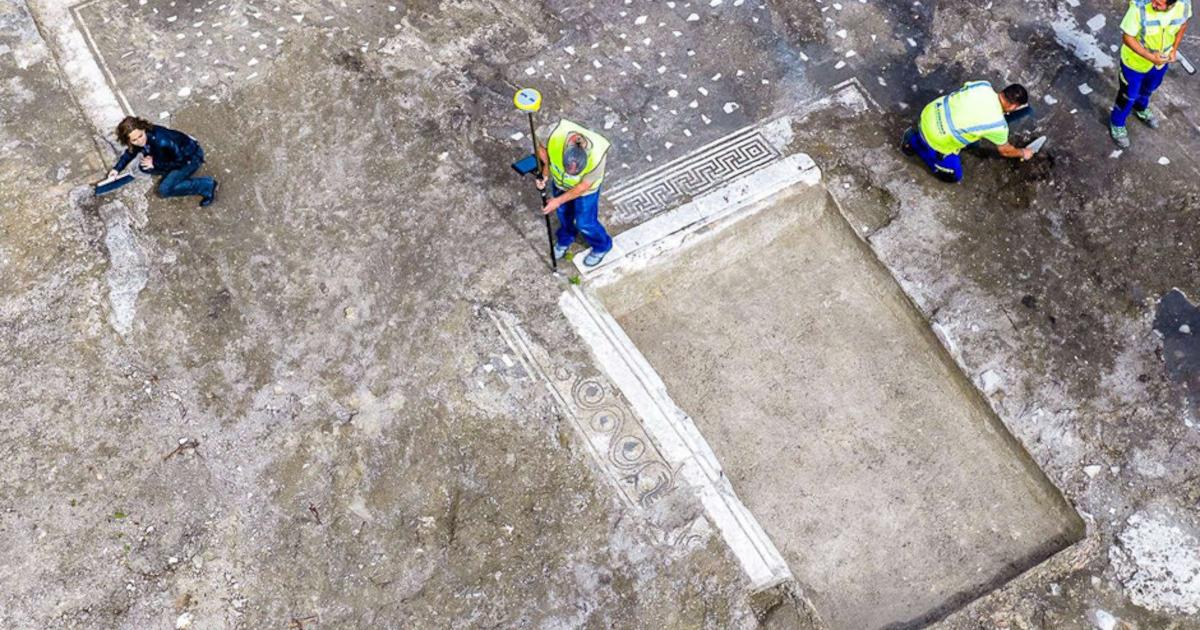

The villa was uncovered at Castel di Guido, a large agricultural estate west of Rome, in an area connected with ancient Lorium, a settlement and imperial property along the Via Aurelia. The discovery was made during investigations by the Soprintendenza Speciale di Roma of Italy’s Ministry of Culture, after unauthorized excavation activity was reported on land owned by the Lazio Region.
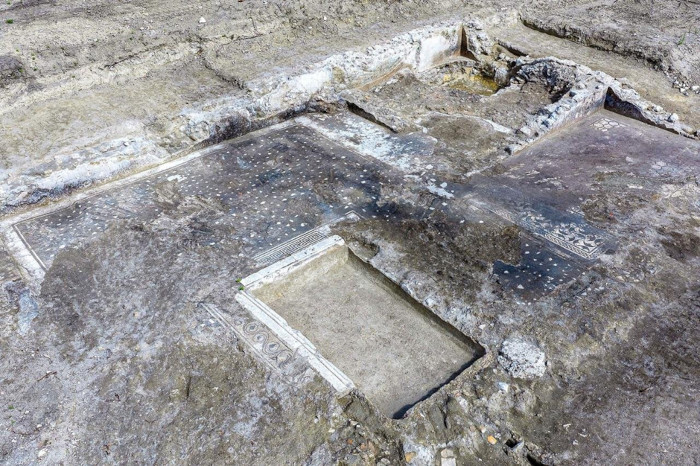
Aerial view of part of the Roman Villa at Castel di Guido. (Italian Ministry of Culture)
From Illegal Excavation to Archaeological Rescue
The case began on February 16, when the Metropolitan Police of Rome informed the Soprintendenza about unauthorized digging at the site. The following day, the Carabinieri’s Cultural Heritage Protection Unit became involved. A joint inspection followed, and by February 23, the area was being secured, fenced, and monitored.
- Luxurious Roman Villa On Display Under Lavish Modern Apartment
- Pristine Roman Mosaic Floor Found Under Vineyard In Italy
The illegal activity had already caused serious damage. Mechanical excavation had cut into ancient structures, leaving deep trenches and large piles of displaced soil around the site. Instead of treating the incident only as a criminal matter, archaeologists expanded the intervention into a controlled excavation, documenting the exposed remains and stabilizing the ancient walls and floors.
Alessandro Giuli, Italy’s Minister of Culture, said the rapid intervention by ministry officials and the Carabinieri had stopped a clandestine operation, secured the archaeological area, and brought to light the remains of a major imperial-period villa in the Roman countryside.
Daniela Porro, Special Superintendent of Rome, emphasized that the discovery also highlights the archaeological richness of Rome beyond the historic center. The find, she noted, came from a protection system based on cooperation and fast response.
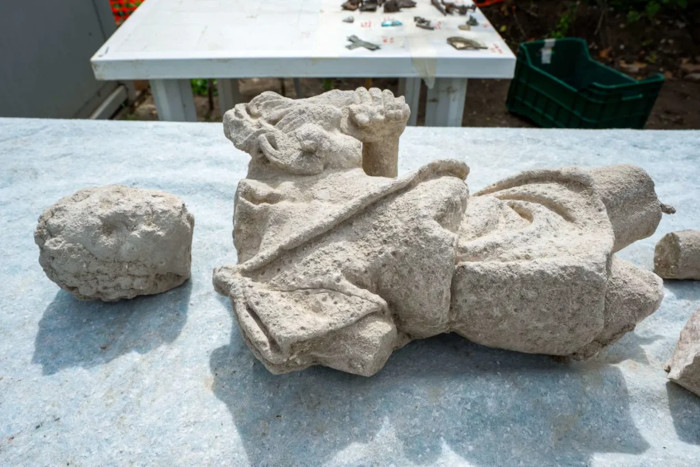
A white marble statue of the Roman deity Silvanus discovered in the impluvium. (Italian Ministry of Culture)
Mosaic Rooms and Painted Walls
The excavation has so far identified a monumental entrance atrium, decorated rooms, and other spaces with different functions. The villa’s entrance was organized around a large central impluvium, the basin used in Roman architecture to collect rainwater.
Around this basin, the floor was decorated with mosaics using geometric and vegetal motifs. Black tesserae, polychrome marble inserts, and a large threshold with braided framing and black pelta motifs on a white ground point to a residence of considerable refinement.
- Powerhouse Breakfasting Platform Unearthed At Hadrian's Villa
- Roman Village, Domus and Elaborate Mosaic Floor Unearthed in Sicily
Traces of wall painting also survive. Archaeologists found a lower red-painted band still in place, while fragments recovered from disturbed soil suggest that the upper walls may once have carried yellow and probably blue panels, enriched with human figures and plant designs. These pieces likely collapsed during the villa’s abandonment in antiquity.
Four rooms developed around the atrium. Three preserve parts of their original mosaic floors. One room had a black-and-white mosaic divided into nine square panels with geometric designs. A second displayed black octagons on a white background. A third used black rectangles with concave and convex sides, a pattern typical of refined domestic decoration in Roman elite houses.
Near one of these rooms, archaeologists also found a basin lined with cocciopesto, the waterproof mortar widely used in Roman construction. A nearby space, still only partly investigated, may have been linked to production or agricultural work. That detail matters: this was not only a luxury residence. Like many Roman villas, it likely combined elite domestic life with the management of land, food production, and rural resources.
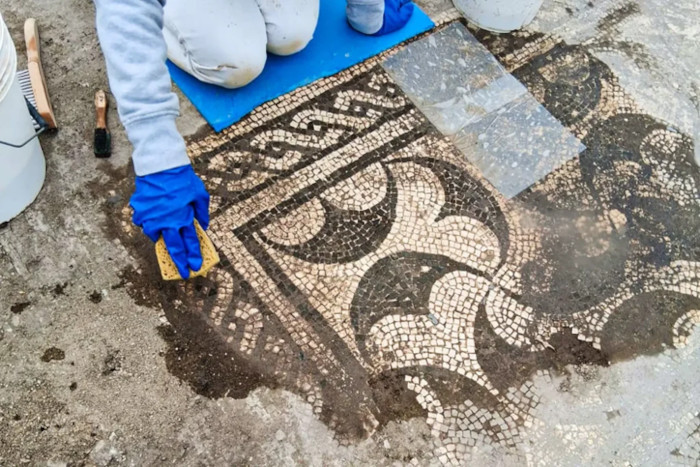
An archaeologist cleans a mosaic floor with a Greek key or meander design. (Italian Ministry of Culture)
A Marble Figure from the Impluvium
One of the most important finds is a fragmentary white marble statue discovered inside the impluvium basin. The sculpture stands about 80 centimeters high and depicts a bearded adult male wearing a short tunic with a strap across the shoulder.
The figure carries a basket-like element on the shoulder, with two birds visible on the front and fruit on the back. The right arm appears to have bent forward, probably supporting a small domestic animal, perhaps a calf or piglet.
The first interpretation suggests that the figure may represent Silvanus, a Roman rural deity associated with woods, fields, boundaries, and the protection of agricultural activity. The identification is not final. Scholars have also considered other possibilities, including a Silenus from a Dionysian context, a seasonal figure, or a shepherd.
Still, the rural imagery fits the setting. In a villa built within an agricultural landscape, a figure connected to fields, animals, and fertility would not be accidental decoration. It would have spoken directly to the world that sustained the estate.
Castel di Guido and the Imperial Landscape of Lorium
The location gives the discovery wider historical weight. Castel di Guido lies in the territory of ancient Lorium, a station on the Via Aurelia at the twelfth mile from Rome. Ancient sources connect Lorium with an imperial estate, especially with Antoninus Pius, who spent part of his youth there, later built a residence in the area, and died there in AD 161.
Hadrian and Marcus Aurelius are also associated with the district. The presence of the imperial court helped turn this western suburban landscape into a preferred zone for high-status residences.
Other important villas were already known nearby, including the Villa delle Colonnacce and the Villa delle Olivelle. The newly discovered villa now adds another piece to the map of elite settlement around Lorium and raises the possibility that aristocratic families close to the imperial sphere, or even members of the imperial household, may have been connected with the property.
The quality of the mosaics, painted walls, and marble sculpture points to owners of very high social standing. For now, archaeologists remain cautious. The villa has not yet been fully excavated, and future work will be needed to clarify its full plan, phases of use, and relationship to the wider Lorium estate.
A Villa Probably Begun in the 1st Century AD
Preliminary dating suggests that the villa may have been built and decorated from the first half of the 1st century AD, when elaborate mosaic and painted decoration became common in aristocratic residences. The building may have been gradually abandoned during the 3rd century AD, possibly when imperial interest in the area declined.
Further study of the recovered materials will be essential. Pottery, construction phases, painted plaster, marble fragments, and stratigraphic evidence may refine the villa’s chronology and reveal whether parts of the building were reused in late antiquity.
For Alessia Contino, the discovery is important because it identifies a previously undocumented imperial-period villa and preserves a decorative context of unusual quality. It also opens new research perspectives for the western suburbs of ancient Rome, a landscape where archaeology still has much to reveal beneath fields, estates, and modern roads.
Top image: Aerial view of the Roman villa at Castel di Guido, near Rome. Source: Italian Ministry of Culture
By Gary Manners
References
Artnet News. 2026. Lost Roman Villa Uncovered After 'Clandestine' Excavation. Available at: https://news.artnet.com/art-world/castel-di-guido-villa-illegal-excavations-2781597
Buyukyildirim, O. 2026. Illegal Dig Leads Archaeologists to Roman Imperial Villa with Mosaics near Rome. Arkeonews. Available at: https://arkeonews.net/illegal-dig-leads-archaeologists-to-roman-imperial-villa-with-mosaics-near-rome/
Finestre sull'Arte. 2026. Rome, large imperial Roman villa discovered after report of illegal excavation. Available at: https://www.finestresullarte.info/en/archaeology/rome-large-imperial-roman-villa-discovered-after-report-of-illegal-excavation
Killgrove, K. 2026. Lavish Roman villa discovered outside Rome's walls may have been frequented by Hadrian and Marcus Aurelius. LiveScience. Available at: https://www.livescience.com/archaeology/romans/lavish-roman-villa-discovered-outside-romes-walls-may-have-been-frequented-by-hadrian-and-marcus-aurelius
The Independent. 2026. Lost first-century villa likely visited by three emperors unearthed outside Rome. Available at: https://ca.news.yahoo.com/lost-first-century-villa-likely-111757039.html






















