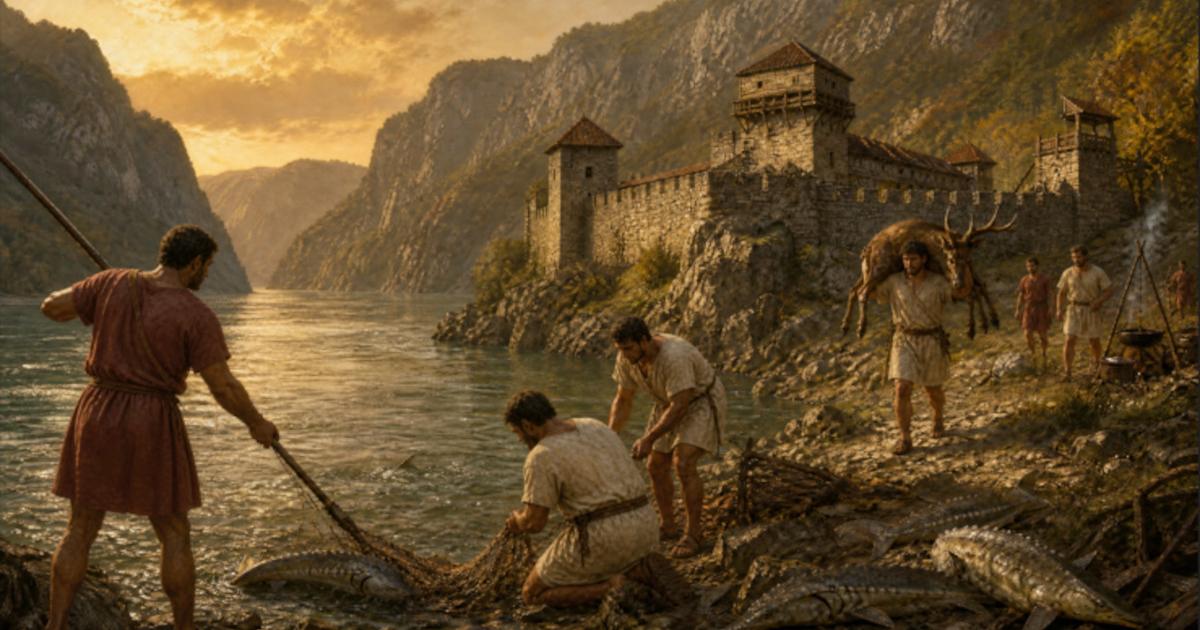

Roman soldiers garrisoned within the Diana-Karatas fort along the Danube ate far more than grain and certain preserved foods. “Foodways of the Roman army at the Danube Limes: evidence from Diana-Karataš (Serbia)”, a new zooarchaeological study of more than 10,000 animal remains, shows meat formed an integral part of their meals for hundreds of years. Previous studies often idealized descriptions of the soldier’s nourishment and rations. Hunting and fishing grew far more common from the 4th century AD onwards as life on the empire’s remote frontiers began to change. According to the study author, Dimitrije Marković of the University of Belgrade:
“The fort of Diana-Karataš presents an exceptional opportunity. It was situated in a unique environment, and occupied throughout the entire period of Roman rule in the region, with decades-long archaeological excavations that produced a large faunal collection.”

Aerial view of the Roman fort of Diana-Karataš in eastern Serbia. (Marković, Nemanja. Journal of Archaeological Science: Reports)
Study Reconstructs Life on Rome’s Distant Frontier
Published in the Journal of Archaeological Science: Reports, the zooarchaeological study examined 10,389 animal remains recovered during excavations located at the Roman fort in eastern Serbia. The fortress once stood at the exit of the Danube Gorges, one of the river’s most crucial crossing points. Built during the first half of the first century AD, the fort housed about 800 to 1,000 soldiers and stayed in continual use until the sixth century AD.
- The Cost of Expanding Rome: Accounting the Salaries of Roman Soldiers
- Roman Fort Discovered Hidden Beneath English Bus Station
Reconstructing Six Centuries of Military Meals
Researchers sorted the remains into four distinct time periods from the late 1st century AD through the early Byzantine era. Almost 3,793 of the animal bones were identified by the specific features of their species. This data allowed the research team to follow changes in food supply and eating habits across six centuries. Domestic animals formed the soldiers’ basic diet during each of these four periods. Cattle, pigs, and sheep or goats made up most of the identified animal bones. In the earliest years, pigs were the main source of meat, making up more than half of the domestic animal remains found at this site. This pattern differs from many Roman sites, where cattle usually appear more often. These findings point toward early soldiers increasingly following local Dacian food traditions among the native population or buying livestock from the nearby communities, since the earliest samples documented were smaller than the later ones.
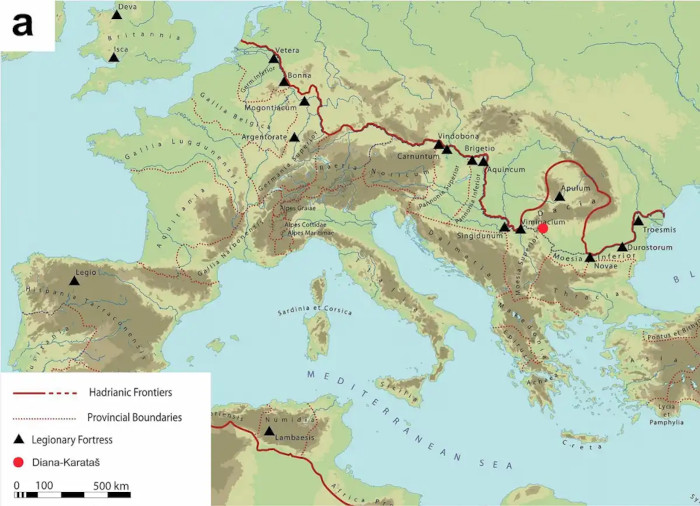
Map of the Roman Empire showing the Hadrianic frontiers, major legionary fortresses, and the location of the Roman fort of Diana-Karataš (red dot) on the Danube frontier in present-day Serbia. The fort served as a key military outpost where archaeologists studied changing dietary habits of Roman soldiers over four centuries. (Marković, Nemanja/Journal of Archaeological Science: Reports)
A Shift from Pork to Beef
From the data collected, the food habits of the soldiers changed over time. Pig remains became less common while cattle steadily increased. By the late Roman and early Byzantine periods, cattle at last made up almost 46 percent of the domestic animal remains. Sheep and goats were part of the diet across every phase, though their share also declined over time. The animal bones show how the fort received food for the soldiers. In addition to this crucial observation, every major part of the animal skeleton appears in the myriad collection uncovered over time. This means the livestock initially arrived alive or as carcasses already slaughtered before the butchering could begin. The remains of newborn pigs and sheep suggest these animals were bred in the fort or not that far away instead of coming from suppliers far away.
- The Colossal Head of Decebalus, King of the Dacians
- Barbarians versus Romans: Violence and Urban Life in Late Antiquity
Cut Marks Reveal How Roman Soldiers Prepared Their Meals
Knife and axe marks appear on nearly one-third of the cattle, pig, and sheep bone remains. These markings match skinning, cutting, and meat removal. One cattle shoulder blade from the late Roman period shows a distinct round hole linked with hanging meat during curing. This finding shows preserved meat formed part of food preparation. The age of these animal bones also adds key details. Most pigs were slaughtered between one and two years of age, showing that the animals were raised mainly for meat. Cattle, sheep, and goats usually lived beyond four years before slaughter. These animals also supplied milk, wool, or farm labor for the soldiers stationed at the fortress.
- Mass Grave Discovery: Roman Soldiers' Brutal Battle Deaths Revealed
- Goths On The Move: The Third Century Barbaricum Invasion of the Roman Empire
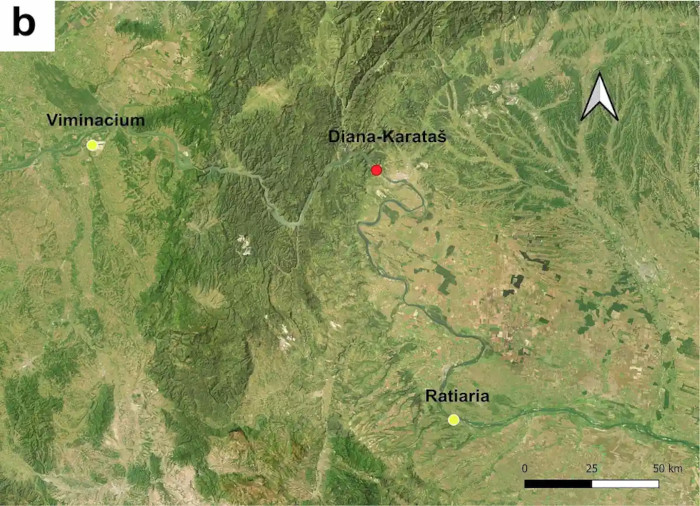
Satellite map showing the Roman fort of Diana-Karataš (red) on the Danube frontier in eastern Serbia. The map also identifies the nearby Roman centers of Viminacium and Ratiaria, illustrating the fort's strategic position within Rome's frontier defense system along the Iron Gates Gorge. (Marković, Nemanja/Journal of Archaeological Science: Reports)
Big Changes Transformed the Roman Soldiers’ Diet
The biggest change in the soldiers’ diet appears after the 4th century. Wild mammals rose from about ten percent of the identified animal bone remains to 18 percent in the late Roman period and 22 percent in the early Byzantine period. Red deer and wild boar became quite common food sources. Roe deer, hare, bear, wolf, fox, and even rare aurochs, a species of wild oxen, also appear in the collection of these animal remains.
Fishing Gains Prominence
Fishing gained more importance as well. Beluga sturgeon made up the largest share of fish remains, with some fish estimated to range between nine feet (275cm) at the minimum and sixteen feet (494cm) long at the maximum. The soldiers also ate Danube fish species, including sterlet, Russian sturgeon, starry sturgeon, catfish, carp, and pike. Many fish bones also show marks left from food preparation. Fishing hooks, net needles, and ceramic net weights found at this site support the bone evidence collected.
Conclusion
Marković maintains that, “Feeding and maintaining large troops required complex supply mechanisms, in which taxation, redistribution, and local procurement of goods were closely connected.” The researchers linked this shift toward hunting and fishing with changes in the Roman Empire and unrest along the Danube frontier. As supply networks became less reliable, soldiers depended more on nearby forests and, especially, the river itself for food. The findings show daily life at Diana-Karatas changed with the times, while local land and water shaped the food selections on the soldiers’ tables.
Top Image: Representation of life at the Roman fort of Diana-Karataš in eastern Serbia after the 4th century, when Roman soldiers increasingly relied on hunting and fishing as frontier conditions changed. Source: Marković, Nemanja. Journal of Archaeological Science: Reports 74
By Ramsey Hardin
References
Carvajal, Guillermo. "The 'Barbarian Invasions' Forced Roman Legionaries on the Danube Frontier to Survive on Hunting and Fishing, as Supply Routes Were Cut Off." La Brújula Verde, 26 De Julio De 2026. https://www.labrujulaverde.com/en/2026/07/the-barbarian-invasions-forced-roman-legionaries-on-the-danube-frontier-to-survive-on-hunting-and-fishing-as-supply-routes-were-cut-off/
Radley, Dario. "Roman Soldiers Relied More on Hunting and Fishing as Life Changed on the Danube Frontier, Study Finds." Archaeology Magazine, July 26, 2026. https://archaeologymag.com/2026/07/roman-soldiers-diet-on-the-danube-frontier/
Marković, Nemanja. "Foodways of the Roman Army at the Danube Limes: Zooarchaeological Evidence from Diana-Karataš (Serbia)." Journal of Archaeological Science: Reports 74 (2026): 105965. https://doi.org/10.1016/j.jasrep.2026.105965
UNESCO World Heritage Center. Frontiers of the Roman Empire – The Danube Limes (Serbia). Accessed July 27, 2026. https://whc.unesco.org/en/tentativelists/6475