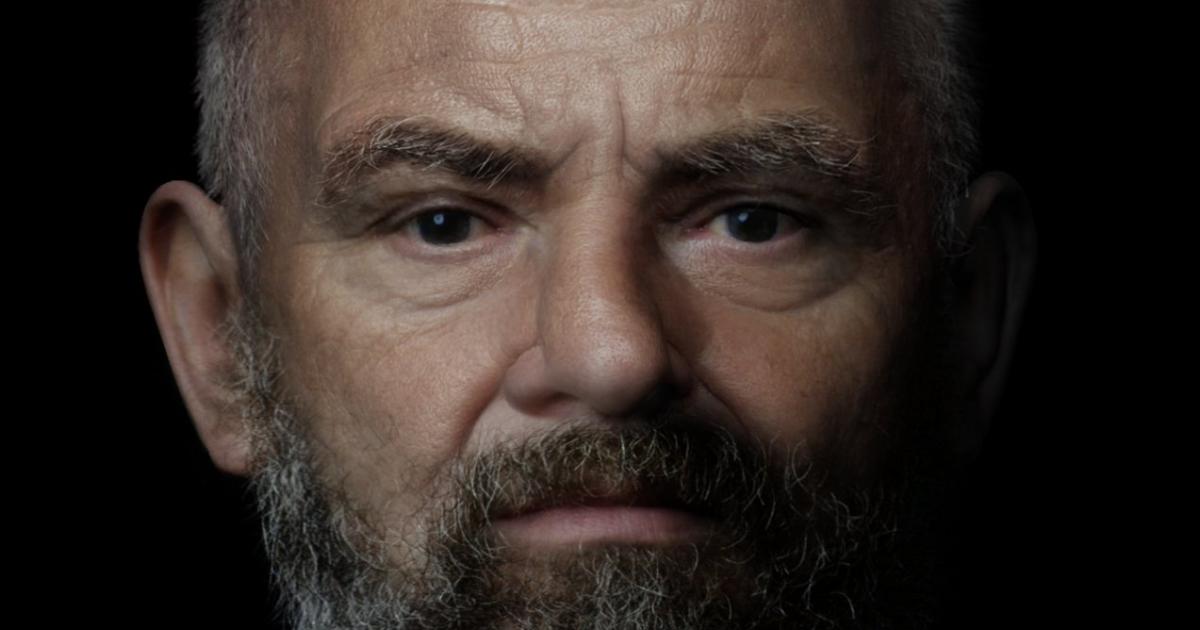

Four of the six adult men buried around the Roman fort at Inveresk, near Edinburgh, had their heads cut off after they died, and one man from that small group of burials has now been given a face. National Museums Scotland revealed the digital reconstruction on October 20, 2026, offering a rare glimpse of someone who lived and died on the northern frontier of the Roman Empire. However, the museum admits that nobody can know exactly how he looked, and its release leaves open whether he was one of the four.
According to National Museums Scotland, the digital reconstruction by Dr Chris Rynn will be shown alongside the man's own skull when Roman Scotland: Life on the Edge of Empire opens at the National Museum of Scotland on November 14, 2026. The exhibition on Chambers Street runs until April 18, 2027, with tickets from £13.50. So how much of this weathered, graying face rests on hard evidence, and how much on informed judgment?
Six Men Buried on the Edge of Empire
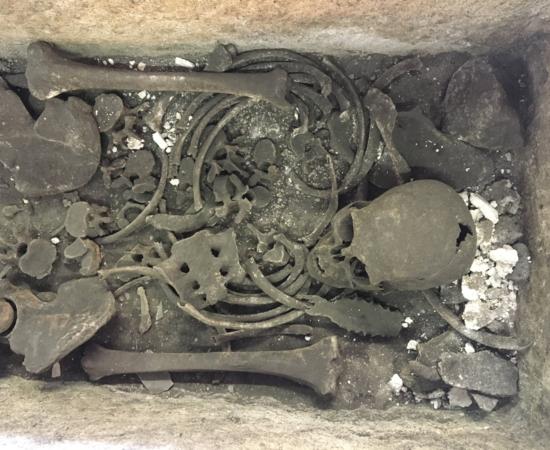
The museum's press release is frank about how unusual the Inveresk graves are. "Burials are rarely discovered in Roman Scotland and these are particularly unusual because four of the six adult men buried here were decapitated after they died," it states, adding that "This enigmatic practice is seen across Britain, but the burials at Inveresk are the first Scottish examples and are amongst the earliest known in Britain."
As for why anyone would treat the dead this way, National Museums Scotland offers possibilities rather than an answer. The release says the reasons for the rite "are hard to identify and probably changed over time." It then lists three options. "It may have been used as a form of punishment, linked to beliefs around the way a person died, or motivated by supernatural concerns."
Whether the reconstructed man was one of the four is less clear than some reports suggest. The Press Association story carried by The Independent and The National says the four decapitated men included the one whose face has been rebuilt. However, the museum's own release, the primary source for that story, does not say so either way.
A Hard and Physically Active Life
The man at the center of the exhibition was a long way from home when he died beside the Firth of Forth. National Museums Scotland says he was born in southern Britain and traveled hundreds of miles north to the frontier. He was most likely in his early 50s when he died, at some point between AD 140 and 165, although the release does not explain how that date range was reached.
His skeleton carries a vivid record of a hard and physically active life. His nose had been broken and had healed. He also had limited use of his right arm because of extensive bone growth around the elbow joint, probably caused by septic arthritis. "Pronounced wear on his front teeth suggests he compensated for this reduced mobility by holding objects between his teeth," the museum notes.
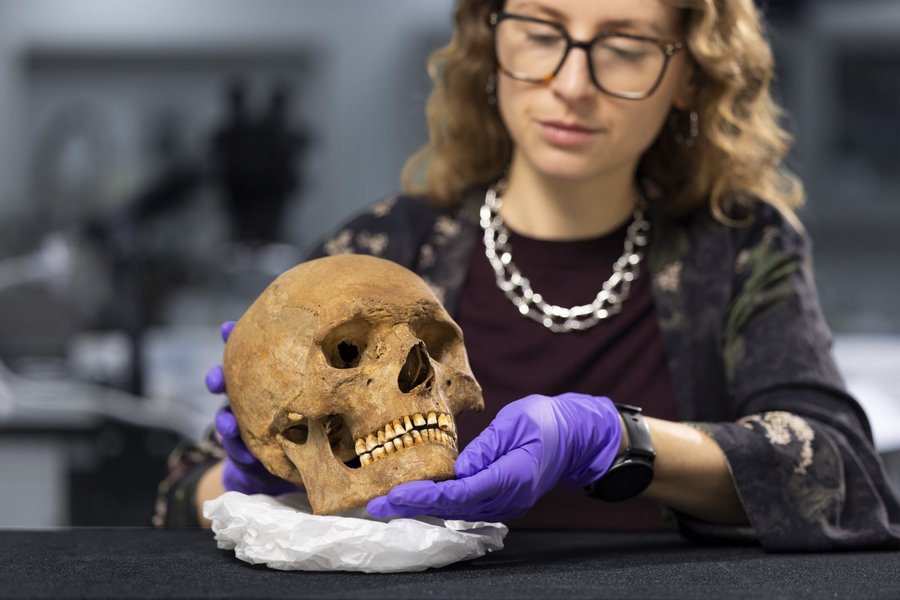
Dr Jess Thompson examines the skull of a man from Roman Scotland. Photo © Duncan McGlynn
That damaged elbow also undoes an easy assumption, that a man buried beside a Roman fort must have been a Roman soldier. "We do not know his occupation, but he certainly was not a soldier when he died as he could not have swung a sword," National Museums Scotland states. However, the careful wording "when he died" leaves open what he did in his younger years. The bones alone cannot settle whether he once served, traded or labored near the fort.
What the Bones, Teeth and Chemistry Record
The face rests on three separate strands of scientific work, which the museum lists without going into detail. The reconstruction "was informed by an osteoarchaeological assessment carried out at National Museums Scotland, previous isotopic analysis led by scholars at Durham University, and ancient DNA by a team based at the Department of Archaeology at the University of York and Harvard Medical School."
No published paper reporting the ancient DNA work from York and Harvard could be found. The museum also does not say which features of the face, such as his brown eyes and dark hair going gray, came from the genetic results and which came from the skull or the artist's judgment.
Earlier research offers some wider context for burials of this kind in East Lothian, although the museum does not cite it. A 2020 study in the Journal of Archaeological Science: Reports, by Joanna Moore, Janet Montgomery and colleagues, examined twelve skeletons from excavations at Musselburgh, "radiocarbon dated to the Iron Age and Roman period." Seven of them were tested for carbon, nitrogen, oxygen, strontium and lead.
Strontium and oxygen are laid down in tooth enamel during childhood. They reflect the rocks and water of the place where a person grew up, which is why the method can pick out incomers. The authors found that the oxygen, strontium and lead values "indicate more diverse origins for the Roman individuals," while their diet showed a land-based protein signal "consistent with other Romano-British studies."
Their conclusion was carefully framed. "These results suggest that decapitation burials were afforded to migrants to the Lothian area, but is not indicative of a common origin," the authors wrote. They added that a link with "a nearby 2nd century fort suggests that they may also represent some of the earliest examples of Roman decapitation burials to be found anywhere in Britain." The abstract does not single out any one individual, so the study cannot be read as an account of the man whose face has now been rebuilt.
Could a Face Reveal Who He Was?
Dr Jess Thompson, Curator of Osteoarchaeology at National Museums Scotland, presents the result as a meeting of laboratory data and artistic interpretation. "This facial reconstruction by Dr Chris Rynn unites cutting-edge science with artistic vision to create an instant connection with the past, offering a dynamic portrait of what he may have looked like and who he may have been," she said.
Dr Fraser Hunter, Principal Curator of Prehistory and Roman Archaeology at the museum, is just as candid about where likeness ends and knowledge begins. "I have worked with the finds from Roman Inveresk for years, but this facial reconstruction finally gives me a sense of what one of its inhabitants looked like," he said, before adding the line that matters most: "We cannot know how exactly he looked, but we think his family and friends would have spotted the likeness."
The museum's own press images make the point visible, since three versions of the face were released to the media. One is clean-shaven with bruising around the eyes and a mark across the bridge of the nose. Another has a full graying beard, and the third is clean-shaven without the bruising, so the facial hair at least is an artistic choice the skull cannot dictate.
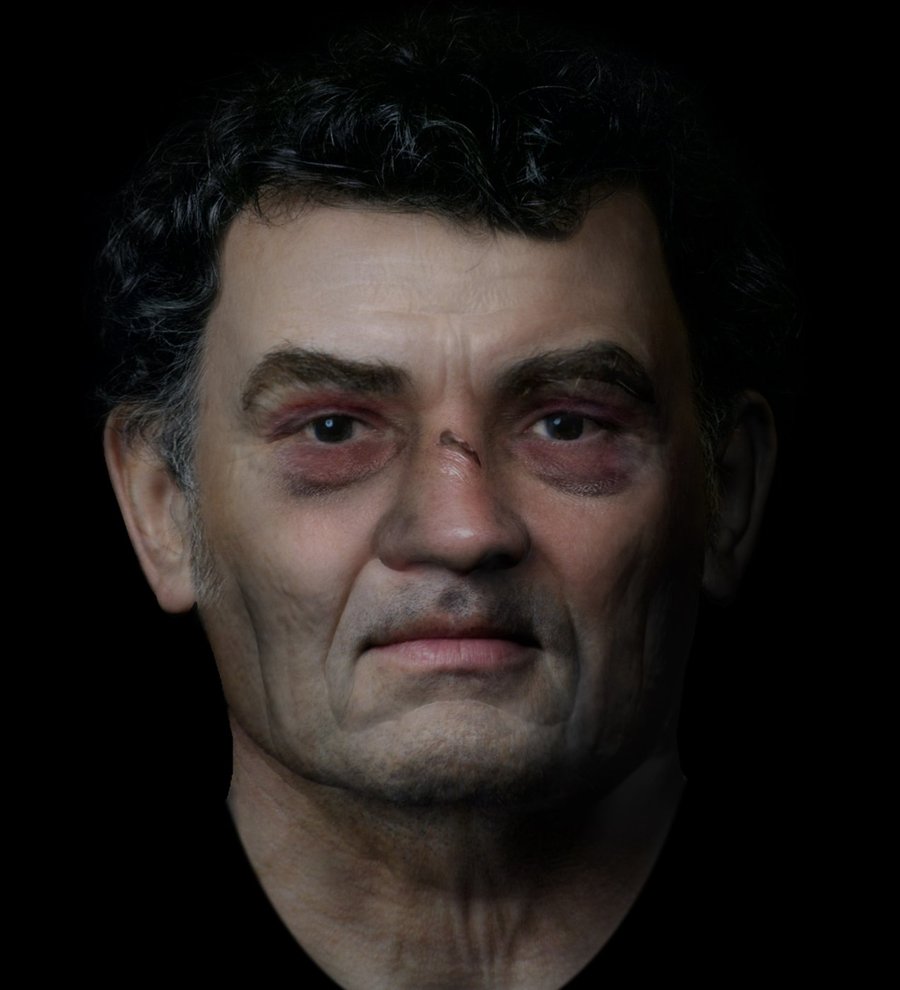
One of three versions of the face released by National Museums Scotland, clean-shaven with bruising around the eyes and nose. Image © Chris Rynn
Forensic artist Cicero Moraes, who was not involved at Inveresk, made the same point about the method in general when he told Live Science in April 2023 about a different reconstruction. "In general, people think that facial approximation works like in Hollywood movies, where the end result is 100% compatible with the person in life," he said. "What we do is approximate what could be the face, with available statistical data and the resulting work is a very simple structure."
Where the Evidence Stands
On the museum's analyses, the six burials and the four post-mortem decapitations are Established. So are the man's birthplace in southern Britain, his age, his date of death between AD 140 and 165, his injuries, and the finding that he was not a soldier when he died. His face is best read as an informed approximation, since Hunter himself says nobody can know exactly how he looked.
His occupation, whether he was one of the four decapitated men, and the reason those men were decapitated all remain Unverified. However, the 2020 Musselburgh study suggests that decapitation burials in that area were given to migrants. That pattern could be tested as more Roman burials come to light in Scotland and the York and Harvard DNA results reach print.
Until then, the face that visitors will meet on Chambers Street from November 14 remains less a portrait of one man than a carefully argued estimate. It is built from a skull, a chemical signature and an artist's judgment, as the museum itself makes clear.
Facial reconstruction of the man from Inveresk, who died between AD 140 and 165. Image © Chris Rynn
By Aris Manus
Sources
- National Museums Scotland. 2026. "2000-year-old face of Roman Scotland inhabitant revealed in new reconstruction." Press release, October 20, 2026. https://media.nms.ac.uk/news/2000-year-old-face-of-inhabitant-of-roman-scotland-revealed-in-new-reconstruction
- National Museums Scotland. 2026. "Roman Scotland: Life on the Edge of Empire." Exhibition page. https://www.nms.ac.uk/exhibitions/roman-scotland-life-on-the-edge-of-empire
- National Museums Scotland. 2026. Facial reconstruction press assets, Roman Scotland. https://media.nms.ac.uk/resources/f/national-museum-of-scotland/exhibitions/roman-scotland/facial-reconstruction
- Moore, J., Rose, A., Anderson, S., Evans, J., Nowell, G., Gröcke, D.R., Pashley, V., Kirby, M. and Montgomery, J. 2020. "A multi-isotope (C, N, O, Sr, Pb) study of Iron Age and Roman period skeletons from east Edinburgh, Scotland exploring the relationship between decapitation burials and geographical origins." Journal of Archaeological Science: Reports 29: 102075. https://doi.org/10.1016/j.jasrep.2019.102075
- Cameron, L. (PA). 2026. "Face of man from Roman Scotland revealed in new reconstruction." The Independent, October 20, 2026. https://www.independent.co.uk/news/uk/home-news/roman-edinburgh-britain-national-museums-scotland-national-museum-of-scotland-b3069578.html
- The National. 2026. "Face of Roman-era man reconstructed for National Museum of Scotland." https://www.thenational.scot/news/26651396.face-roman-era-man-reconstructed-national-museum-scotland/
- Nalewicki, J. 2023. Report on the Nazlet Khater 2 facial approximation, with an interview with Cicero Moraes. Live Science, April 3, 2023. https://www.livescience.com/see-the-oldest-human-ever-found-in-egypt-in-stunning-new-facial-approximation