Archaeologists have discovered a vividly colored Roman pet mosaic in Adramytteion, Turkey that contains the names of two animals: a cat named Emerald and a dog named named Ocean. The mosaic is 1,800 years old and dates back to the time when it decorated the reception hall of a wealthy abode. The pair of animals are placed among fish, birds and mythological characters, according to an exclusive report by The Independent.
- Stunning 1,700-Year Old Roman Mosaic Floor Unearthed in Eastern Turkey
- Rare Winged Medusa Mosaic Found in Ancient Roman Villa in Spain
Emerald and Ocean Greeted the Villa’s Guests
The mosaic is approximately 5 meters by 3.6 meters (16.4 feet by 11.8 feet) in size and includes 15 framed panels which are arranged into three rows. According to the analysis of the house conducted by archaeologist Hüseyin Murat Özgen in 2026, the mosaic is located at the middle part of the North Hall of the villa, where guests would see its images during formal receptions.
The images are assembled from the colored tesserae of various shades such as red, orange, blue, green, yellow, burgundy, black, and white. The positioning of the mosaic near the entrance of the house shows that it was intended to be enjoyed and viewed by visitors, not just for the pleasure of the house’s residents.
The pale cat sits on a blue-green cushion beside the Greek letters ΖΜΑΡΑΓΔΙΝ, interpreted as “Emerald.” Across the room, a running or leaping dog appears with ΩΚΕΑΝΟΣ, meaning “Ocean.” As Live Science noted, these are the only animals in the composition identified by name, although researchers have not yet proved that the images are portraits of pets.
- A Roman Era Pet Cemetery: 86 Cat Burials Discovered in Egypt
- Study Reveals Secrets of Largest Roman Dog Sacrifice Site Found in Britain
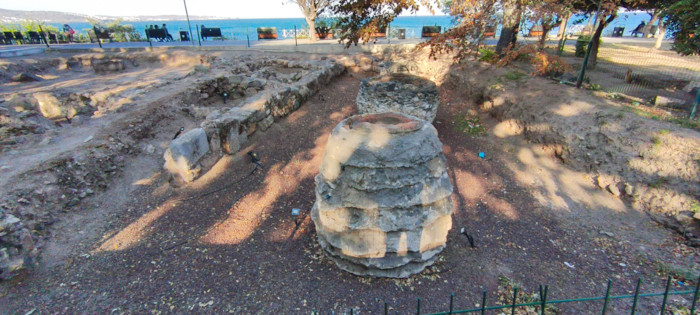
A panoramic view of some of the remains at Adramytteion, the ancient Aegean city beneath modern Ören. (Özgür Arda Bayram/CC BY-SA 4.0)
A Status Display Inside a Working Home
The area of the villa was approximately 730 square meters and organized around the central atrium. There were 3 paved halls, secondary rooms as well as pipes, channels and drains. The villa was similar to other luxury buildings discovered near Rome in the way it mixed a luxurious design with the functions of a residential building. The expensive materials used for the floor demonstrated the owners’ wealth while the numerous representations of Medusa and the winged horse among others testified to their education and social status as well as possibly civic pride.
The winged horse is included as an icon on the coins of Adramytteion from the fourth century BC, indicating the connection between the property owner and the ancient past of the area. Other similar finds, such as the mosaic depicting the Iliad from a villa in Britain, suggest how property owners were able to show their cultural education with the use of reception room floors.
The building of Adramytteion was reconstructed and restructured after it was severely damaged, yet the water management system remained an important component of the building design.
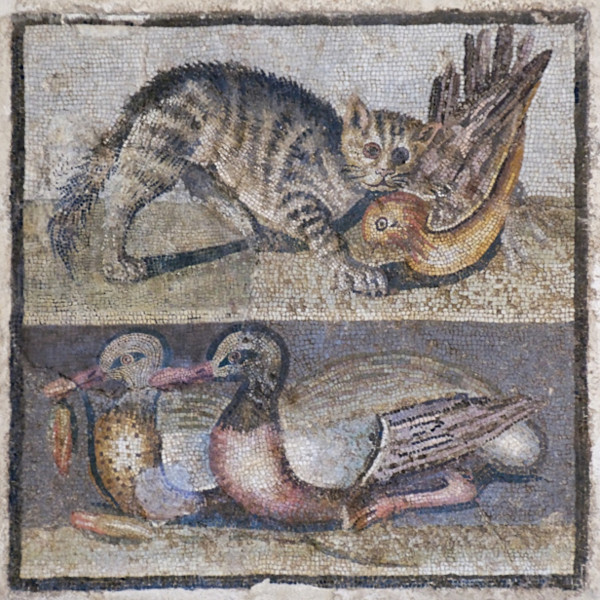
Roman floor mosaic showing a cat and two ducks, from a suburban villa near Rome. (Marie-Lan Nguyen/Public Domain)
A Rarely Preserved Personal Touch
The American Institute for Roman Culture, explains animals played various practical, symbolic, and emotional functions in the life of Romans, and dogs could take on the job of watchers, hunters, and pets. Cats are less represented in the artwork of Romans, which makes the pose of Emerald the cat and the name written on the tablet such a mystery. Earlier archaeological discoveries such as mosaics in rich Roman houses from Alexandria showed how various regions of the empire developed a peculiar style that communicated and shared images from across the empire.
According to Özgen, the mosaic’s North African features could illustrate the trading route of its possessor, but this is purely speculative. The name Ocean seems to derive from the port of Adramytteion, while Emerald could reference the gems of Egypt in the Roman times. Nonetheless, the Roman pet mosaic encapsulates something far more essential than any renowned constructions, namely the two animals that had gained such familiarity as to be immortalized in stone. Thus, it serves both as a public statement and private memorial.
Top image: Photo of the recently uncovered mosaic at Adramytteion, Turkey. Source: Özgen/ Uludağ University Faculty of Arts and Sciences Journal of Social Sciences
By Gary Manners
References
Altuntaş, L. 2026. 1,800-Year-Old Roman Villa Mosaic Discovered in Türkiye Preserves the Names of a Cat and Dog. Available at: https://arkeonews.net/1800-year-old-roman-villa-mosaic-discovered-in-turkiye-preserves-the-names-of-a-cat-and-dog/
American Institute for Roman Culture. 2024, updated 2026. Dogs in Ancient Rome. Available at: https://ancientromelive.org/dogs-in-ancient-rome/
Killgrove, K. 2026. Stunning Roman-era mosaic discovered in Turkey features ‘Emerald’ the cat and ‘Ocean’ the dog. Available at: https://www.livescience.com/archaeology/romans/stunning-roman-era-mosaic-discovered-in-turkey-features-emerald-the-cat-and-ocean-the-dog
Özgen, H. M. 2026. A Multi-Phase Residential Area at Adramytteion: A First Assessment of a Roman Period Atrium-Centered Residence and an Adjacent Multi-Phase Complex. Uludağ University Faculty of Arts and Sciences Journal of Social Sciences, 27(51 ), 427–448. Available at: https://doi.org/10.21550/sosbilder.1880583
Sankaran, V. 2026. Roman man’s tribute to beloved pet cat and dog found in 1,800-year-old mosaic. Available at: https://www.the-independent.com/news/science/archaeology/roman-mosaic-turkey-pet-dog-cat-b3045693.html