

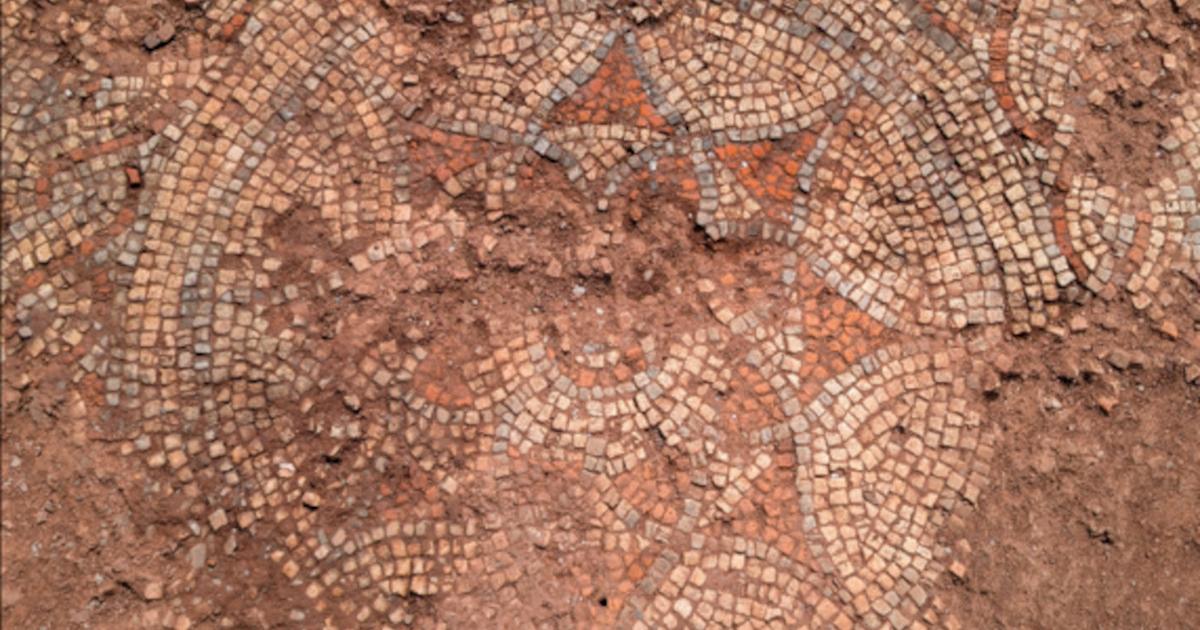

A striking and rare, multicolor mosaic has been discovered amid a Roman villa discovered in farmland in Devon, England. The beautiful 12 square-meter floor, made with thousands of red, white, and dark blue-grey tesserae is part of a large complex at the site. Together with a magnificent set of baths and other luxurious features, the villa illustrates the huge wealth of the Roman Empire stretched to its farthest corners.
The excavation, part of the SHARE (Saving Halberton’s Ancient Roman Environment) project, was led by archaeologists from the University of Exeter and Cotswold Archaeology. Funded by The National Lottery Heritage Fund, the two-month dig took place between Halberton and Sampford Peverell.
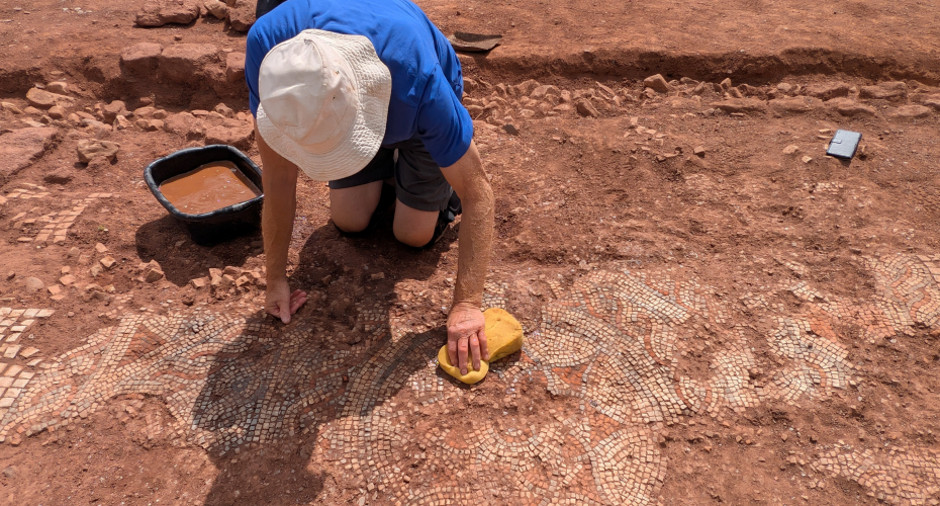
Archaeologist carefully cleaning the intricate Roman mosaic. (University of Exeter)
A Masterpiece of Roman Design
The mosaic, believed to have adorned a dining or reception room in the fourth century AD, is a masterpiece of Roman craftsmanship. Its central roundel features a stylized flower with eight overlapping teardrop petals, surrounded by interlaced squares and a classic knotted line pattern.
"At the outset, we knew this villa, and its surrounding working areas, was an important site for understanding the ‘Romanization’ of Devon," said Dr. Susan Greaney, project lead from the University of Exeter. "But from day one, it has offered us a wealth of interesting and sometimes surprising finds in addition to this striking polychrome mosaic."
- Remarkable Roman Villa Unearthed from a Bronze Age Site in England
- Impressive Mosaic and Large Roman Villa Discovered in UK
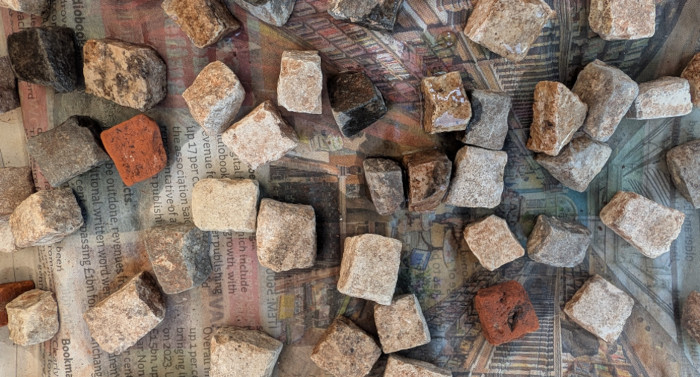
Loose tesserae from the mosaic found at the site. (University of Exeter)
Luxurious Living on the Frontier
Beyond the mosaic, the excavation revealed an elaborate bathhouse equipped with at least two plunge pools constructed from waterproof Roman concrete (opus signinum). The presence of such luxurious amenities is highly unusual for the region. Bill Horner, Devon County Council’s County Archaeologist, noted that the mosaic is the most westerly example found in a Roman villa in Britain, underscoring the affluence of its inhabitants.
The layout of the villa proved more extensive than initially thought, suggesting multiple expansions. Additional rooms, a rainwater gulley, and hints of a timber staircase indicating a possible second story point to a substantial and evolving estate. A separate large rectangular building, likely a barn, yielded quantities of animal bone and worked antler, hinting at agricultural activities.
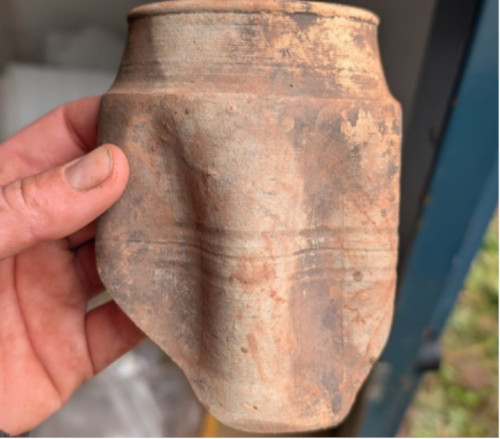
This indented beaker was a drinking cup, dating from the late 3rd or 4th century. (University of Exeter)
Treasures from the Past
The artifacts recovered from the site further illustrate the high status of the villa's residents. Among the most significant finds is an intaglio—a blue glass ornament depicting the goddess Victory, originally set in a ring used to seal wax documents.
Other discoveries include a delicate copper alloy bangle found resting on the mosaic, a fine silver-plated spoon, and various pottery pieces, such as a beaker for drinks and a Samian ware mortarium with a lion’s spout. A natural flint piece, likely used as a mixing palette for cosmetics or paint, was also unearthed.
- 30 Stunning Roman Intaglios Discovered at Hadrian's Wall Bathhouse
- Eight-Year Roman Bath Excavation in Spain Unveils Massive Complex
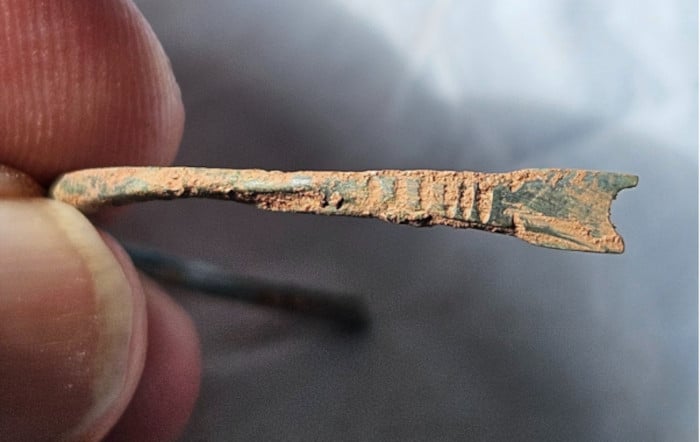
A delicate copper alloy bracelet found on top of the mosaic. (University of Exeter)
Community and Conservation
The SHARE project has brought together professional archaeologists, university students, and community volunteers. Dan Sausins, Project Officer at Cotswold Archaeology, praised the collaborative effort and highlighted the crucial role of responsible metal-detecting in the site's discovery.
The mosaic is currently being carefully lifted for conservation and will eventually be displayed at the Tiverton Museum of Mid-Devon Life, ensuring this extraordinary piece of Roman history is preserved for future generations.
Top image: The central roundel of the mosaic design features a flower with overlapping petals. Source: University of Exeter
By Gary Manners
References
Merrington, A., 2026. Archaeological dig reveals full extent of Roman villa with intricate mosaic and bath house. University of Exeter News. Available at: https://news.exeter.ac.uk/faculty-of-humanities-arts-and-social-sciences/archaeology-and-history/archaeological-dig-reveals-full-extent-of-roman-villa-with-intricate-mosaic-and-bath-house/





















