
A marble inscription discovered at Hadrian’s Villa has preserved the rare physical reminders of the Roman rite of lightning which was performed at the place the lightning was thought to have struck. Still attached to the original masonry, the slab mentions Summanus, the Roman god of night lightning, and probably indicates the site had been declared sacred. This small find has revealed a telling detail about the faith of the Romans in one of the Empire’s grandest residences.
A Message Cut into Marble
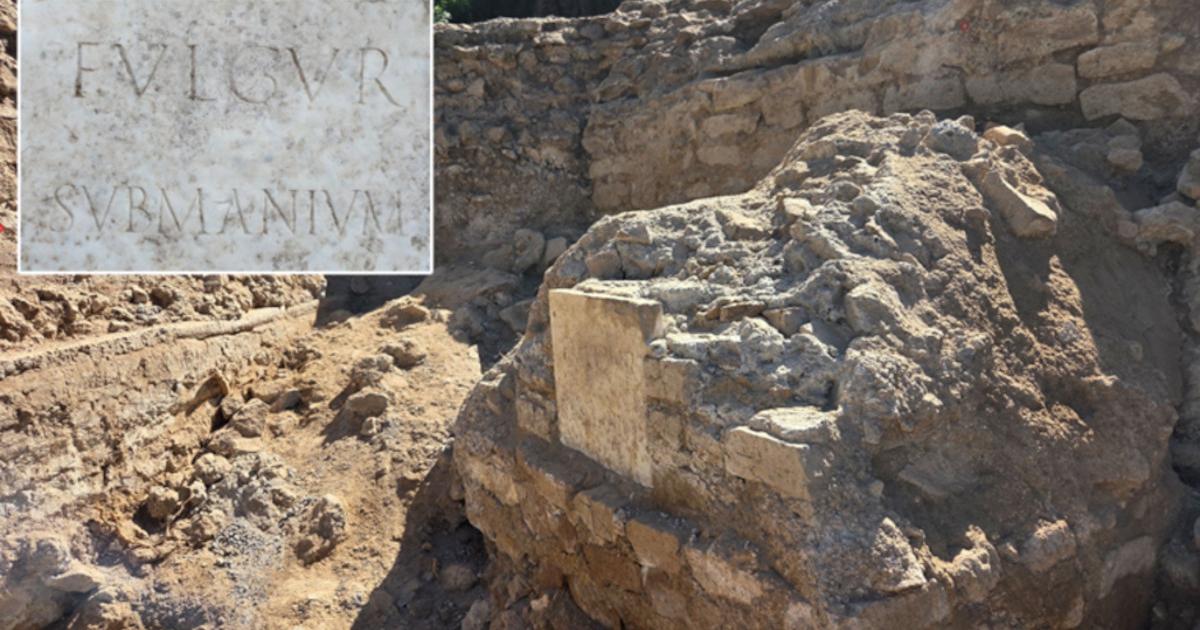
On September 10, 2026, the Italian Ministry of Culture announced a new discovery after excavations in the location known as the Amphitheatre. The excavation team from University of Urbino Carlo Bo came to discover a small quadrangular structure made up of tufa blocks held together by mortar, which was situated between the so-called Amphitheatre and a bank of tufa. In the forepart of the structure, a marble slab was found, measuring around 40 cm by 35 cm (15.7 by 13.8 inches), which bore inscriptions in two lines reading: FVLGVR SVBMANIVM.
- Oldest Structure at Hadrian's Villa Uncovered Beneath Imperial Palace
- Powerhouse Breakfasting Platform Unearthed At Hadrian's Villa
Marble slab bearing reference to Roman deity of nocturnal lightning.
The engraved marble slab found buried under ancient Roman villa. (Italian Ministry of Culture)
In contrast to an antiquity that has been displaced from its original site, the stone is still in its original position, thus maintaining its archaeological context. According to The Independent, Fabio Giorgio Cavallero who was the director of the excavation described the in situ survival as maintaining “data of exceptional importance” because it would shed light on how the monumental area was organized by people living there. That context matters at a residence whose hidden service routes and monumental spaces reveal sharply different layers of imperial life.
How Romans ‘Buried’ a Lightning Strike
For Romans, lightning could be divine action rather than simply severe weather. A struck place became religiosus, belonging to the divine sphere, while damaged material was gathered and deposited in the earth with prescribed words and sacrifices. This Roman lightning ritual was called fulgur conditum—literally, lightning laid away or buried—and the marked sacred space could be known as a bidental, as Archaeology Magazine explains.
According to the Roman beliefs, when lightning occurs it is not simply regarded as a meteorological phenomenon but rather as divine phenomenon. If an object is struck by lightning, it is referred to as religiosus, and the items that were affected were taken and buried ceremonially with certain words and offerings. This was a ritual known in Rome as fulgur conditum, which means ‘lightning laid to rest’. The area considered to be affected by the lightning strikes was known as bidental explains Archaeology Magazine.
- The Augurs of Rome: Birds Predicting The Will Of The Gods
- Roman Seals Showing Hundreds of Gods Unearthed in Turkey
The newly exposed structure may have marked or enclosed just such a bidental. As Heritage Daily noted, the survival of inscription, masonry and surrounding deposits together shows how such religious rules could physically change a Roman landscape. Comparable buried ritual deposits are now being studied at a Roman sanctuary in Frankfurt, although the Tivoli find is distinctive for naming the celestial event so directly.
Summanus, God of the Night Sky
The inscription’s spelling reflects ancient Latin orthography: “V” serves for modern “U,” so the text is read as Fulgur Submanium. Ancient authorities distinguished daylight thunderbolts, normally assigned to Jupiter, from bolts at night, which belonged to Summanus. That division fits a religious culture attentive to natural signs, including regulated augury and the use of divine imagery on seals.
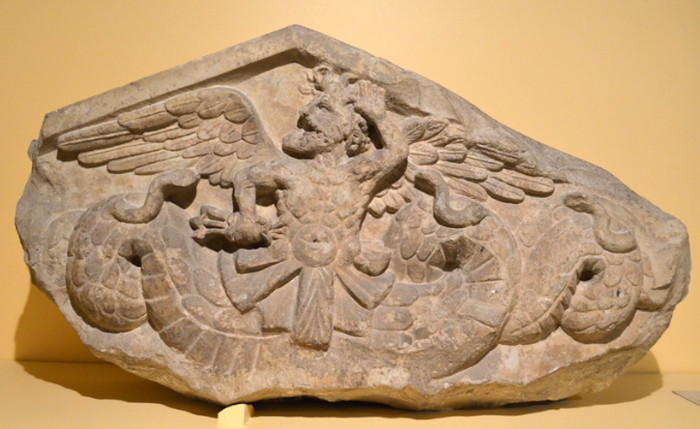
1st century BC pediment with relief-carving of a winged, snake-footed deity holding a lightning bolt (could represent Triton/ Charon/ Jupiter/ Typhon/ Summanus?) (Musei Capitolini Rome/Dan Diffendale)
Today, Summanus is hardly known compared to Jupiter; however, the inscription proves that precision in Summanus’s area made it possible determine a response to a particular event. The official announcement included the declaration of the director of VILLÆ, Alberto Samonà, according to whom the discovery provides an opportunity to move from grand architecture to “the most intimate sphere of Roman religion” and to see its “meticulous ritual procedures”. Modern interest in revived Jupiter worship underlines how enduring, if transformed, the appeal of Rome’s sky gods has proved.
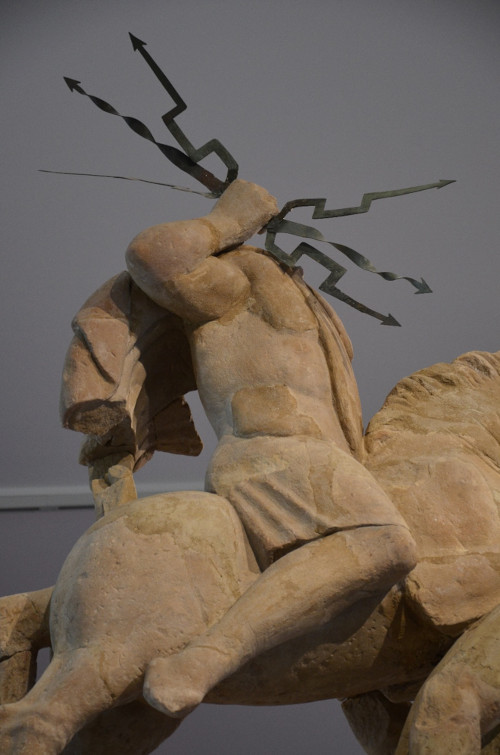
Jupiter carrying thunderbolts on horseback, from a Roman Jupiter column dating to around AD 200. (Carole Raddato / CC BY-SA 2.0)
A Small Find in an Imperial Landscape
Hadrian built his villa in Tivoli from 117 – 138 AD, creating a structure that merged Roman, Greek and Egyptian art and culture. According to UNESCO, 30 of the buildings remain today within an area of 120 hectares. Ancient Origins has explored both the site’s Roman architecture and Hadrian’s place among the Five Good Emperors. Against that enormous backdrop, the small slab demonstrates that a single flash in the night could command a spot be recognized permanently.
Today’s scientists are studying the stratigraphical relationship between a sacred marker stone, the leveling of a palace found near it in 2024, and the subsequent burial of those buildings. This chain of events can tell whether the Roman lightning ritual had an impact on further development of the area, as opposed to being just a tribute paid to a localized storm. Nearly two millennia later, the stone records the moment when Romans believed a god had entered human space - and architecture had to acknowledge it.
Top image: Marble slab bearing reference to Roman deity of nocturnal lightning. Source: Italian Ministry of Culture
By Gary Manners
References
Italian Ministry of Culture. 10 September 2026. Villa Adriana, nell’area dell’Anfiteatro riaffiora una testimonianza del fulgur conditum, l’antico rito romano che consacrava i luoghi colpiti dal fulmine. Available at: https://cultura.gov.it/comunicato/29315
Milligan, M. 12 September 2026. Rare Roman inscription marks lightning strike at Hadrian’s Villa. Available at: https://www.heritagedaily.com/2026/09/rare-roman-inscription-marks-lightning-strike-at-hadrians-villa/159243
Radley, D. 11 September 2026. Romans buried traces of lightning strikes for the god Summanus, a 1,900-year-old inscription reveals. Available at: https://archaeologymag.com/2026/09/inscription-reveals-romans-buried-lightning/
Sankaran, V. 11 September 2026. Ancient marble engravings show how Romans revered lightning strikes. Available at: https://www.the-independent.com/news/science/archaeology/roman-ritual-engravings-hadrian-villa-lightning-b3048398.html