



Perhaps the first pocket-sized legal handbook from ancient Rome known to exist has been translated from fifty scraps of animal leather preserved in the Penn Museum in Philadelphia for over 100 years. The leather parchment had previously survived in the Egyptian desert sands for 1,600 years and has now been found to contain laws about taxes, road repairs, grain supply, and how to use public buildings properly.
According to the report from University of Cincinnati, Matthijs Wibier, assistant professor at the University, has reconstructed and translated the Latin text from the leather sheets. The text represents something completely different from the usual formats of texts of common imperial law.
A Lost Legal Handbook from Roman Egypt
The Penn Museum's manuscript collection features a variety of writings and manuscripts from Egypt meticulously written on papyrus, leather, and other mediums. Many other written documents survived in the region because of the dry conditions. These particular fragments of parchment were obtained from an Egyptian antiquities vendor back in 1911, but the Latin text had not previously been fully translated or matched to a known code. Wibier assembled the seven largest pieces out of a total of 50 different fragments, permitting researchers to reveal the form of a damaged two-sided leaf.
Wibier has dated the manuscript back to the last half of the fourth century and connected it with legal documents that were around at the time of Constantius II and Julian from 337-363 AD. This piece of Roman law parchment could have served as a select compilation of imperial laws, perhaps used by tax officials, landowners, or lawyers. The surviving passages concern roads, taxation, grain supply, and public property.
“We don’t have a book like this that we know of, which makes it the first of its kind,” Wibier said, according to a University of Cincinnati release. “I don’t think it contained thousands of laws like most of the Roman codes we know. I think it was a book that traveling officials could put in their pocket.”
- Roman Law and Its Lasting Influence On the Legal System of Europe
- Corpus Juris Civilis Law: Created by a Byzantine Emperor and Still Relevant in Courts Over 1,500 Years Later
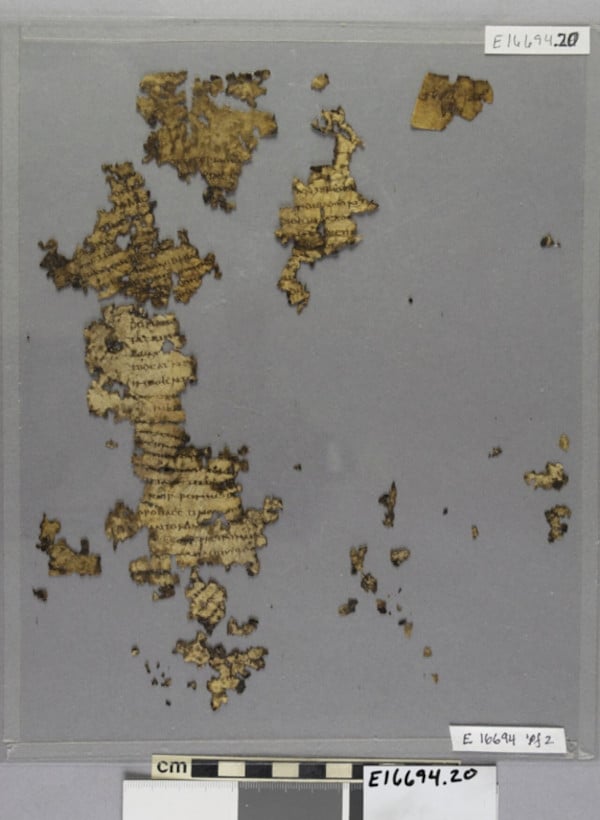
The fifty fragments of animal skin that preserve a double-sided fourth-century Latin legal text. (Penn Museum)
Taxes, Roads and Grain Kept the Empire Moving
According to the account provided by the University of Cincinnati, the surviving texts are related to roads and raising taxes to maintain public infrastructure. Some of the laws required that wealthy citizens repair roads and provide grain for the food supply, while another law warned people not to treat public buildings as private property.
The texts reveal that the imperial requirements became practical local obligations.
Wibier compared the texts with the Theodosian Code, a 16-book compilation of imperial laws which came into use in 439 AD, but he came to the conclusion that the document originated from elsewhere. The Library of Congress has a sixth-century version of this code, which speaks about the volume of the late Roman codification and vulnerability of the material used in law books.
Other works, e.g. Corpus Juris Civilis, were written in a more systematic manner, so the smaller find provides evidence that selected imperial laws circulated outside the large surviving codes.
According to the words of Professor Daniel Markovich, the head of Cincinnati’s Department of Classics:
“What makes this discovery particularly remarkable is that, unlike nearly all other fragmentary Roman law books, this text does not correspond to any known imperial legal code.”
- Fantastic New Digital Map Adds 100,000 km to Roman Road Network
- 2,000-Year-Old Roman Road Discovered Linking Frontier Forts Across the Swabian Alb
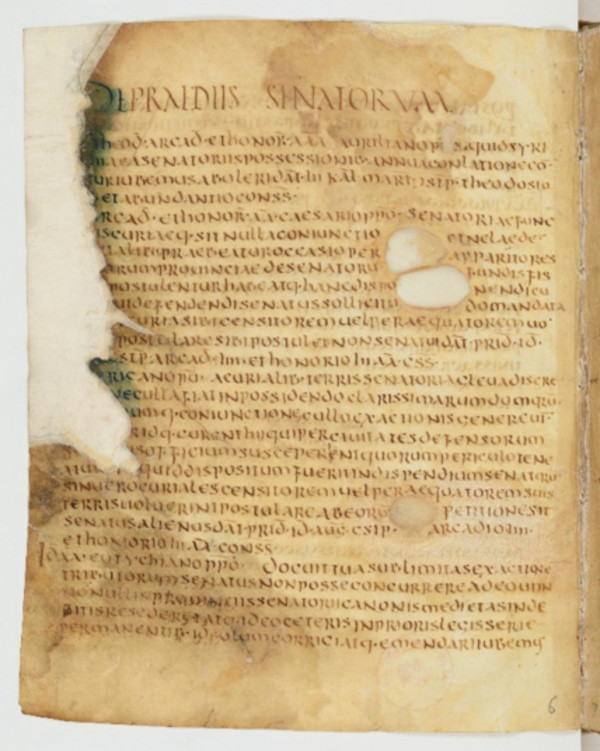
A sixth-century parchment page from Books Six, Seven and Eight of the Codex Theodosianus. (Library of Congress)
Ultraviolet Light Recovered the Faded Latin
The contrast produced between ink and parchment using ultraviolet light allowed Wibier to retrieve some of the hidden words that were invisible in normal light. Similar imaging techniques have revealed erased writings on medieval manuscripts along with other writings related to earlier philosophical texts beneath later writings. Three red-ink marks added by a scribe on one side of the page and the absence of markings on the other side, combined with the textures of skin, aided the researcher in determining which side of the page came first in the codex.
The textured hair side of the animal's skin formed the odd-numbered page on the right of the codex and the smoother flesh side faced the left. The physical details of the codex tell us about how ancient readers physically handled and read through a legal book. The process echoes work on the Herculaneum papyri, where new technology is recovering material once considered unreadable.
What the Roman Law Parchment Changes
Ancient Rome under Constantius and Julian was vast, stretching from what is now England, across Europe all the way to Egypt and Syria. This included tens of millions of people. Wibier notes:
“The things the empire values is keeping the population fed, particularly in cities. If there isn’t enough grain in Constantinople, people will protest, which is dangerous. And they want to make sure the military is well provisioned. Those are very big concerns.”
“There is a concern with having too many wealthy people that can raise their own armies,” he said. “The empire makes sure there are essential services. And people with money have to pay for that system. It’s hierarchical. But it also ensures there is no challenge to the emperor.”
The Roman law parchment was not a replacement for the imperial codes but, rather, it showed how selected imperial decrees or laws circulated among officials, landowners, and legal advisers through the empire, as opposed to what was written down more formally by the government. A small handbook could have contained just that which would allow an official, taxpayer or advocate who sought answers regarding the issue of transport (for example), the movement of grain, and property.
Wibier’s full study is due in Il Codice Teodosiano, edited by Detlef Liebs and Dario Mantovani for Pavia University Press. The research was supported by the European Research Council and the Semple Classics Fund. Penn Museum curator Jennifer Houser Wegner said it demonstrates “the immense potential within museum collections that house unpublished manuscripts,” in the University of Cincinnati release. Fifty fragile scraps have restored a lost page—and the obligations that helped hold an empire together.
Top image: University of Cincinnati Assistant Professor Matthijs Wibier in the UC Classics library. Source: Connor Boyle/University of Cincinnati
By Gary Manners
References
Abercrombie, J. R. 1978. Egyptian Papyri. Available at: https://www.penn.museum/sites/expedition/egyptian-papyri/
Library of Congress. n.d. Books Six, Seven, and Eight of “Codex Theodosianus”. Available at: https://www.loc.gov/item/2021668234/
Miller, M. 2026. Roman law expert pieces together ancient legal history. Available at: https://www.uc.edu/news/articles/2026/02/uc-penn-parchment-ancient-roman-tax-law.html
Penn Museum. n.d. Egyptian Section. Available at: https://www.penn.museum/about-collections/curatorial-sections/egyptian-section
University of Cincinnati. 2026. Expert pieces together puzzle from fragments of 1,600-year-old Roman text. Available at: https://phys.org/news/2026-08-expert-pieces-puzzle-fragments-year.html






















