
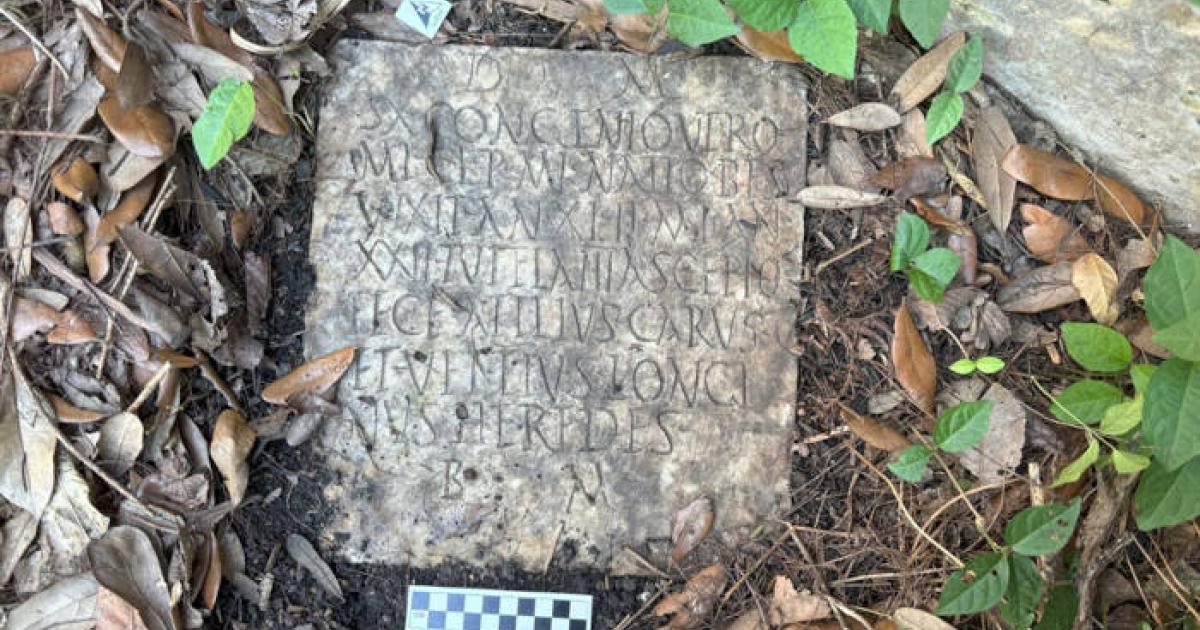

A New Orleans couple have uncovered a 2nd-century Roman headstone in their Carrollton backyard, inscribed with the name of a naval sailor - Sextus Congenius Verus. The marble slab, likely looted during World War II, was identified as a missing artifact from an Italian museum. Now in FBI custody, it awaits repatriation to Civitavecchia, with questions being raised about just how it reached Louisiana.
Daniella Santoro, a Tulane University anthropologist, and her husband, Aaron Lorenz, found the stone while clearing weeds at 1106 Cambronne Street. The slab, roughly 3 feet by 2 feet, bore faded Latin text. Santoro contacted Dr. D. Ryan Gray, an archaeologist at the University of New Orleans, suspecting it might indicate a buried cemetery, common in New Orleans’s history of above-ground tombs reports the Preservation Resource Center of New Orleans.
Gray examined the inscription - “D M SEXTVS CONGENIVS VERVS NAVALIS” - which honored Verus, a sailor, erected by his heirs, Atilius Carus and Vettius Longinus. Recognizing its Roman origin, he reached out to international experts to confirm its significance.
- Roman Chronicle Fragments Offer a New Glimpse of Emperor Hadrian’s Agenda
- Plotinus: Platonism with a Twist for Christian, Muslim, and Jewish Thinkers

Daniella Santoro and Aaron Lorenz with the mystery engraved stone found in Louisiana. (Courtesy of Susann Lusnia/PRCNO)
Inscription Points to Roman Navy
The headstone, a funerary “libation inscription,” dates to the 2nd century AD, likely from the reign of Hadrian or Antoninus Pius. It originates from Centumcellae, now Civitavecchia, a key Roman port 50 miles (80 km) from Rome. Such stones lined necropolis roads, where passersby poured offerings for the dead. Verus, a naval sailor, likely patrolled Mediterranean trade routes.
Gray sent images to Prof. Harald Stadler at the University of Innsbruck, whose brother, a Latin specialist, translated the text. Dr. Susann S. Lusnia, a Tulane classical studies professor, matched the slab to a Civitavecchia museum inventory, listed as missing since 1954. “It’s an exact fit,” Lusnia told The Guardian.
The inscription’s style aligns with Flavian-era markers from ports like Ostia Antica.
The slab’s discovery prompted Lusnia’s team, dubbed “Team Tombstone,” to research its context. Roman naval tombstones, often simple, honored sailors who died young, their inscriptions preserving personal legacies. Similar artifacts, found at sites like Misenum, highlight the navy’s role in Rome’s economy.
Wartime Looting Suspected
Civitavecchia’s museum acquired the headstone in the 19th century from local excavations. Allied bombings in 1943–44 destroyed much of the town, a strategic Axis port, scattering artifacts. The stone was likely looted during the 1944 liberation by U.S. troops, possibly from the Fifth Army. “Postwar chaos made such losses common,” Gray said in the PRCNO report.
New Orleans - a WWII port - hosted thousands of GIs. The stone may have arrived as a soldier’s souvenir, later used as a garden slab. Checks at the National WWII Museum cleared a neighbor who served in the Pacific, but broader records are unexamined. The FBI’s Art Crime Team now secures the artifact, coordinating its return to Italy.
Repatriation and Local Context
New Orleans’s cemeteries, like St. Louis Cemetery No. 1, use Roman-inspired vaults, but an authentic Roman artifact is rare. Unlike speculative finds like the Oak Island sword, this stone has clear provenance. Postwar looting was rampant - U.S. customs seized 70,000 illicit items in the 1940s, per the Antiquities Coalition.
Lusnia, after visiting Civitavecchia in 2025, confirmed the museum’s intent to display the stone. Its cracks suggest ancient ritual damage, later worsened by handling. Tess Davis of the Antiquities Coalition emphasized repatriation’s importance, citing cases like the Benin Bronzes.
The headstone’s path remains unclear, but its return to Italy nears. “It’s a piece of history heading home,” Gray said. In a city of layered pasts, this find links New Orleans to ancient Rome, highlighting the global reach of looted artifacts.
Top image: The stone before removal with its inscription visible. Source: Preservation Resource Center of New Orleans
By Gary Manners
References
Davis, T. 2025. Repatriation Ethics in the Age of Discovery. Available at: https://theantiquitiescoalition.org/news/
Gray, D.R. 2025. How did a 2nd Century Roman Headstone Wind Up in a New Orleans Backyard? Available at: https://prcno.org/how-did-a-2nd-century-roman-headstone-wind-up-in-a-new-orleans-backyard/
Lusnia, S.S. 2025. From Centumcellae to the Crescent City: Tracing a Lost Inscription. Tulane University Press.
Stadler, H. 2025. Latin Epigraphy and Modern Mysteries. University of Innsbruck Journal of Classics. Available at: https://www.uibk.ac.at/classics/epigraphy-2025