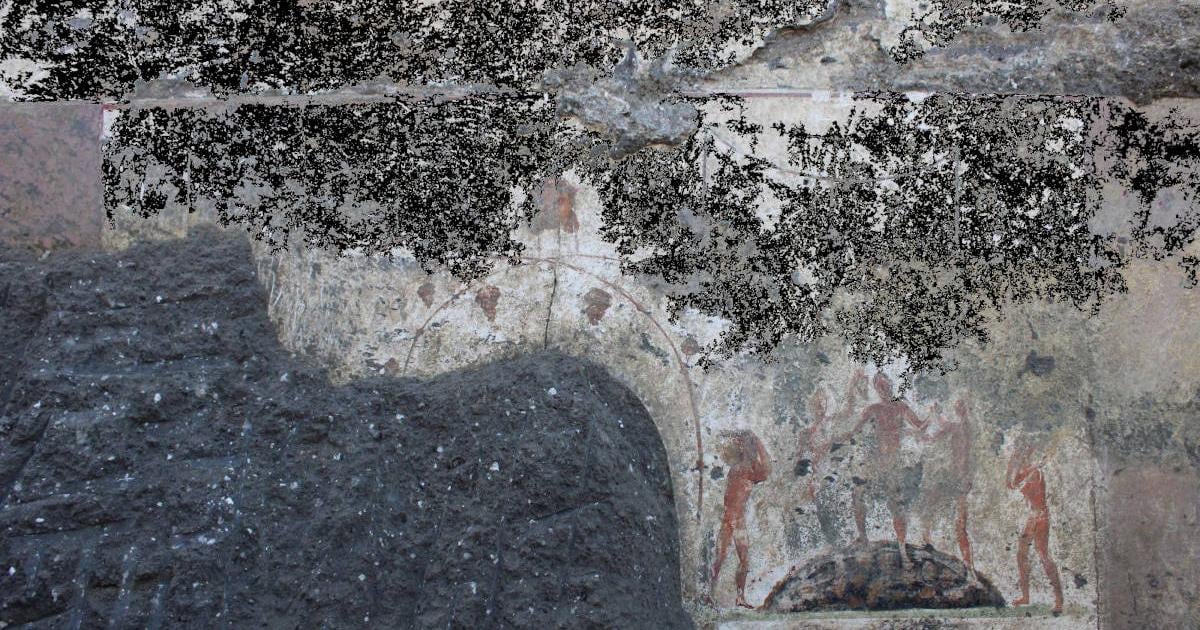

Archaeologists continue to unveil the long-hidden secrets of Villa Cuomo, an ancient rural estate located in Sant’Antonio Abate, near Naples, Italy. Among the most significant findings at this site are a set of breathtaking wall frescoes illustrating the various activities involved in grape harvesting (for wine production), illuminating the agricultural practices of the Romans and the deeper (sacred) meaning of those practices to the people.
Buried beneath three meters of lapilli during the catastrophic eruption of Mount Vesuvius in 79 AD, Villa Cuomo was initially unearthed in 1974, and has been offering fresh perspectives on Roman rural life and culture ever since.
A Working Estate with Fantastic Frescoes
Unlike the luxurious residences of Pompeii and Herculaneum, Villa Cuomo functioned as an agricultural estate, a pure working farm. Its layout was basic and functional, featuring service rooms arranged around a central courtyard with unplastered brick columns. Recent excavations have reinforced the site’s historical importance, providing further evidence of its role in the region’s agricultural economy.
- Opulent Roman Winery With Fountains of Grape Juice Uncovered
- No One Questions that Vikings Drank; But Did They Make Wine?
One of the most striking discoveries at Villa Cuomo is a collection of detailed paintings portraying the various steps involved in grape harvesting. These frescoes emphasize the villa’s deep connection to viticulture and the cult of Dionysus, a god of revelry and rebellious energy from the Greek world who was renamed Bacchus by the Romans.
The artwork not only captures the technical aspects of grape growth and harvesting, but also reveals its ritualistic and communal significance. For the Romans, the grape harvest and the ceremonies connected to it were parts of a celebration of abundance, closely linked to vital religious and social customs.
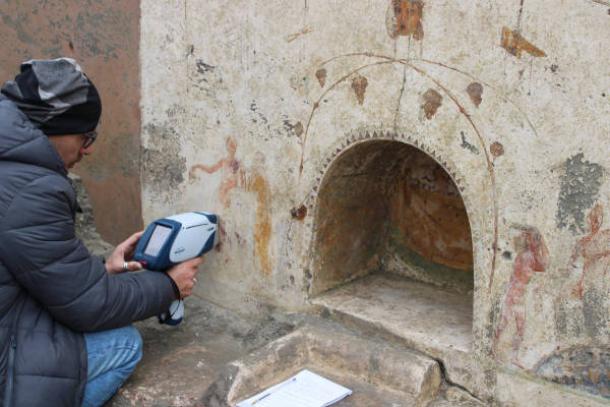
Archaeologist carefully uncovering painted images pf grape harvesting found on the walls of Villa Cuomo. (ABAP Superintendence for the Metropolitan Area of Naples)
These paintings provide a rare glimpse into the integral role of grape growing and winemaking in both everyday life and sacred traditions among the Romans, and it is remarkable to find such revealing works of art in an environment that would have been otherwise production-oriented and utilitarian.
Advanced Techniques to Preserve Ancient Murals
To ensure the longevity of these delicate frescoes, a dedicated team led by Dr. Davide Melica, a specialist in restoration and conservation, has initiated an extensive preservation project. The team employs non-invasive techniques combined with laboratory analyses to assess the condition of the murals and determine the most effective restoration strategies.
A key technique being utilized in this effort is X-ray fluorescence (XRF) spectrophotometry. This analytical method helps researchers identify the chemical composition of the pigments used in the frescoes. By understanding the materials and techniques employed by ancient Roman artists, conservationists can develop targeted approaches for preserving these valuable artworks while also expanding our knowledge of historical painting methods.
- Make Wine Not War: Digs in England Reveal 1st Century Roman Vineyard
- Dionysus, the Mysterious Greek God of Wine and Ecstasy
The ABAP Superintendence for the Metropolitan Area of Naples has emphasized the importance of these studies in a statement on Facebook, noting that XRF spectrophotometry provides crucial insights into the elements that make up the fresco’s pigments. These findings will guide future restoration efforts and deepen our understanding of Roman artistry.
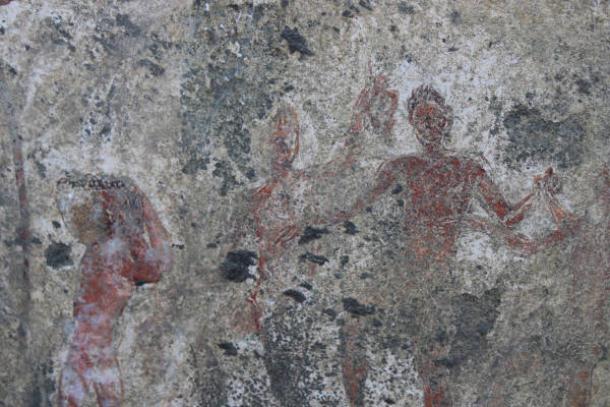
Close up of figures involved in grape harvesting activities and Dionysian ceremonies on frescoes of Villa Cuomo. ( ABAP Superintendence for the Metropolitan Area of Naples).
Winemaking and the Sacred Grape Harvest
Wine was central to Roman culture, serving as an essential element of daily life, social gatherings, and religious ceremonies. Unlike other beverages, it was consumed by people of all social classes, from elite citizens to common laborers, travelers, and slaves. Roman winemakers produced vast quantities of wine to meet the demand of an ever-growing population with a seemingly unquenchable thirst.
Historical estimates suggest that the average Roman citizen consumed a bottle of wine per day. This daily intake was possible due to the relatively mild alcoholic content of ancient wines compared to modern varieties. Furthermore, since water sources in the Italian Peninsula were not always reliable, Romans often turned to wine as a safer alternative to drinking water, believing it could counteract health risks associated with contaminated water supplies.
Beyond its role as a common beverage, wine played a significant role in religious practices.
The Romans revered Bacchus, the god of wine, fertility, and festivity, attributing to him the discovery of the vine and the perfection of winemaking. His cult was especially popular, drawing devotees who embraced the ecstatic and uninhibited nature of Bacchic celebrations. The frescoes at Villa Cuomo serve as a direct reflection of Bacchus’s influence on Roman society, revealing the profound connection that existed between harvests and spiritual practices.
The prominence of Bacchus's cult eventually waned as Rome transitioned to Christianity, leading to the decline of traditional pagan celebrations. But the frescoes at Villa Cuomo function as a vivid reminder of a time when Bacchus was perhaps the most popular deity in the traditional Roman pantheon.
Preserving the Fascinating Heritage of Villa Cuomo and Ancient Rome
Villa Cuomo was discovered in 1974 after an intense storm revealed traces of ancient structures. Archaeologists then began excavations, uncovering a site that had remained hidden since the infamous eruption of Mount Vesuvius in the first century AD.

Villa Cuomo. (ABAP Superintendence for the Metropolitan Area of Naples).
The villa originally featured a two-story design with an external staircase leading to the upper level. Experts believe the estate dates back to the Republican era (first century BC) but underwent modifications during the imperial period.
To the north of the farmyard, archaeologists identified a spacious room with a beaten stone floor, a niche for a lararium (a small shrine for household gods), and a circular structure believed to be the base of a millstone. Just outside, a room with a masonry basin has been interpreted as a drinking trough for animals. Near the entrance, a small chamber served as a guardhouse.
The most remarkable aspect of Villa Cuomo remains its wall paintings, which not only celebrate winemaking but also depict various animals and plants that were essential food sources. These artworks provide valuable insights into the artistic sensibilities of the time, while at the same time offering a window into daily life on a working farm in ancient Rome.
The restoration of Villa Cuomo represents a crucial step in safeguarding the historical and cultural heritage of the Naples region, rooted as it is in the most famous era of history on the Italian peninsula. Ongoing preservation efforts aim to transform the site into a key cultural landmark, allowing visitors to experience firsthand how Roman agriculture, religion, and art were all part of an integrated whole.
Top image: Dionysian-themed frescoes of grape harvesting being carefully uncovered from beneath the layer of hardened Vesuvius ash that has covered them since 79 AD.
Source: ABAP Superintendence for the Metropolitan Area of Naples.
By Nathan Falde