
A historically significant discovery at a Roman-era cemetery in York, England, has provided the first direct physical proof that gladiators really faced off against wild animals—specifically lions—in life-or-death spectacles. Although ancient writings and mosaics have long depicted such brutal combats, no archaeological evidence had ever confirmed the reality of these battles, until now.
Excavations at Driffield Terrace on the outskirts of York unearthed a cemetery dating back roughly 1,800 years, to the time when England was occupied by the Romans. Within it lay 80 decapitated skeletons, most of which belonged to robust young men. For years, these remains were thought to be either soldiers or slaves due to their physical condition and signs of violence. But new forensic analysis has upended that narrative.
One skeleton in particular—a man between the ages of 26 and 35—caught the attention of researchers. Buried in a grave shared with two others and topped with horse bones, the man’s pelvis bore strange puncture wounds. These injuries, initially attributed to an animal attack, puzzled experts for years. It wasn’t until researchers compared the damage to modern examples of bones featuring the teeth marks of big cats like lions, leopards, and tigers that a match was found.
Matching the Bite to the Beast
To better understand the wounds, the research team collaborated with several zoos in the UK. They examined the damage done to horse bones by captive big cats to compare with the injuries found on the York skeleton. The bite marks aligned most closely with those inflicted by lions.
“For years, our understanding of Roman gladiatorial combat and animal spectacles has relied heavily on historical texts and artistic depictions,” Tim Thompson, an anthropologist from Maynooth University in Ireland and lead author of the new study, said in a University of York press release. “This discovery provides the first direct, physical evidence that such events took place in this period, reshaping our perception of Roman entertainment culture.”

Pelvic bone of ancient gladiator showing bite marks made by a lion. (Maynooth University).
What made this find even more intriguing was the location of the bite. Instead of targeting the head or neck—areas where lions typically kill—the marks were on the pelvis. This led the researchers to believe the man may have already been incapacitated when the animal bit him, before being dragged around by the lion after his death.
“The pelvis is unusual. You can survive that injury, it’s not fatal,” Thompson explained. “We think the individual had been incapacitated and that these marks are evidence of the animal dragging the body away.”
It does seem likely that the man died in combat before being bitten. The bite wound did not show signs of healing, suggesting it was inflicted either at the time of death or shortly after. The decapitation may have been part of a burial ritual rather than an execution, adding another layer of complexity to Roman funerary customs.
The Roman Thirst for Blood Ignored Borders
The implications of this discovery stretch beyond a single gruesome event. It shifts the spotlight away from Rome’s Colosseum and suggests that gladiator combat—including the infamous bestiarii who fought wild animals—was a feature of life even in the far provinces of the Roman Empire.
“We often have a mental image of these combats occurring at the grand surroundings of the Colosseum in Rome,” said Malin Holst, an archaeologist from the University of York and co-author of the study. “But these latest findings show that these sporting events had a far reach, well beyond the center of core Roman territories.”
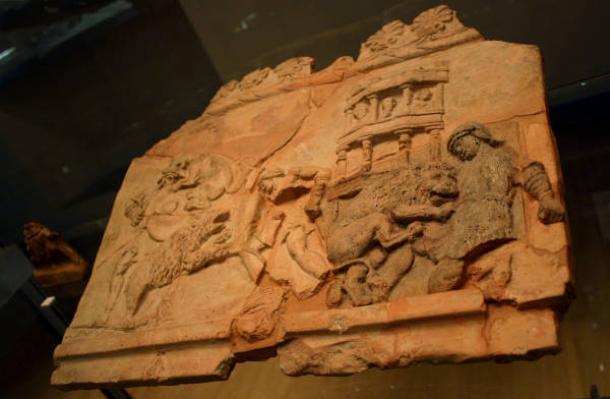
Ancient Roman terracotta plaque, dating from the 1st century, showing a hunting scene inside an arena, now in the Antiquarium in Milan, Italy. (©Giovanni Dall'Orto)
At the time, York was both a Roman town and a key military fortress, second only in population to Londinium (modern-day London). This makes it plausible that gladiators trained at a local ludus—a gladiatorial school—possibly linked to the stationed Roman legion.
“These may be gladiators who trained in a gladiatorial school at York linked to the Roman legion based there, and their comrades from the arena or training ground took responsibility for burying them,” Dr. John Pearce of King’s College London explained to the Guardian.
One mystery that remains is the logistics behind transporting a lion from Africa to northern Britain, an astonishing feat by any measure.
- Flamma the Syrian: The Mysterious Gladiator Who Refused Freedom
- Rare Roman Knife Handle Depicting Gladiator Found Near Hadrian’s Wall
“This shifts the conversation,” Thompson said. “We now know that these events happened in the provinces of the Roman empire, but it raises other questions. How, for example, do you get a lion from Africa to York?”
As intriguing as the discovery is, many questions remain unanswered. Chief among them is the exact location of York’s amphitheater, which has yet to be found. Due to the city's extensive preservation of historical buildings, excavating beneath modern structures presents obstacles, raising the possibility that the gladiators’ venue will never be found.

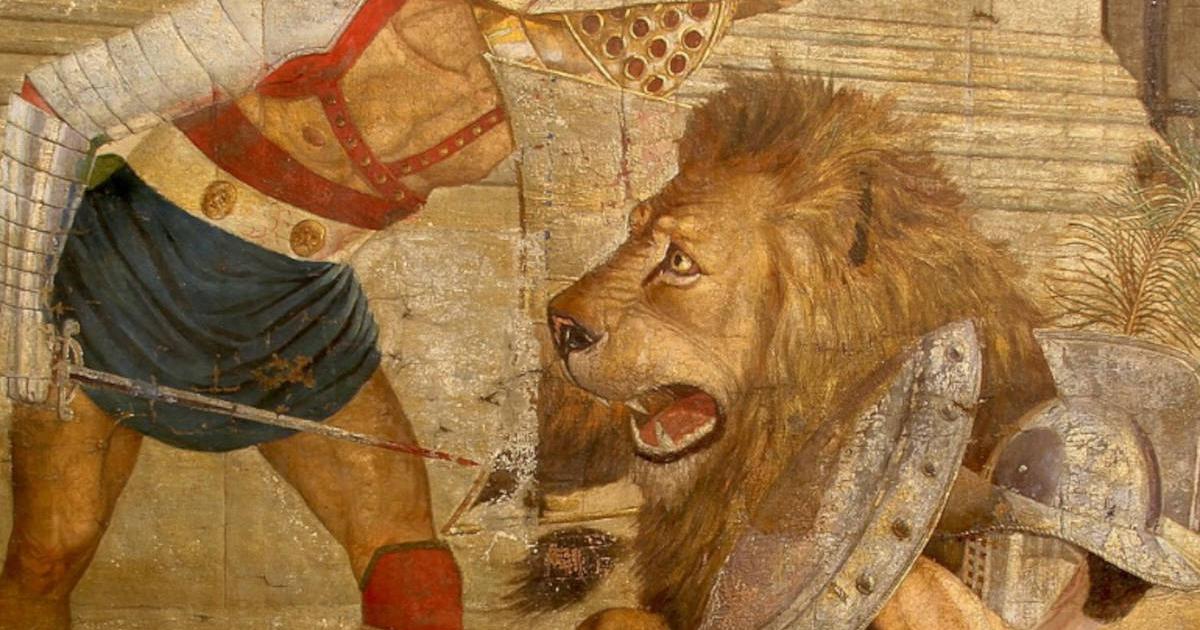
Preserved Roman fresco from villa in Merida, Spain, showing a gladiator facing off against a lion. (Yuntero/CC BY-SA 3.0).
Nevertheless, this groundbreaking evidence redefines what we know about Roman entertainment and the cultural reach of gladiatorial spectacles, which illustrated the barbaric and psychopathic nature of ancient Roman society. Men and animals were both made to suffer for their entertainment, as this new find so grimly demonstrates.
Top image: Painting of gladiator vs. lion combat in the Roman Colosseum.
Source: French Painting/Public Domain.
By Nathan Falde