Several years ago archaeologists excavating the site of the former Animal Husbandry Center at Nescot College in Ewell, Surrey, made an astonishing discovery. Beneath the surface lay the remains of an ancient Roman quarry pit, which revealed evidence of ritual practices and sacrificial offerings dating back to Britain’s Roman period. The most remarkable find was an immense collection of dog bones—5,436 in total—representing at least 140 individual canines. This assemblage is among the most extensive ever uncovered from those times, and it raises questions about the role of dogs in the spiritual and religious practices of the era.
Dr. Ellen Green, a paleopathologist from the University of Reading, set out to answer some of those questions. In a new article published in the International Journal of Paleopathology, she presents evidence the dogs discovered inside the Nescot Shaft were likely sacrificed to the gods, but only after long lives during which they were extremely well cared for by their owners. It seems they were cherished pets, perhaps only offered for sacrifice after they’d reached a certain age, or at a point when the infirmities of aging made it seem like euthanasia was the most compassionate option.
- Bow Wow, Wow! The 45 million-year-old History of Dogs, And Us!
- Dogs in the Middle Ages: What Medieval Writing Tells Us About Our Ancestors’ Pets
Dogs in Roman and Romano-British Society
Dogs played a fundamental role in both Roman and Romano-British daily life. They served practical purposes as hunting aids, livestock guardians, protectors, and faithful companions. In fact, Roman Britain was well-known for its prized hunting dogs, a reputation so prominent that even the Greek geographer Strabo documented them as one of Britannia’s valuable exports.
Beyond their utilitarian functions, dogs held profound symbolic and religious significance in Roman culture. They were associated with deities and spiritual beliefs, particularly in relation to the afterlife, protection, healing, and fertility. The underworld god Pluto was frequently depicted with a guardian dog, while Hecate, the goddess of magic and the moon, was often linked to spectral hounds. These connections suggest that dogs were believed to have protective or guiding roles in the transition between life and death, potentially explaining their presence in ritual contexts.
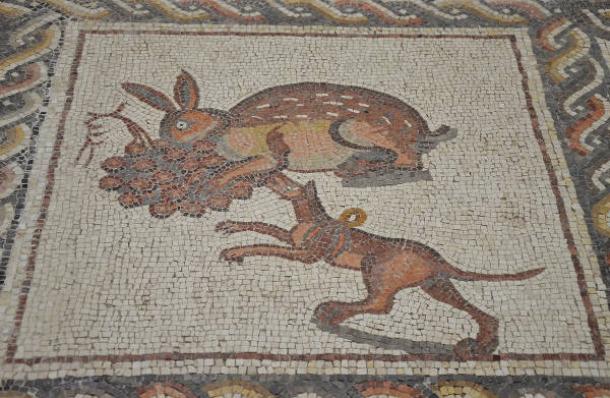
Roman hunting dog mosaic, found in Roman house in Israel dating to 300 AD. (Carole Raddato/World History Encyclopedia).
The Nescot Ritual Shaft: A One-of-a-Kind Find
The excavation at Nescot revealed an oval-shaped shaft, measuring approximately 13 feet (four meters) deep, dating back to the late first and early second centuries AD. Originally used as a Roman quarry pit, the site was later repurposed as a deposit for a diverse range of items, including animal remains, human bones, pottery, metal objects, coins, and even gaming tokens.
Archaeologists identified three distinct phases in the shaft’s use. The first two phases contained the vast majority of the faunal remains, with an overwhelming proportion belonging to dogs, while in the third phase there was a notable decline in ritual deposits, as the site seems to have been used primarily as a garbage dump.
At most Romano-British archaeological sites, dog remains account for no more than four percent of the animal bones recovered. However, at Nescot, out of 10,747 animal bones recovered more than half belonged to dogs, which makes it clear the site was used for a purpose specifically connected to dogs.
- 8,000-Year-Old Engravings in Arabian Desert Are Oldest Known Depictions of Dogs on Leashes
- A Woman’s Best Friend: The Herstory of Dog Domestication
Dr. Green’s analysis of the remains provided valuable insights into the physical conditions of the dogs prior to their deposition.
The collection exhibited a diverse range of canine types, but with a notable prevalence of smaller breeds. Some of these dogs displayed chondrodysplasia, a genetic disorder characterized by shortened limbs, akin to modern corgis. Historical sources indicate that Romans kept small companion dogs resembling the modern Maltese, which aligns with many of the Nescot specimens.
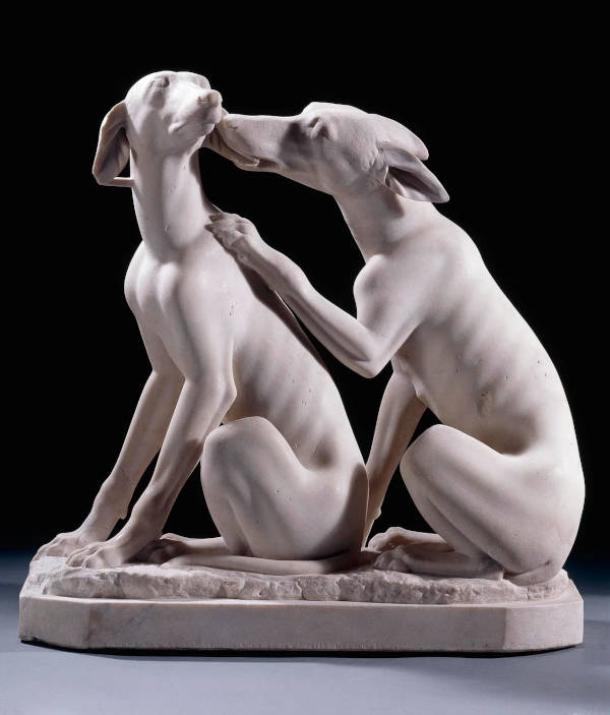
A 2nd-century Roman statue of two sighthounds playing, discovered in 1774 in Monte Cagniolo, Italy. (The British Museum London/World History Encyclopedia).
Interestingly, several of the dogs showed evidence of long-term care, as indicated by age-related conditions including spondylosis deformans, a degenerative spinal disease, and ossified costal cartilage, a condition that causes rib cartilage to harden into bone as a dog ages. In general the dogs showed signs of good health and a long lifespan, and because they were mostly small few would have been useful as working dogs.
Were the Dogs Really Sacrificed?
The presence of human remains, coupled with similarities to other ritual shafts in Roman Britain, strongly suggests that the Nescot dogs were included in ceremonial or sacrificial activities.
Dr. Green theorizes that cultural traditions influenced the selection of these animals for ritual purposes.
"The Romans had specific guidelines regarding which types, colors, ages, and sexes of animals were appropriate for sacrifice to different deities," she wrote. "It is highly plausible that these dogs were chosen based on such ritualistic criteria."
This interpretation aligns with findings from other sites. While urban Roman settlements were known to sacrifice stray dogs living in the streets, ritual sites outside the cities that were reserved for ceremonial practices have tended to produce the bones of smaller and healthier dogs during excavations. What makes the Nescot ritual shaft so unique is the sheer number of dogs that were interred there after their deaths, which is far greater than anything ever found in excavations of Romano-British sites before.
Over time, the shaft’s function shifted. By the third phase of its lifespan, the volume of animal remains had sharply declined, and those that did appear bore clear evidence of butchery, such as chop marks and fresh fractures—suggesting that they were used for food rather than religious purposes.
By the early second century AD, the shaft was abandoned for good. This change indicates that the site, once held as sacred, gradually lost its ritual significance, presumably a reflection of changing customs.
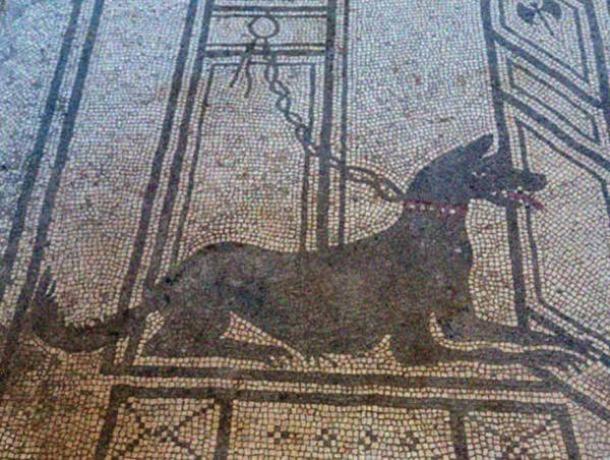
Image of guard dog or pet in Roman mosaic. (Sergii Figurnyi / Adobe Stock)
The Continuing Mysteries of the Nescot Discovery
The Nescot ritual shaft presents a unique and perplexing challenge to existing interpretations of Roman and Romano-British religious practices. It raises key questions that will take more analysis to answer, if they are answerable at all. For example: if the dogs were being sacrificed, to what Roman deity were their spirits being delivered? And does the presence of human bones in the shaft mean that people were sometimes sacrificed side-by-side with dogs?
While definitive answers remain elusive, the evidence strongly supports the notion that these dogs played a crucial role in spiritual or religious ceremonies. The discovery also highlights the blending of Roman and native British traditions, as some ritualistic dog burials have been dated to pre-Roman Iron Age Britain.
Although the exact motivations behind these deposits may never be fully understood, Dr. Green’s research presents a compelling narrative: these dogs were not simply abandoned, but purposefully chosen, venerated, and ritually interred in a practice that wove together Roman and indigenous spiritual beliefs. Their presence in the shaft serves as a haunting reminder of how deeply animals were embedded in the sacred and supernatural belief systems of ancient societies.
Top image: Statues of Roman era dogs, from first and second centuries AD, in the Archaeological Museum in Naples.
Source: Carlo Raso/Flickr/Public Domain.
By Nathan Falde