
More than 1,000 ancient bone dice have been lifted from the soil beside a single small building in northeastern France, an accumulation so extreme that archaeologists are still arguing over what it means. The hoard comes from Grand, a village of a few hundred people in the Vosges that in Roman times was a Gallo-Roman town covering more than 70 hectares, with monumental buildings, an amphitheater for 17,000 spectators and a sanctuary of the healing god Apollo Grannus, explains the Greek Reporter. With that mix of spectacle and speculation, coverage has already reached for a modern nickname: an ancient "Las Vegas".
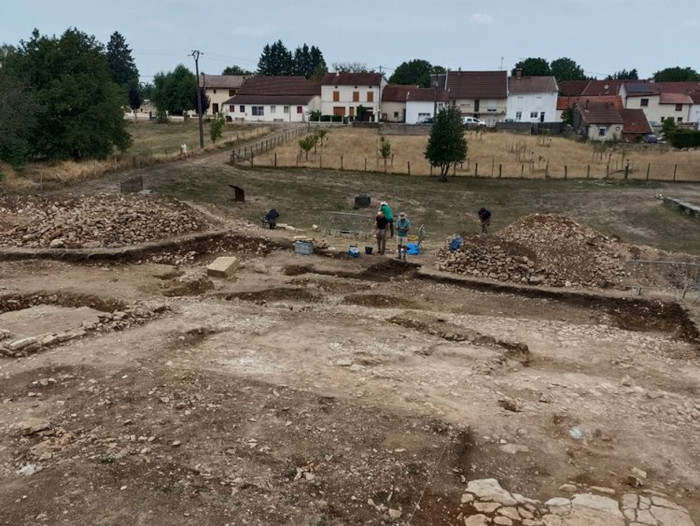
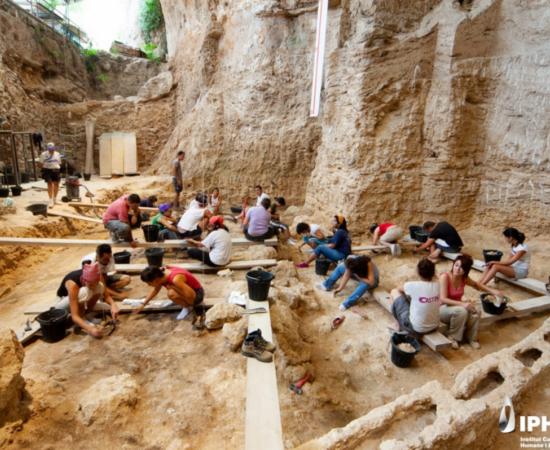
A view of the excavation site in Grand, France. (CD88/via Historia)
A Tiny Building and a Very Large Hoard
Archaeologists returned to this part of Grand in 2022 to reassess structures first examined in the 1960s. Excavations in 2023 and 2024 exposed a modest building just 4.5 by 3.8 meters beside an east-west road, the decumanus, one of the town's two principal axes. Its walls carried red-painted plaster above a yellow base, and the surrounding deposits yielded pottery, animal bones, shoe nails, bronze coins, fibulae and eyed needles, writes Historia.
Then came the dice. By July 2026 the team had recovered more than 500 of them; later reporting placed the total above 1,000, according to France 3 Grand Est. Three came from the building's foundations, suggesting they were tied to whatever happened there rather than casually lost.
"What characterizes the exceptional nature of this discovery is the quantity. Usually we find ten, fifteen. But rarely this many," said Thierry Dechezleprêtre, the chief curator leading the project, adding that the concentration is what suggests "ritual or profane practices."
- An Altered Past: Modified Dice Tells Tales of Medieval Gambling in Norway
- It's not how you play the game, but how the dice were made
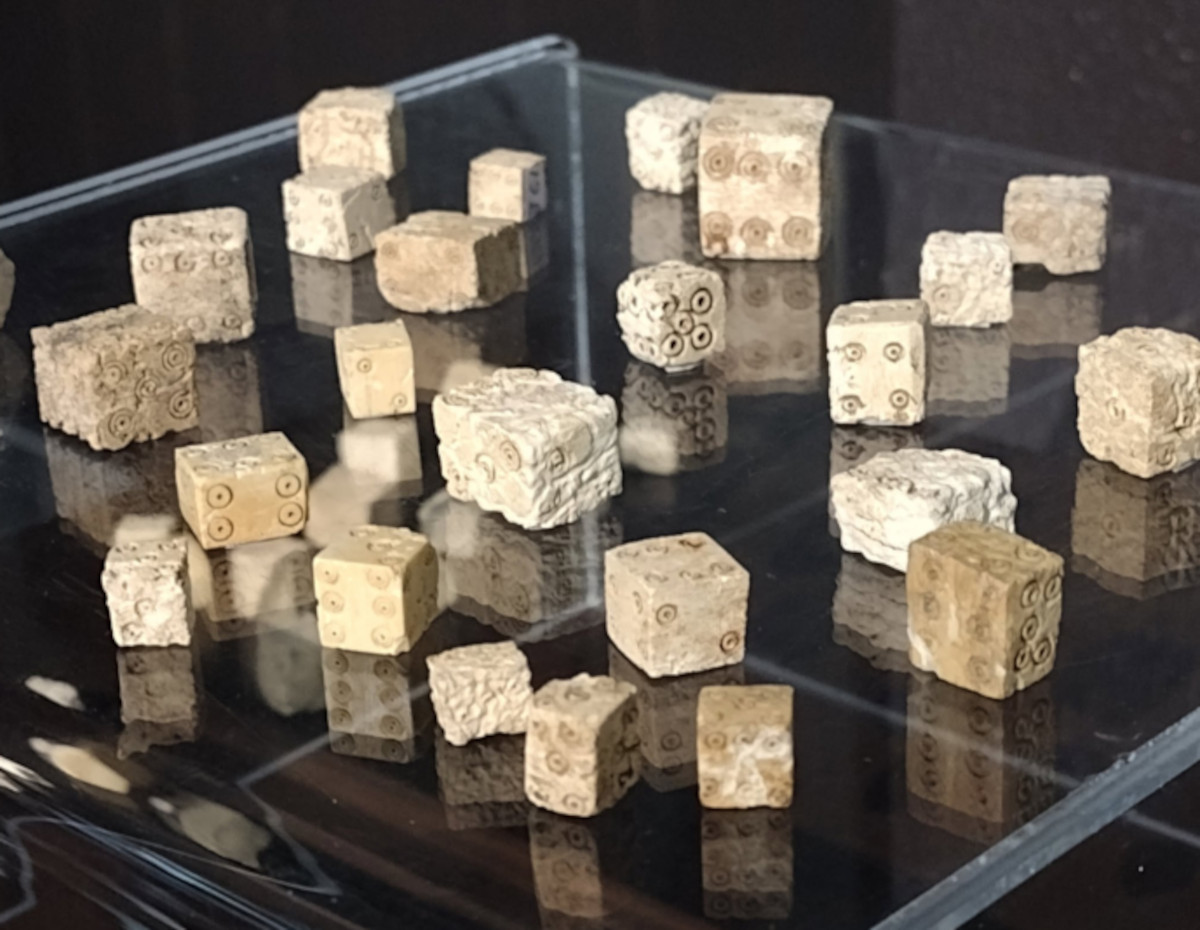
Some of the hundreds of dice found at the Gallo-Roman town of Grand. (Sites de Grand et Domremy-la-Pucelle)
Workshop, Casino or Sanctuary?
Three explanations remain in play. The structure could have been a workshop for making dice, a room where people gathered to play, or a place with a ritual function. Roman dice were never purely recreational: they were used to gamble, but also to read the future, and the line between a game and a forecast was thin. The subject of divination sits comfortably alongside that of play in the ancient Mediterranean.
Several finds tilt the balance toward devotion. The team recovered two fragments of a stone altar and the upper part of a small shrine that once sheltered a deity, along with coins, a number of them bearing the figure of Fortuna, the goddess of luck. A rectangular pit may have held a wooden basin, fed by a narrow conduit traced about 20 meters north of the building. "This set is probably linked to a context of devotion," Dechezleprêtre told Historia. Fortuna, whose Greek counterpart Tyche personified chance itself, is a fitting patron for a place where so many throws were made.
- The Evolution of Board Games: From Royal Pastimes to Global Phenomena
- Ancient Board Games Simulating War Strategies And Predicting Afterlife
Sevens, Ocelles and the Roman Love of Chance
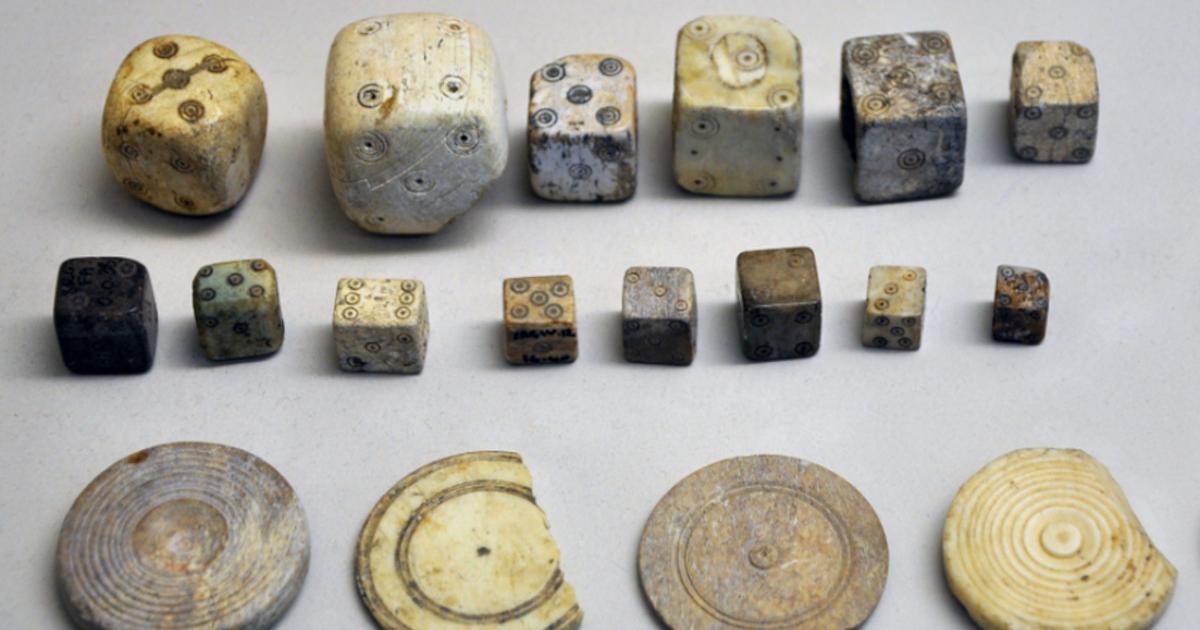
Most of the dice were carved from the bones of cattle or sheep, cut into cubes or flatter forms when the raw material was too small. Their markings are small concentric circles known as ocelles, incised with a fine metal tool and sometimes darkened with wax and charcoal to stand out against the pale bone. All follow the "sevens" arrangement, in which opposite faces add up to seven, the same scheme used on modern dice.
Some examples are oddly blank. "Generally, dice are always marked. Has their original paint disappeared? That is one hypothesis," Dechezleprêtre told Historia. Whatever they once looked like, dice were prized across the empire for play and for predicting what lay ahead.
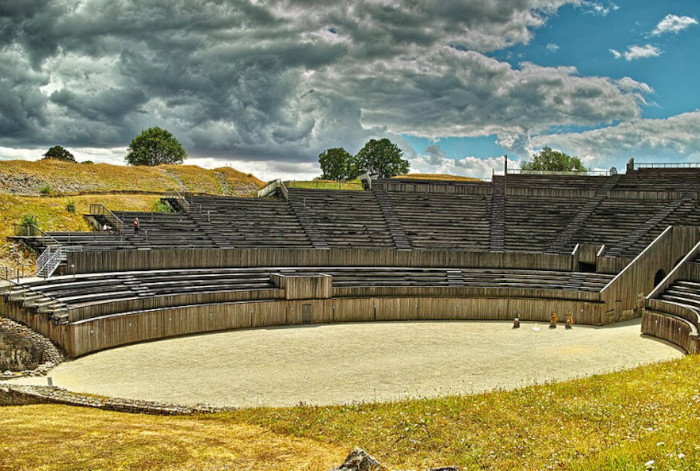
The Roman amphitheater of Grand. (PY54/CC BY-SA 4.0)
A Roman Town That Lived Up to Its Name
Grand was never a backwater. Its amphitheater spanned about 148 meters and could hold more than 17,000 spectators, who gathered for gladiatorial contests and animal displays. Nearby lies a mosaic of more than 220 square meters inside a monument traditionally identified as a basilica, among the largest floors of its kind preserved in Gaul, and comparable to other Gallo-Roman mosaics unearthed in France.
Religion gave the town its pulling power. Its sanctuary honored Apollo Grannus, a healing deity whose cult drew visitors seeking cures and sacred waters, a tradition echoed in Roman healing sanctuaries elsewhere in the empire. An underground conduit at Grand may have carried spring water toward the town's baths.
The dice do not prove that Grand was a Roman casino, and the excavation report makes no such claim. What they suggest is a place where craft, play and prayer overlapped in ways modern categories struggle to separate.
Top image: A collection of Roman bone dice and gaming counters from the Gallo-Roman Museum of Saint-Romain-en-Gal, France. The dice are cut with the small concentric circles known as ocelles. Source: Vassil/ CC0 1.0
By Gary Manners
References
Arkeonews. 2026. An 'Ancient Las Vegas'? More Than 1,000 Bone Dice Unearthed at a Roman Town. Available at: https://arkeonews.net/an-ancient-las-vegas-more-than-1000-bone-dice-unearthed-at-a-roman-town/
France 3 Grand Est. 2026. La plus importante collection de dés à jouer de l'Antiquité mise au jour lors de fouilles archéologiques dans les Vosges. Available at: https://france3-regions.franceinfo.fr/grand-est/vosges/la-plus-importante-collection-de-des-a-jouer-de-l-antiquite-mise-au-jour-lors-de-fouilles-archeologiques-dans-les-vosges-3389842.html
Greek Reporter. 2026. 1000 Roman Dice Found in France Spark 'Ancient Las Vegas' Mystery. Available at: https://greekreporter.com/2026/10/08/roman-dice-france-las-vegas/
Neyret, E. 2026. Archéologie : un exceptionnel ensemble d'au moins 1000 dés de l'époque gallo-romaine découvert dans les Vosges. Historia. Available at: https://www.historia.fr/archeologie/civilisations-anciennes/archeologie-un-exceptionnel-ensemble-dau-moins-1000-des-de-lepoque-gallo-romaine-decouvert-dans-les-vosges-2245488
Newcomb, T. 2026. A Hoard of 1,000 Ancient Bone Dice Has Archaeologists Completely Stumped. Popular Mechanics. Available at: https://www.popularmechanics.com/science/archaeology/a74066978/1000-ancient-roman-dice/
Ouest-France. 2026. Dans ce petit village, ils découvrent un millier de dés à jouer enterrés, mais personne ne sait à quoi ils servaient. Available at: https://www.ouest-france.fr/leditiondusoir/2026-08-18/dans-ce-petit-village-ils-decouvrent-un-millier-de-des-a-jouer-enterres-mais-personne-ne-sait-a-quoi-ils-servaient-55357b89-a52b-4dca-bcf0-1f1f4c20c550