
Why so many Roman coin hoards end up being buried and never found has baffled archaeologists for decades. A major new study has shown that the non-recovery of these hoarded treasures was caused by several major periods of insecurity caused by war, invasion, and natural disasters, rather than an accident. The research helps illustrate the extent of the vulnerability of the Roman Empire and how fragile human existence can be during times of turmoil.
The new study, published in the Journal of Ancient History and Archaeology, was led by researchers Cristian Găzdac and Adrian-Daniel Stan from the Institute of Archaeology and Art History of Cluj-Napoca & Babes-Bolyai University. The researchers were able to create maps connecting the occurrence of unrecovered hoards and historical crises using the Coin Hoards of the Roman Empire (CHRE) database, which contains more than 18,200 entries and more than 7.5 million individual coins. Using hoards that have between 100 and 10,000 coins with dates ranging from the 1st to the 3rd century AD, the researchers filtered the data to remove ritual and accidental hoards from the analysis, thereby allowing them to study hoards that were obviously meant to be retrieved later.
- Record-Breaking Hoard: 15,000 Roman Coins Unearthed in Wales
- Huge Number of Coins Unearthed in Roman "Piggy Banks" in France
Tracing Tragedies Through Buried Treasure
The researchers compared the geographical and chronological distribution of these hoards with known historical events. The results were striking. A clear pattern emerged: areas affected by significant violence or disaster showed large concentrations of unrecovered hoards.
For instance, the Battle of the Teutoburg Forest in 9 AD, where three Roman legions were annihilated by Germanic tribes, corresponds directly with a cluster of hoards near the battle site of Kalkriese. These soldiers and officers buried their money in the heat of battle and never survived to reclaim it.
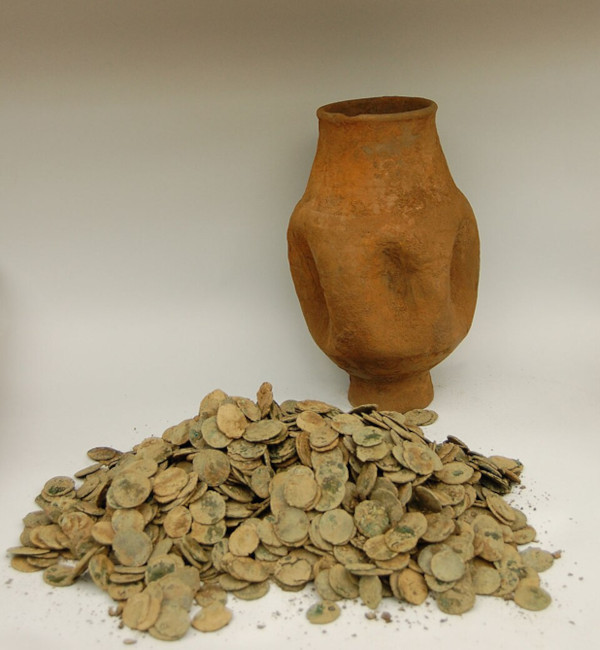
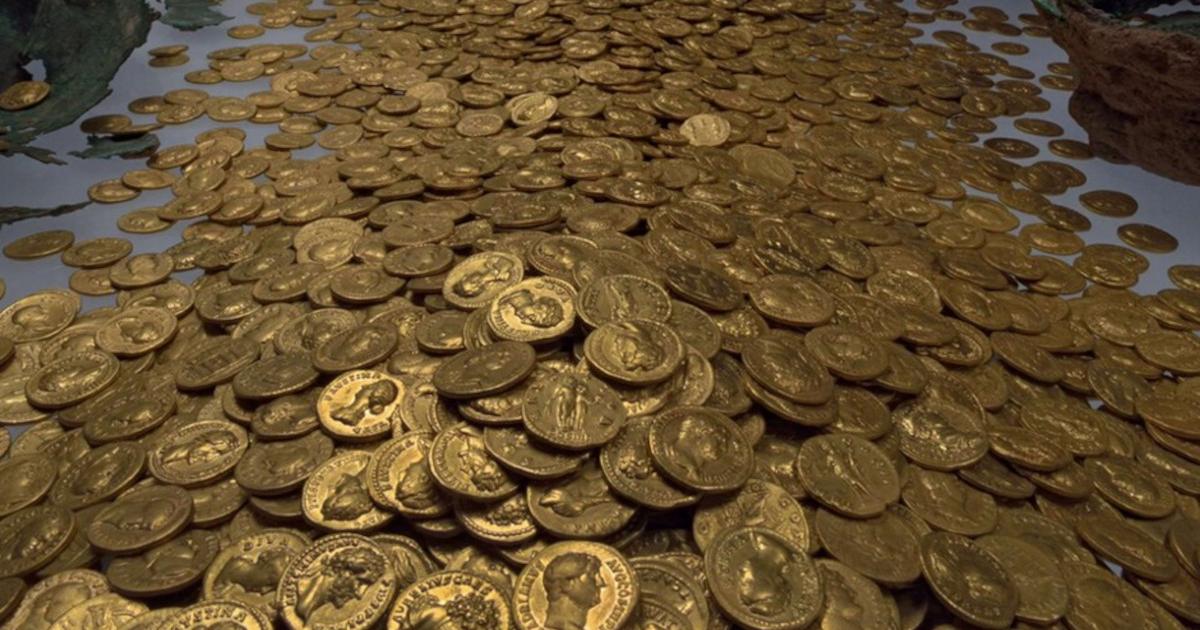
A massive collection of Roman coins. (Portable Antiquities Scheme/ The Trustees of the British Museum / CC BY-SA 4.0)
Similarly, in Britain, a concentration of hoards dating between 20 and 60 AD aligns with a period of intense conflict, including tribal wars, the Roman invasion of 43 AD, and Boudicca's revolt. The accumulation of finds in the southeast of England during this time reflects a prolonged period of fear and violence.
Natural Disasters and Imperial Crises
The study also highlights the impact of natural disasters. Between 70 and 90 AD, hoards almost disappear from Britain, a time of relative peace. However, a significant cluster appears around Mount Vesuvius, directly linked to the devastating eruption in 79 AD that buried Pompeii and Herculaneum.
Further evidence comes from the Danube frontier during the Dacian Wars (85–106 AD) and later Gothic invasions. The maps show clear concentrations of unrecovered hoards corresponding to these military campaigns, indicating that troops and civilians alike buried their savings as they faced invading forces.
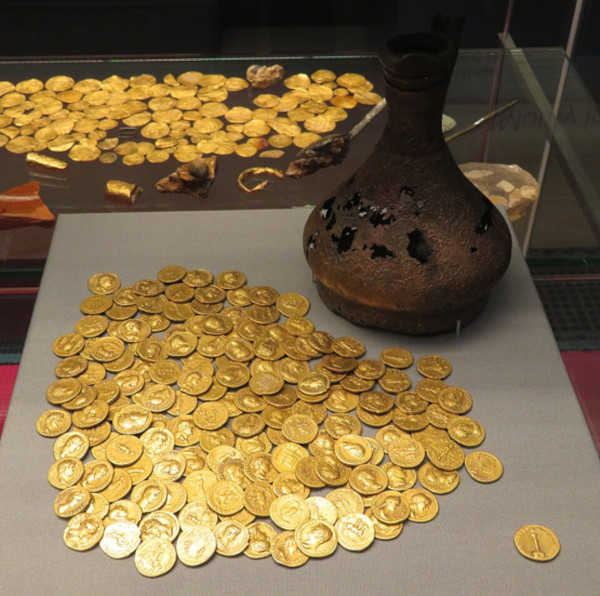
The Corbridge Hoard of Roman gold coins. (BabelStone / CC BY-SA 3.0)
The most dramatic concentration belongs to the Crisis of the Third Century (251–270 AD). During this chaotic period, the Roman Empire faced invasions from Franks, Alemanni, and Goths, alongside internal civil wars. The study identified 940 hoards distributed precisely in the affected regions, such as Gaul, Pannonia, and the Balkans. The owners of these hoards were victims of widespread violence, forced to flee or killed before they could return for their wealth.
Two Questions, Two Answers
The authors emphasize the importance of separating the reason for burial from the reason for non-recovery. While people buried coins for economic security or to protect assets, the failure to retrieve them points to insecurity - either collective events like wars and invasions or individual tragedies such as death or displacement.
"Roman hoards thus reflect not only episodes of instability, but also enduring human vulnerabilities," the researchers conclude. "They remain in the ground as archaeological witnesses to the Empire’s crises and the fragility of human plans."
This comprehensive study demonstrates that the thousands of Roman coin hoards found today are not just collections of metal, but poignant reminders of lives interrupted by tragedy.
Top image: The Roman gold hoard found in Trier. Source: Th. Zühmer/CC BY-SA 3.0
By Gary Manners
References
Găzdac, C. & Stan, A.D. 2026. Why did they not recover the hoards? Insecurity in the Roman Empire. Journal of Ancient History and Archaeology. Available at: https://www.jaha.org.ro/index.php/JAHA/article/view/1506
La Brujula Verde. 2026. Why Did the Romans Never Recover Their Hoards? A Massive Study With 18,200 Finds Reveals the Reason. Available at: https://www.labrujulaverde.com/en/2026/06/why-did-the-romans-never-recover-their-hoards-a-massive-study-with-18200-finds-reveals-the-reason/
Archaeology Magazine. 2026. Why thousands of Roman coin hoards were never recovered, new study reveals. Available at: https://archaeologymag.com/2026/06/why-roman-coin-hoards-were-never-recovered/