
An extraordinary archaeological discovery in the central Netherlands has brought to light the remains of a previously undocumented late 4th-century Roman bridge. Found deep within the bed of the Meuse River, the discovery of massive oak piles indicates that the Roman Empire’s sophisticated road network was far more extensive in the peripheral "Rivierenland" (Land of Rivers) than previously believed. This find sheds new light on Roman military and economic strategy in northern Gaul during a period of increasing border instability.
The discovery occurred during a large-scale sand extraction operation known as the Over de Maas project near the town of Dreumel, in the Gelderland province. Since its launch in 2010, this massive project has yielded approximately 400,000 artifacts, ranging from mammoth molars and ancient vessels to Roman pottery and weapons. However, the four massive oak posts uncovered in the riverbed stand out due to their exceptional size and the historical implications of their strategic location.
- Buried Roman Canal and Road Unearthed in the Netherlands
- First Roman Temples from 2000 Years Ago Found in the Netherlands
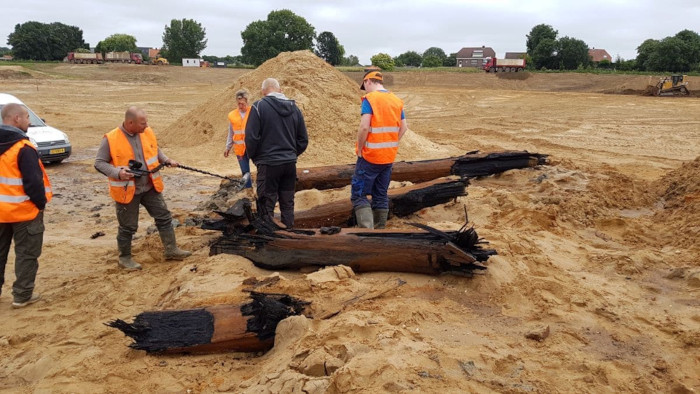
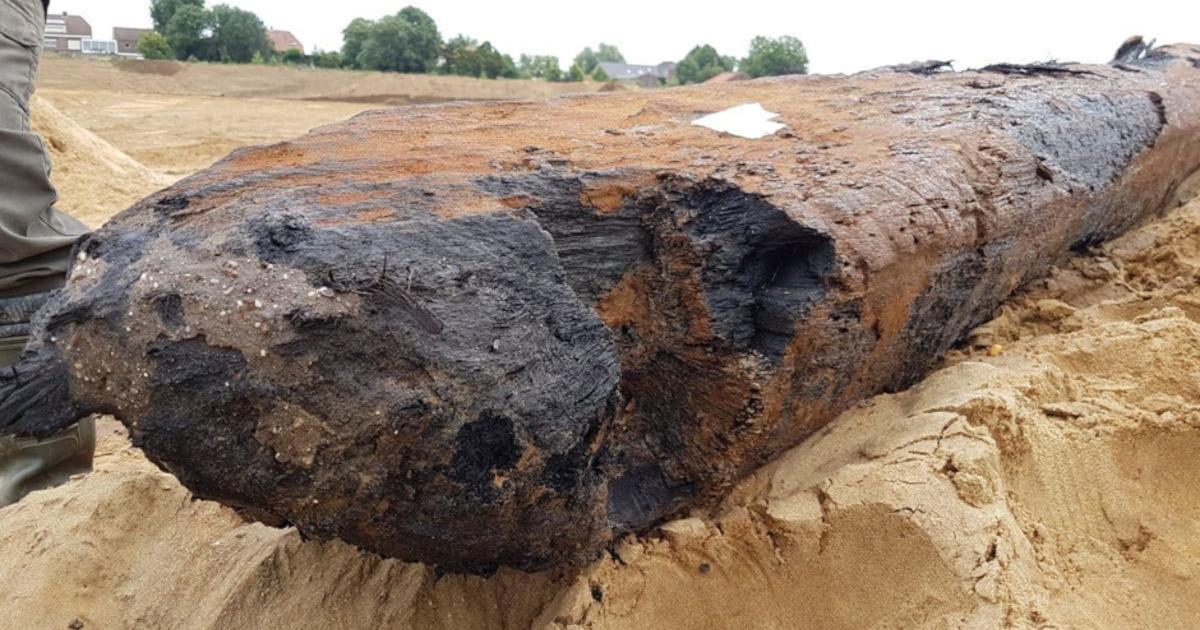
Researchers examining the four oak wood piles found in the Meuse River, Dreumel, The Netherlands. (Gelderland Province)
Uncovering the Colossal Oak Piles of Dreumel
The exhumed wooden structures are remarkable for their dimensions, with the largest piece measuring an impressive 11.5 meters (37.7 feet) in preserved length. Archaeologists estimate that the posts originally exceeded 13 meters (42.6 feet) before their upper sections decayed over centuries of exposure. The lower, pointed ends of these colossal oak piles remained firmly driven into the riverbed, perfectly preserved by the anaerobic, waterlogged conditions of the Meuse.
Traces of deliberate human craftsmanship are highly visible on the timbers. The sides of the posts were carefully flattened and squared by Roman engineers to facilitate structural assembly. Furthermore, detailed morphological inspections revealed signs of wood decay and ancient insect damage on specific sections of the timbers, indicating that these portions were not permanently submerged but emerged periodically above the river's surface.
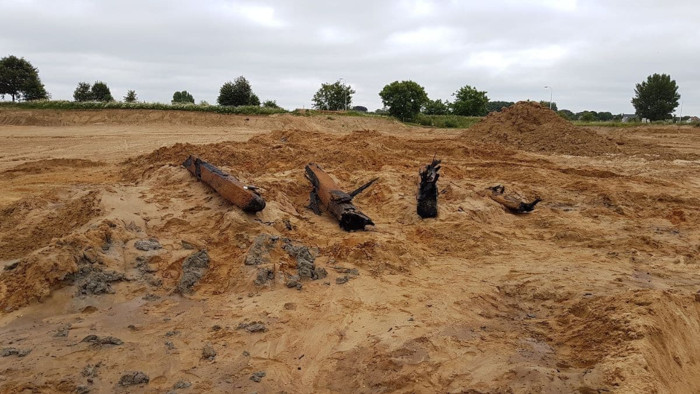
The four oak piles on the dry riverbed of Meuse River. (Gelderland Province)
Dendrochronology Pins Construction to 363 AD
To determine the exact age and purpose of the structures, the Province of Gelderland commissioned the specialized archaeological firm Vos Archeo to conduct a comprehensive study. Led by prominent archaeologist Wouter Vos, researchers utilized dendrochronological analysis (the study of tree growth rings) to establish a precise felling date for the oaks. The analysis revealed that the trees were felled in the year 363 AD, placing the construction firmly in the Late Roman period.
Initially, researchers considered whether the posts belonged to a Roman dock, jetty, or mooring platform. However, Wouter Vos concluded that several key factors point directly to a major bridge. These include the massive length of the piles, their central position within the ancient river channel, and striking structural parallels with well-documented Roman bridge remains discovered further south in the nearby town of Cuijk.
- 2000-Year-Old Roman Bridge Revealed: Swiss Excavation Uncovers Oak Piles
- Roman Temples and Sacred Stones Unearthed in the Netherlands
A Strategic Crossing in the Land of Rivers
Geographical and landscape reconstructions indicate that the bridge was built at a highly strategic location between present-day Moordhuizen on the northern Gelderland bank and Lith in North Brabant. During the Roman era, this specific stretch represented the narrowest natural bottleneck of the Meuse River in its entire middle basin. Choosing this narrow crossing minimized the span of the bridge, allowing Roman engineers to build an exceptionally sturdy structure.
This crossing served a vital practical purpose for the Roman military. During the late 4th century, the regional lowlands were plagued by frequent, severe flooding of the Meuse and Waal rivers, which regularly rendered the primary roads connecting the key military stronghold of Nijmegen (Noviomagus) to the western territories impassable. A permanent bridge at the river's narrowest point provided a secure, flood-proof detour, ensuring that troops and supply wagons could cross safely without relying on unstable low-capacity boats.
The dating of the bridge to 363 AD is historically significant. This was a period of extreme geopolitical tension along the Limes Germanicus, the northern frontier of the Roman Empire, which is today recognized as a UNESCO World Heritage site. Despite the rising threat of Germanic incursions, the Roman administration under Emperor Julian the Apostate and his successors continued to invest heavily in robust, permanent infrastructure to maintain control over peripheral regions like the Rivierenland.
Top image: Close up one of the four oak wood piles found in the Meuse River, near Dreumel, Gelderland Province, The Netherlands. Source: Gelderland Province
By Gary Manners
References
Drenth, P. 2026. Archaeological Discovery in Dreumel: 4th-Century Roman Bridge Piles Found. Province of Gelderland. Available at: https://www.openrijk.nl/en/provinces/province-of-gelderland/article/archaeological-discovery-in-dreumel-4th-century-roman-bridge-piles-found
Lendering, J. 2020. Ceuclum (Cuijk ). Livius.org. Available at: https://www.livius.org/articles/place/ceuclum-cuijk/
Gelderland Province, 2026. Wooden poles from the 4th century, possibly Roman bridge. Available at: Houten palen uit 4e eeuw mogelijk Romeinse brug