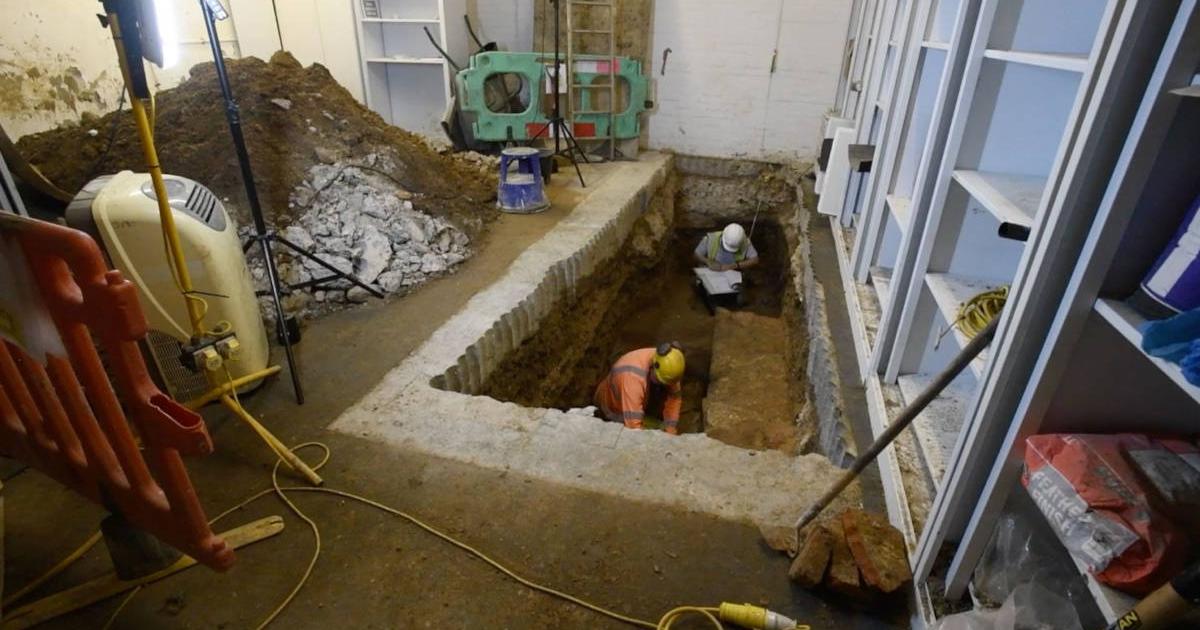

A significant archaeological find beneath the basement of an office building in London is providing an exceptional glimpse into the city's Roman past. Excavations have uncovered a substantial portion of London’s very first basilica, a public building central to the governance and administration of Roman Londinium, dating back nearly 2,000 years.
- 6 Ways Roman Engineers Were Way Ahead of Their Time
- Researchers discover secret recipe of Roman concrete that allowed it to endure for over 2,000 years
An Unexpected Treasure Beneath a Modern Office Building
The site of the discovery, located at 85 Gracechurch Street, was previously slated for demolition as part of a redevelopment project. Early investigations hinted at the potential presence of ancient structures, however, prompting the archaeological team assigned to the project to dig several test pits beneath the building’s concrete floors. On the third attempt, between filing cabinets, archaeologists stumbled upon a monumental find—sections of an ancient stone wall, well-preserved despite the passage of time.
- Advanced Scottish Culture Stopped Romans Taking All Of Britannia
- The Incredible Subterranean Basilica Cistern
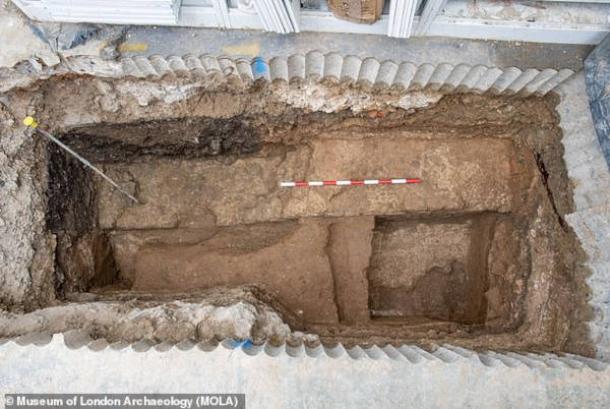
London’s Roman basilica was a public building used for court proceedings and various official and civic functions. (MOLA)
Sophie Jackson, an archaeologist from the Museum of London Archaeology (MOLA), who led the excavation, expressed her excitement over this unexpected discovery.
"You can see a huge chunk of Roman masonry, and it's incredible that it survives this well. We're absolutely thrilled that there's so much of it here," she told the BBC.
The well-preserved wall, composed of limestone quarried in and imported from Kent, forms a significant portion of the basilica’s base, which would have risen to about two-and-a-half stories in height.
Understanding the Early Government of Roman London
The basilica was part of the forum in ancient Londinium, a vibrant city center where the affairs of Roman politics, commerce, and law would have been carried out. Measuring approximately 130 feet (40 m) in length, 65 feet (20 m) in width, and standing nearly 40 feet (12 m) tall, this administrative center would have been an imposing structure, standing out among all the buildings in the settlement.
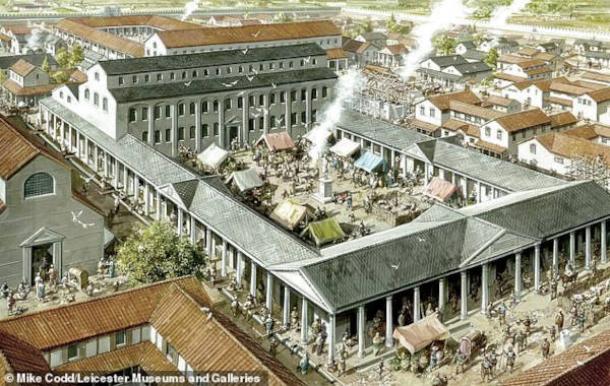
The Roman Forum hosted public gatherings, legal proceedings, and even gladiatorial combats. Shown here is the Leicester Roman Forum as it appeared in the early 3rd century. (Leicester Arts and Museums Service / Mike Codd)
"The basilica is the town hall, and then in front of it was a big open market square with a range of shops and offices around the outside,” Jackson explained. “It's the place you came to do business, to get your court case sorted out, it’s where laws were made, and it’s where decisions were made about London, but also about the rest of the country."
Artifacts discovered alongside the basilica include a roof tile stamped with the mark of an official, offering further insight into the building’s role in daily Roman life. As the excavations continue more artifacts are likely to be discovered, providing archaeologists with some fabulous information about how Rome governed the province of Britannia.
Built around 80 AD, shortly after the Roman conquest of Britain, the basilica and its adjoining forum were among the first public buildings constructed in the growing city of Londinium. However, the first basilica had a relatively short lifespan, and was only in use for around two decades before being replaced by a larger and more elaborate forum, likely reflecting the rapid growth of London during the Roman period. This discovery is shedding light on the early stages of the city’s development, which set the stage for the critical role that Londinium would play in the foreign affairs of the Roman Empire.
“This building will tell us so much about the origins of London, why London grew, and why it was chosen as the capital of Britain. It’s just amazing,” said Jackson, emphasizing the monumental significance of this delightful discovery.
A Change in Plans
As would be imagined, the owners of the office block, Hertshten Properties, have revised their plans in light of this discovery. The Roman remains will be preserved and incorporated into the new office building, subject to planning approval. The space will also be opened to the public, allowing future visitors to explore the remnants of Roman London in a thoroughly modern setting.
James Taylor, an architect with Woods Bagot, explained the challenges of incorporating the historical site into the new design.
“The scheme has been comprehensively adjusted,” he acknowledged. “Simple things like the columns have had to literally move position, so you’re not destroying all these special stones that we found in the ground.”
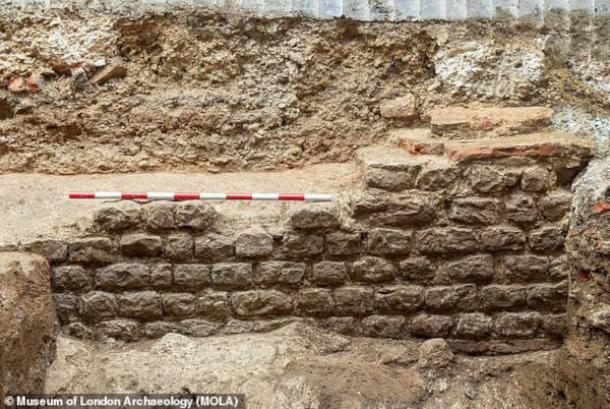
Beneath the concrete, excavations revealed foundations and walls constructed from flint, ragstone, and Roman tile. (MOLA)
Taylor said that some alterations to the building’s height and layout were necessary, including a reduction in the number of elevators to minimize disturbance to the archaeological site.
Despite the challenges, Taylor remains optimistic about the project’s outcome: “To actually see people using and enjoying the space, moving through the public hall and down to see the remains, will be absolutely incredible.”
London Then and Now
This basilica discovery adds to the growing list of Roman-era findings beneath London’s modern streets, and the city has made efforts to integrate these historical sites into the public experience. For instance, parts of an ancient amphitheater are now visible under a glass floor at the Guildhall Art Gallery, while the Temple of Mithras has been brought to life with an immersive sound and light staging at Bloomberg’s offices.
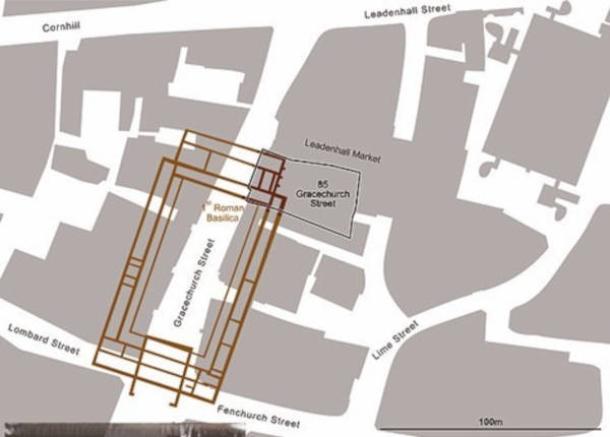
This map overlays modern London, including 85 Gracechurch Street, with the location of the Forum—the bustling open-air hub of daily life in Roman London. (MOLA)
Chris Hayward, a representative from the City of London Corporation, expressed his desire for more people to connect with the city’s remarkable ancient past.
“The fact that Roman London is beneath your feet is, frankly, quite a remarkable emotion to experience,” he stated. “You can actually see and visualize how Roman London would have been in those times. And then you can walk outside, and you can say, ‘now look at the skyscrapers, now look at the office blocks,’ this is progress, but at the same time, progress combined with preservation.”
Whatever London is now its roots go back to Roman times, and the merging of the old with the new in the new development project will emphasize this fact quite dramatically.
Top image: Archaeologists pictured during excavation works at the site, uncovering remains of London’s first Roman Basilica.
Source: MOLA
By Nathan Falde