

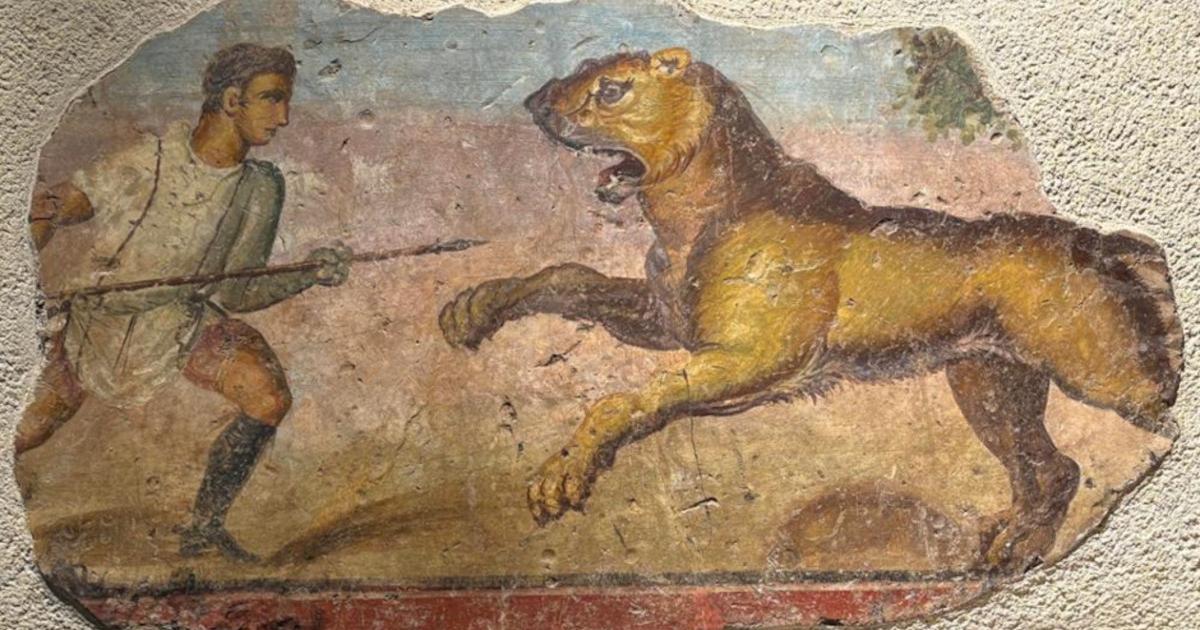

The loud roar of a lion in a Roman arena was the culmination of a process starting far away from the amphitheater. But recent research reveals that the Roman spectacles of ferocious animals were made possible thanks to the contribution of soldiers, frontier authorities, and local inhabitants who often bore costs associated with this event. In a new legal study from Carlos III University of Madrid, Rosa M. Carreño Sánchez explores two pieces of legislation from the late Roman Empire, revealing the mechanisms behind this process.
The Empire’s Hidden Animal Supply Chain
Public hunts and combat between animals were known as venationes and included competitions between animals or animals and human beings. The success of venationes made the wild animal business very profitable for providers of animals for gladiatorial contests. Every event depended on a special team to capture a beast as well as cages, carts, ships, military personnel and others needed to carry a dangerous cargo over long distances.
According to Carreño Sánchez, the Roman team included specialists called ad leones, ursuarii and vestigiatores, involved in tracking down and catching wild animals and securing them in the areas around Rome. It should be noted that the supply chain comprised not just private residents and businessmen but also military units. Archaeologist Jordon Alex Houston also finds hunter troupes and middlemen supplying trained animals and fighters to provincial games.
- Complex Elevator and Trap Door System for Raising Wild Animals in Colosseum
- Secret Imperial Passage Opens in Rome’s Colosseum After 2,000 Years
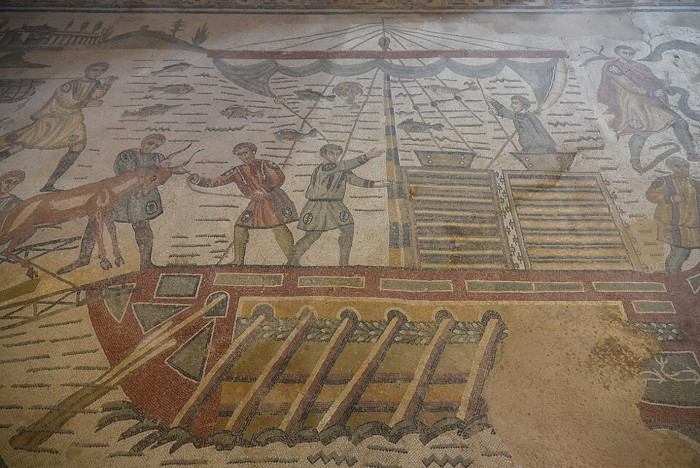
The fourth-century Great Hunt Mosaic at Villa Romana del Casale depicts the capture and shipment of wild animals for the venationes. (Image source/Carole Raddato/CC BY-SA 2.0)
Seven Days Before the Fines Began
The clearest evidence comes from Theodosian Code 15.11, preserving laws issued in AD 414 and 417. The later measure followed a complaint from Euphratensis that military animal handlers had stayed at Hierapolis for three or four months, consuming provisions and demanding cages. Officials limited beasts to seven days in any city and threatened responsible frontier commanders and their staffs with five-pound gold fines.
This text tells us of how the burden of animal spectacles could fall into the lap of the local population far away from the capital. Not only did towns have to feed animals and their human escorts, but longer stays of the wild beasts could lead to the depletion of the municipality’s resources, and may even have concealed animals diverted to unauthorized private shows.
The measure survived in a compressed form in Justinian’s Code 11.45, evidence that the problem remained legally significant long after the original complaint.
- The Exotic Menagerie: The Wild Animals Slaughtered in Gladiator Games
- Gladiators: Ancient Romans Loved Their Deadly Games
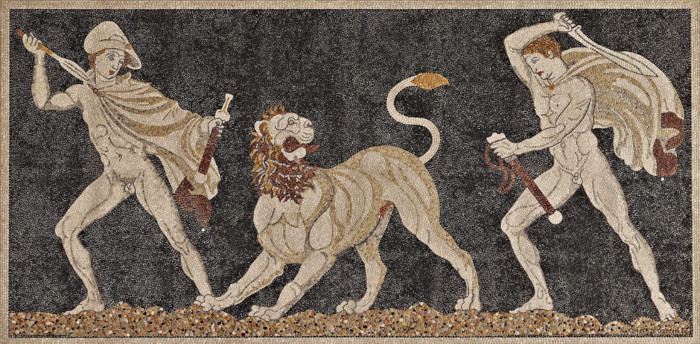
A Hellenistic mosaic from Pella depicts two hunters confronting a lion, evoking the elite hunting culture later appropriated by Roman spectacle. (Julianna Lees/CC BY-SA 2.0)
Did the Emperor Own Every Lion?
The prior constitution gave permission to provincials to kill lions endangering their safety without the fear of facing any legal consequences, but made a point of differentiating between killing the big cats, and hunting and selling them. According to Carreño Sánchez, this is evidence of the creation of a state monopoly aimed at preserving the rare big cats for imperial spectacles: “all lions belonged to the emperor,” she explained in the UC3M announcement.
The law’s wording is important - the conclusion concerns control over capture and commerce, not a ban on defending people from predators.
That distinction turns spectacle into a question of sovereignty as well as entertainment. Exotic beasts advertised the ruler’s command over distant landscapes, while the state tried to prevent competitors from siphoning off the supply; even elephants and other prestigious animals had long carried political meaning. Archaeological evidence, including lion bite marks on a Roman-period skeleton, gives the arena’s violence a physical reality that legal texts now help place within a much larger system.
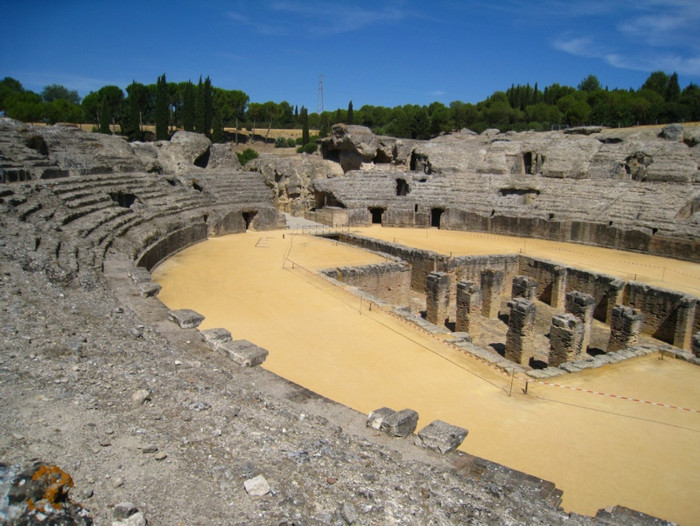
The amphitheater at Italica, Santiponce, Spain, where Roman crowds could watch gladiatorial and animal spectacles. (Image source/Pufacz/Public Domain)
From the Frontiers to Hispania
The provinces of the Roman Empire enjoyed the show business of the animal fights from across the empire. The giant amphitheater in Italica, today Santiponce in Spain, was used for hunting and gladiatorial performances while the design of the Colosseum and the inventiveness of the mechanism of lifts and trapdoors underline the manner in which the entrance of the beasts was made possible. The new study shifts attention away from that dramatic event itself and toward the months of capture, transport, provisioning and negotiation that made it possible.
The laws capture a conflict between central ambition and local cost. The emperor wanted the animals, military offices moved them, and provincial cities paid until limits were imposed. As Carreño Sánchez concluded, Roman law reveals “the management of resources, territorial conflicts, and the enormous logistical effort” behind the shows, making Roman animal spectacles a story of administration and power as much as bloodshed.
Top image: Roman mural painting including a hunter with a lion. Source: Museo Nacional de Arte Romano (MNAR), número de inventario CE26719.
By Gary Manners
References
Blume, F. H. (trans.). n.d. The Annotated Justinian Code: Book XI, Title XLV, Concerning the Chase of Wild Beasts. University of Wyoming College of Law. Available at: https://www.uwyo.edu/lawlib/blume-justinian/_files/docs/book-11pdf/Book11-45.pdf
Carreño Sánchez, R. M. 2026. De venatione ferarum (CTh. 15.11 ): Aspectos jurídicos sobre la captura y transporte de animales exóticos para los espectáculos públicos. Revista General de Derecho Romano, 46. Available at: https://dialnet.unirioja.es/servlet/articulo?codigo=10819077
Encyclopaedia Britannica Editors. n.d. Venationes. Available at: https://www.britannica.com/sports/venationes
Houston, J. A. 2024. Exotics for Entertainment: A Reconstruction of the Roman Exotic Beast Trade (First to Third Centuries AD ). Theoretical Roman Archaeology Journal, 7(1), 1–39. Available at: https://doi.org/10.16995/traj.10158
The Latin Library. n.d. Theodosiani Codex: Liber XV. Available at: https://www.thelatinlibrary.com/theodosius/theod15.shtml
UC3M. 2026. A UC3M study reveals the military apparatus and laws that made it possible for wild beasts to be brought into the amphitheaters. Available at: UC3M






















