
Roman amulets did not disappear when Christianity spread through the empire. Leiden researcher Patricia Kret's 2026 doctoral thesis examines objects from the first century BC to the sixth century AD and finds that people still guarded bodies and places with them, even as crosses and biblical words appeared. She studied about 300 examples, according to Leiden University, and discovered the custom endured even though bishops condemned it.
Protection Without a Break
The placement of an amulet has always played a part in its purpose. Roman amulets were objects that might be suspended around the neck, or they might have been objects that protected a house or field. Kret proposes that this relationship between an object and its position lasted beyond the arrival of Christianity, and even when the inscriptions on the object changed. An example is this gold jewelry protecting a Roman girl, which shows how personal these tokens could be.
Rome wasn’t transformed overnight as the spread of Christianity unfolded. An imperial period temple excavated in Spello shows that older religious practices were still relevant at the time when Christianity became established. In the materials analyzed by Kret, people placed protection where they needed it, while the crosses and biblical language provided it’s form.
- 3rd Century Silver Amulet Reveals Secret History of Early Christianity
- 1,800-Year-Old Silver Amulet is Bulgaria's Oldest Christian Relic
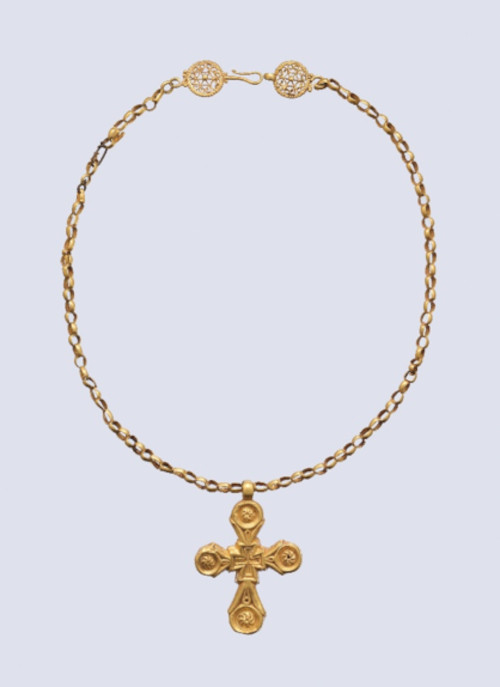
Sixth-century Byzantine gold necklace with a cross pendant, an example of Christian imagery worn on the body. (The Metropolitan Museum of Art / Public Domain)
Scripture Worn Against Harm
The change could be as small as a quotation written on a scrap of papyrus or a thin metal sheet. Kret notes that bishops threatened amulet users with exclusion from the church, yet their sermons also told priests to stop producing the objects. Biblical passages on surviving examples suggest that clergy, with access to manuscripts, sometimes supplied them despite the disapproval. For many wearers, Kret told Leiden University, an amulet was “something Christian that people could take home with them.”
According to Kret, the changes could be something as small as something written on a piece of papyrus or a thin metal sheet. He stated that the bishops threatened the users of amulets that they would be excluded from being part of the church, but also that the sermons of bishops required priests to stop creating the amulets. The biblical excerpts of the surviving examples suggest that some priests who had access to manuscripts might have provided them despite the disapproval from the Christian elite. Kret told Leiden University, that for many an amulet was “something Christian that people could take home with them.”
- Is This Byzantine-Era Demon-Repellent Amulet Jewish or Gnostic?
- Abracadabra! The power of spells against the forces of evil
A Christian silver amulet from Frankfurt, described in a Goethe University Frankfurt account, was buried with a man around AD 230–270; its tiny rolled foil bears 18 lines of Christian text. Another early Christian amulet from Deultum, Bulgaria names Christ and the archangels Gabriel and Michael. Neither find is presented here as an object Kret examined, but they show how a familiar protective format could carry new religious words.

Sixth or seventh-century silver cross from Lausanne inscribed with the protective ABRAX ABRACA formula; a later parallel, not an object identified in Kret's sample. (Glafoululle des Alpes / CC BY-SA 4.0)
Fever Charms and Family Keepsakes
Kret focused on the objects themselves as a study of their application rather than how they had been made. Some inscriptions would indicat either the ailment at hand or the protection required of the amulet. Others began with the word abracadabra and eliminated letters in a line-by-line fashion corresponding to withdrawal from fever. The Roman origin of this term dates back to much earlier than the world of stage magicians today.
The practice of reuse provides some insight into attachment. Kret mentions a metal plaque that was engraved as a remedy for migraines, and was buried along with three other amulets, but is much older. She suggests that the plaque might have been passed through the family since migraines tend to run in families, but the exact history of the plaque cannot be determined. This is significant because the grave can establish reuse but not the identities or intentions of the former owners of the item.
The practice has also passed from one community to another and across centuries, as illustrated by a later Byzantine demon-repellant amulet. Kret concludes that this does not mean that all Roman amulets became Christian or that the church embraced them. What Kret wants to demonstrate is that seeking protection was still a matter of concern, and Christianity furnished some people with new terminology to address this issue. For the person wearing an amulet, it was not about disputing the difference in categories but rather whether the charm would do the trick.
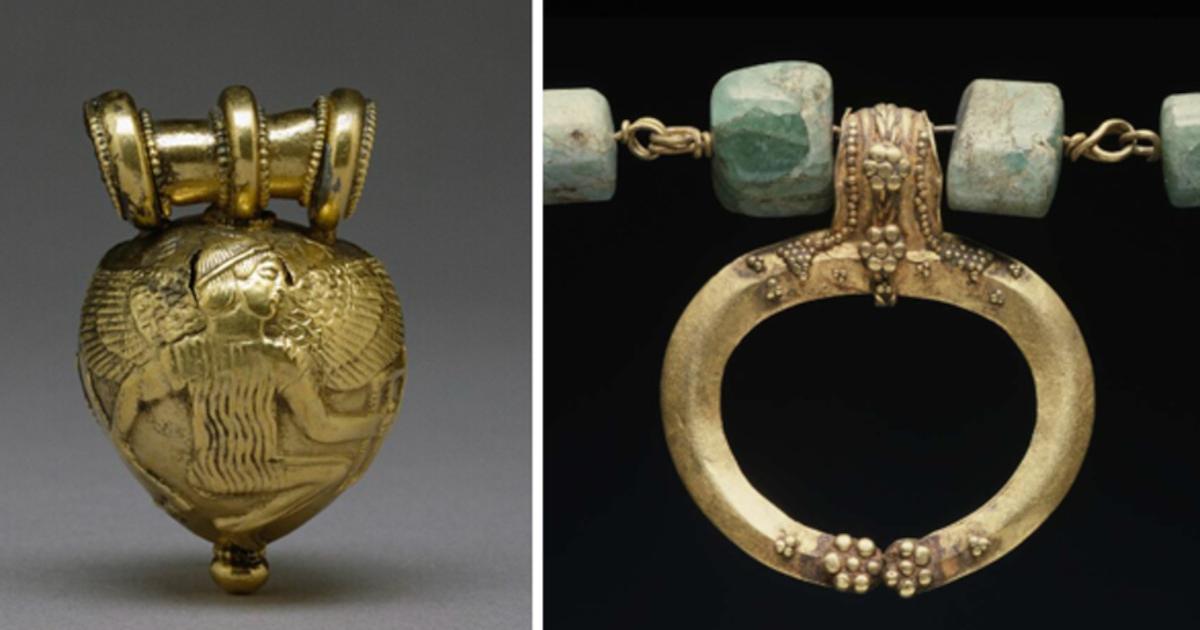
Top image: Left; Etruscan bulla depicting Icarus. Right; Roman necklace with ‘Lunula’ Source: Left; Walters Art Museum/Public domain. Right; Walters Art Museum/CC0
By Gary Manners
References
American Numismatic Society. 2026. Touchable Faith: Ancient Christian Amulets at the ANS. LT265 [video]. Available at: https://www.youtube.com/watch?v=Md9Cb1lHfTg
Goethe University Frankfurt. 2024. Frankfurt silver inscription: Oldest Christian testimony found north of the Alps. Available at: https://aktuelles.uni-frankfurt.de/en/english/frankfurt-silver-inscription-oldest-christian-testimony-found-north-of-the-alps/
Kret, P.M.M. 2026. Amulets, materiality and experience: demarcating space in the Roman world (doctoral thesis, Leiden University ). Available at: https://scholarlypublications.universiteitleiden.nl/handle/1887/4309854
Leiden University. 2026. Forbidden protection: amulets in early Christianity. Available at: https://www.staff.universiteitleiden.nl/news/2026/09/forbidden-protection-amulets-in-early-christianity
The Metropolitan Museum of Art. n.d. Necklace with Pendant Cross. Available at: https://www.metmuseum.org/art/collection/search/464055