


Discovery Offers Unique Glimpse
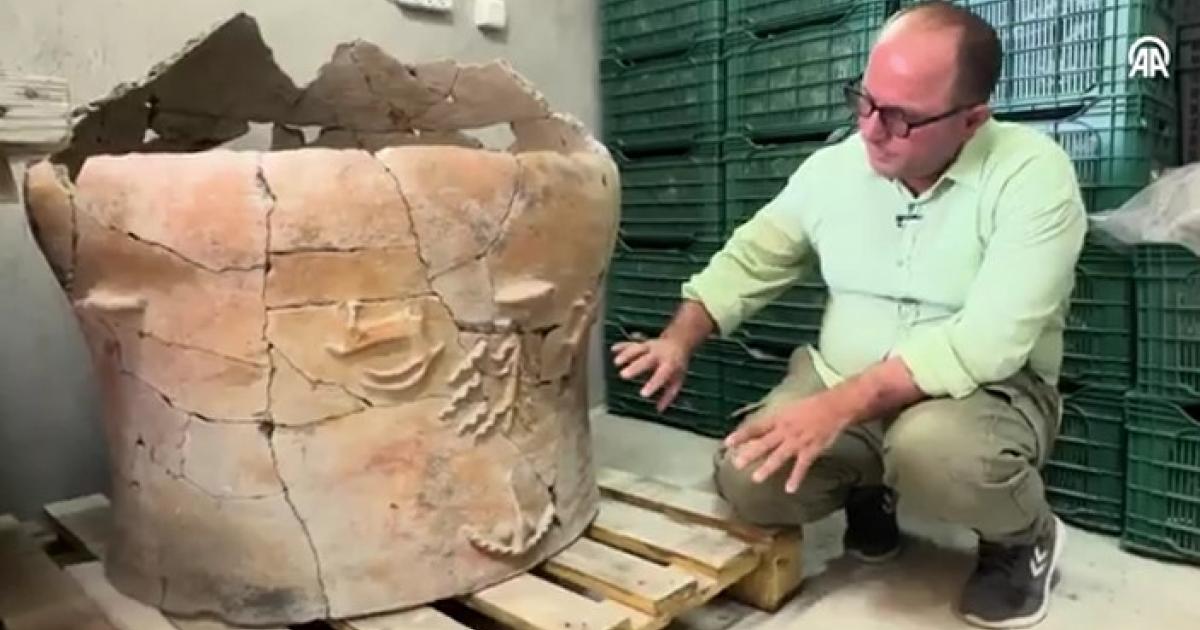
The discovery of this jar is able to offer an unique glimpse into the symbolic world of communities primarily living in Central Anatolia around 3000 BC. The design of the jar is quite vivid and realistic. Details include showing two eyes with raised eyebrows, and a prominent nose formed around its wide opening. Directly beneath the human face is a stylized tree. On either side, wild goats also appear to climb toward branches representing a tree of life, which creates a very beautiful symbolic scene rather than a simple decorative pattern.
- 2,800-Year-Old Seeds Retrieved from Ancient Castle in Turkey to be Brought Back to Life
- Cappadocia, Enchanted Land of Khepat, Ancient Anatolia’s Mother Goddess

Closer view of the jar. (YouTube Screenshot)
Unique Position of Jar Shares Intriguing Details
The research team first encountered part of the vessel in 2024. A wider section of the excavation area, known as Trench F8 was opened in 2025, which revealed more of the jar and the archaeological context that came with it. One of the most intriguing details was its unique position. Large storage vessels such as this jar are only normally found with their opening facing upward, reflecting how they were once used inside houses, storerooms, or workshops. At the site of Gökhöyük, the jar had been carefully turned upside down.
Architectural Plan Not Fully Exposed
Archaeologists believe this action was done intentionally to the jar rather than a simple building collapse. The inverted position may also show that this vessel was ritually decommissioned or that the surrounding structure became abandoned over time. Whether this structure was just an ordinary residential building or a space that’s only reserved for certain ceremonies cannot yet be determined. Excavations around the vessel are continuing, and the architectural plan has not been fully exposed.
Ancient Remains Butt up Against Irrigation Canal
Gökhöyük, also knownas Kanal Höyük, lies about eight kilometers from the current town of Seydişehir. The mound was actually first recorded by the British archaeologist James Mellaart during successive surveys of the Konya region in the 1950s. Its archaeological importance truly became far clearer in 2002, when ancient remains were discovered during work on a nearby irrigation canal. Construction was halted, and the Konya Museum Directorate conducted subsequent excavations between 2002 and 2005. Research began to resume in 2020 under the direction of Associate Professor Gunduz. This project is also supported by Turkey’s Ministry of Culture and Tourism through their Heritage for the Future Initiative, together with Konya Metropolitan Municipality and Seydisehir Municipality.
- Early Neolithic Ceremonies in Turkey Found to Include Facial Piercings
- 4,000-Year-Old Hidden Tunnel Discovered in Ancient Castle in Turkey
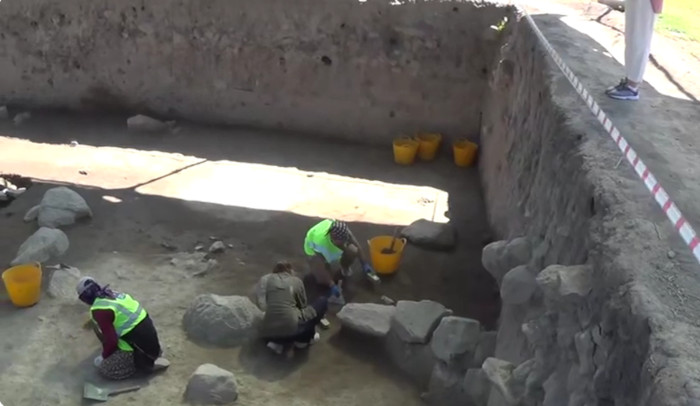
The ongoing excavation at Gökhöyük where the jar was found. (YouTube Screenshot)
Excavations Reveal Numerous Historical Layers
In the settlement, excavations have revealed numerous cultural layers belonging to Neolithic, Chalcolithic, Bronze, and Iron Ages, making it one of the most valuable stratified prehistoric sites on the Southern Konya Plain. Archaeologists have also uncovered mud-brick buildings, hearths, grinding stones, storage vessels, botanical remains, and evidence of destructive fires. Because these myriad layers have survived one above the other, Gökhöyük allowed the researchers to examine how certain factors such as farming, food production, domestic architecture, and belief systems changed over thousands of years. Previous excavations that took place at this site have even come to show a human skeleton which had once been held beneath collapsed mudbrick walls on a layer of destruction dated back to the Bronze Age.
Jar Holds Different Materials Ranging From Grains to Liquids
Excavation director Associate Professor Ramazan Gunduz of Selçuk University seems to believe the composition may have represented fertility, abundance, and the continuation of life. In his interpretation of the jar, the human-like figure positioned above the tree and animals may also have been imagined as a protective or creative power overseeing the natural cycle. The jar was measured at approximately 1.2 meters in height, while its mouth is only one meter wide. Researchers of this study also estimate that the jar could have held between 800 and 1,000 kilos at maximum - of materials such as grains and liquids.
Vessel Contains Provisions for a Host of Social Events
Five handles placed around the body of this jar were found to show that the vessel may occasionally have moved, despite its incredible size. The elaborate relief decoration shown on the jar also crucially distinguishes it from the more utilitarian storage jars commonly associated with prehistoric households. Gündüz said the research team considers ceremonial use more likely than routine food storage. The vessel may have contained provisions used during certain communal gatherings, seasonal rituals or religious offerings, although no definitive evidence has yet come to light in establishing the nature of these separate ceremonies.
- 7,800-year-old Female Figurine Found at Anatolia’s Ulucak Mound
- Gods, Goats And Cheesemakers In Ancient Times
The newly documented jar has been able to add another critical dimension to that historical record. Rather than only showing what Gökhöyük’s inhabitants stored or ate, the artistic elements such as the human face, climbing goats, and tree-like motif may actually reveal how the people understood fertility, protection, and the renewal of life nearly five thousand years ago. Although the true function remains uncertain, the vessel’s imagery, enormous capacity, and carefully arrayed abandonment suggest that it may have even come to play a role in certain ceremonies rather than just making up ordinary household storage.
Top Image: Excavation director Associate Professor Ramazan Gündüz examines the reconstructed 5,000-year-old ceremonial vessel unearthed at Gökhöyük in central Turkey. Source: YouTube Screenshot
By Ramsey Hardin
References
Büyükyıldırım, Oğuz. “5,000-Year-Old ‘Mystery Jar’ Found Upside Down at Gökhöyük Bears a Human Face and Wild Goats.” Anatolian Archaeology, July 29, 2026. https://www.anatolianarchaeology.net/5000-year-old-mystery-jar-found-upside-down-at-gokhoyuk-bears-a-human-face-and-wild-goats/.
Kayra, Oğuz. “5,000-Year-Old ‘Mystery Jar’ with Three Enigmatic Symbols Found Upside Down at Gökhöyük.” Arkeonews, July 29, 2026. https://arkeonews.net/5000-year-old-mystery-jar-with-three-enigmatic-symbols-found-upside-down-at-gokhoyuk/.






















