
First discovered in 1912 by the prominent British geologist William Sollas and the French archaeologist Abbé Henri Breuil, the markings were initially celebrated as the first specimen of prehistoric cave painting in Britain. However, the initial excitement was short-lived, as skeptics in 1928 dismissed the red stripes as mere mineral seeps of iron oxide. For nearly a century, this priceless archaeological treasure was forgotten by mainstream academia and obscured by decades of modern graffiti and calcite flows.
- The Cresswell Horsehead: The Oldest Art Ever Found in Britain
- The Peculiar Narrative of the Red Lady of Paviland, A Man from Paleolithic Wales
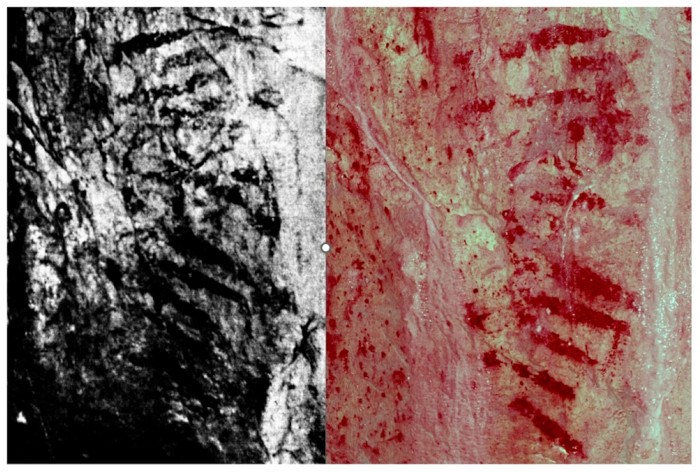
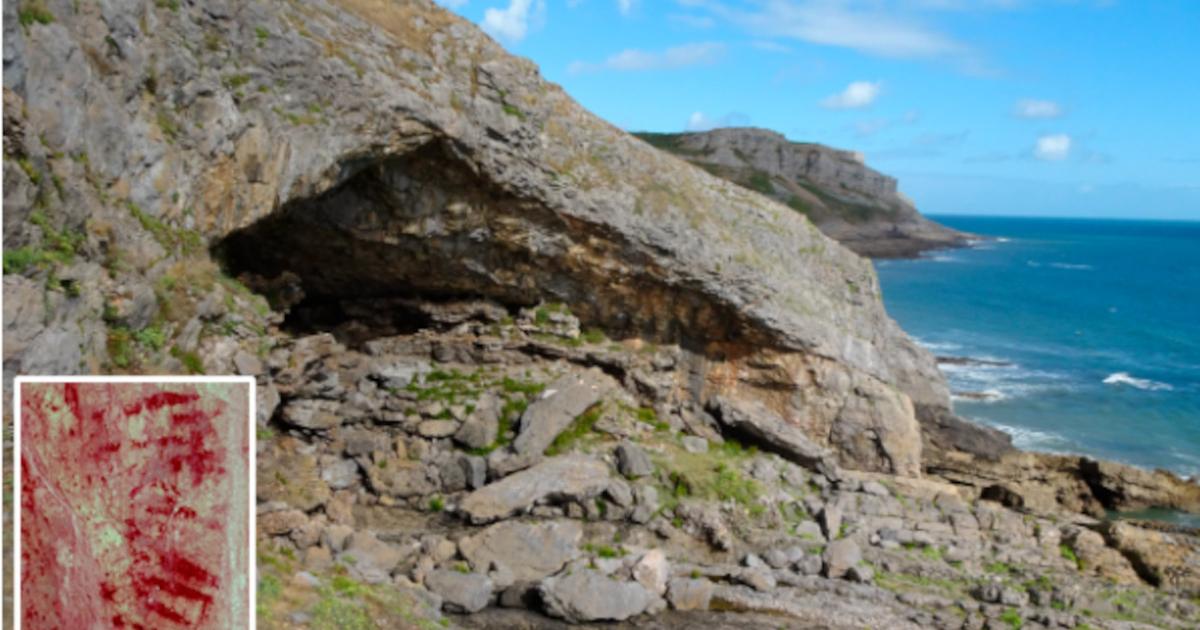
The painted panel pictured in 1913 (left) and D-Stretch filtered image in 2024. (George Nash/Quarternary Journal)
Scientific Vindication of a Century-Old Discovery
The turning point came when an international, multidisciplinary research team led by Dr. George Nash, an archaeologist at the University of Liverpool, rediscovered the lost panel in 2022. Utilizing cutting-edge scientific technology, the researchers analyzed the red pigments and the overlying calcite layers. They employed uranium-thorium dating, a radiometric technique that measures the radioactive decay of uranium isotopes into thorium within the calcite crust that had slowly grown over the rock art.
The laboratory results yielded a minimum age of 17,100 years before present, placing the creation of the art firmly within the Upper Paleolithic, during the last phase of the Stone Age. This makes the Bacon Hole markings the oldest verified rock art in the British Isles, surpassing the previous record-holder, a 14,000-year-old engraving of a reindeer found by Dr. Nash in nearby Cathole Cave in 2012. The team also used D-Stretch, an advanced digital color enhancement tool, which revealed that the stripes were applied using human fingers dipped in hematite, a natural iron-oxide compound sourced from other parts of the cave.
- Ten Amazing Ice Age Artworks By The Magdalenians Discovered In France
- The History of Wales, in a Nutshell
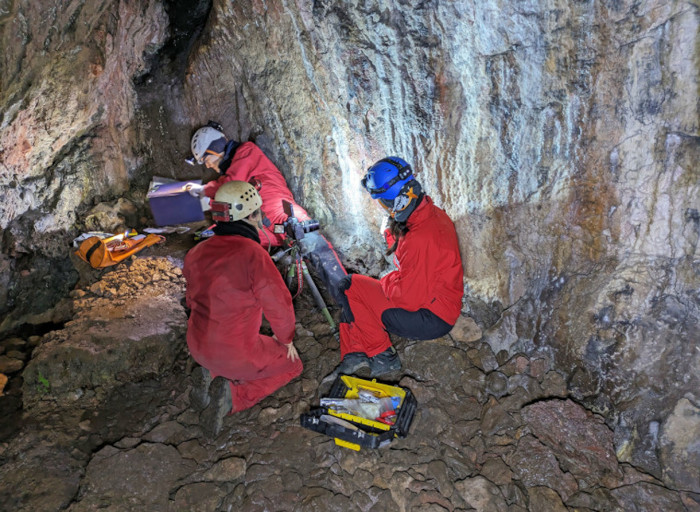
Members of the First-Art Team conducting in-situ pigment sampling and analysis inside the dark chambers of Bacon Hole (First-Art Team/National Trust Wales)
A Ritualistic Communication System in a Frozen Landscape
To fully appreciate the significance of this prehistoric masterpiece, one must envision the Welsh landscape as it existed 17,000 years ago. During this late glacial period, what is now the Bristol Channel was not a body of water but a rich, fertile, and treeless plateau. This vast plain served as a summer feeding ground for herds of mammoth, woolly rhinoceros, giant elk, and reindeer, which in turn attracted highly mobile bands of Paleolithic hunter-gatherers.
While these ancient peoples used the numerous limestone caves along the Gower coast for shelter, the placement of the red stripes deep within the pitch-black, acoustically unusual chambers of Bacon Hole suggests a purpose far beyond the domestic. Dr. George Nash suggests that the equidistant, structured horizontal bands could have functioned as a primitive communication system or "tally marks," perhaps recording seasonal visits or marking the cave as a site of ritual significance. Entering these disorienting, subterranean realms likely represented a symbolic transition from the everyday world into a spiritual domain, where the act of painting was a form of prehistoric art expression.
Preserving a Fragile Heritage for Future Generations
The rediscovery of the Bacon Hole cave art highlights the incredible fragility of Britain's earliest cultural heritage. The panel survived not only the harsh conditions of the Ice Age but also the modern intrusions of the 19th century, including extensive graffiti left by a local fisherman named Jonny Bates in 1894. Today, the cave is managed by National Trust Cymru, which has installed a heavy steel grill across the side chamber to protect the ancient markings from vandalism, leaving the subterranean sanctuary undisturbed except for the local bat populations.
As prehistoric art is an exceptionally rare and irreplaceable component of global heritage, archaeologists and conservationists are actively calling for Bacon Hole to be officially designated as a scheduled monument. This status would grant the site the highest level of legal protection under British law, ensuring that this invaluable window into the minds of our Ice Age ancestors remains preserved. Vindicated after a century of skepticism, the red stripes of Bacon Hole stand as a powerful reminder of the enduring power of human creativity at the very dawn of British history.
Top image: A general view of Bacon Hole cave on the Gower Peninsula, Wales, overlooking the Bristol Channel, where Britain's oldest cave art has been authenticated. Insert, image of the cave art. Source: George Nash/Quarternary Journal
By Gary Manners
References
Breuil, H. and Sollas, W. 1912. First specimen of prehistoric painting ever discovered in UK. Available at: https://www.theguardian.com/science/2025/may/29/first-specimen-of-prehistoric-painting-ever-discovered-in-uk-archive-1912
Nash, G. H., Collado, H., Gomes, H., Garcês, S., Lattao, V., Rosina, P., Marrocchino, E., Eftekhari, N., Oosterwijk, B., Pike, A. W. G., Hoffmann, D. L., Standish, C. D., Hiemstra, J. F. and Shao, Q. 2026. Rediscovered Late Upper Palaeolithic painted imagery at Bacon Hole, Gower Peninsula, South Wales. Available at: https://doi.org/10.3390/quat9030043