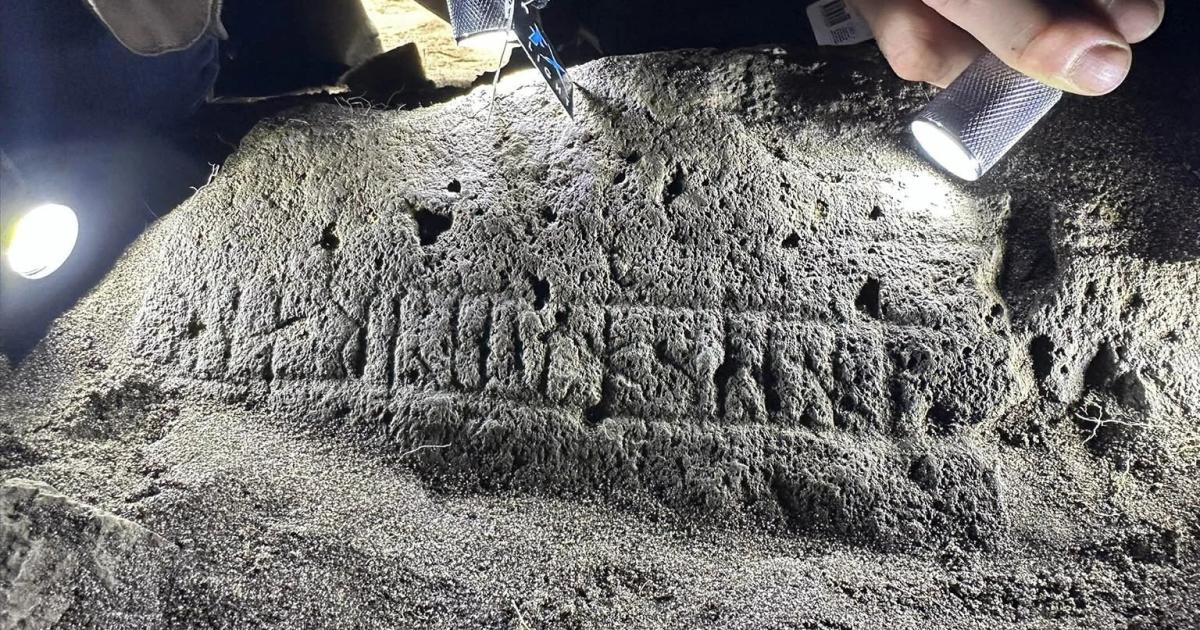

A rare runestone embedded in the floor of a structure believed to be a medieval chapel in the remote Faroe Islands has revealed an unexpected link to the islands’ Norse past. The discovery offers insight into the lives of the people who inhabited this windswept North Atlantic archipelago centuries ago.
The find was made at the archaeological site Á Sondum in Sandur Village on the island of Sandoy, during an excavation directed by the staff from Tjóðsavnið, the National Museum of the Faroe Islands, in partnership with Aarhus University and the Moesgaard Museum in Denmark. The excavation team immediately recognized the significance of what they’d found since runestones are exceptionally rare in the Faroe Islands. The stone had been built into the floor of a structure uncovered during the summer’s dig: a placement that raises intriguing questions about how and why it ended up there. Was it simply reused as convenient building material, or did its inscription carry a meaning that medieval builders—or worshippers—still recognized? As researchers work to decipher the runes and establish the stone’s age and original purpose, the find could provide more context for the medieval life and religious activities on the islands. The Faroe Islands are a self-governing archipelago within the Kingdom of Denmark, located roughly halfway between Scotland and Iceland. This remote setting makes any written record from the deep past particularly significant.
- Archaeological Insights into the Early Norse Settlements in the Faroe Islands
- Vikings in Ireland: Recent Discoveries Shedding New Light on the Fearsome Warriors that Invaded Irish Shores
What does the stone’s inscription mean?
According to National Museum Head of Archaeology Helgi Michelsen, one problem for researchers is deciphering the runic inscription on the stone. He believes that the beginning of the inscription “Her hvílur…” is Old Norse for “Here lies…” or “Here rests…” He cautions that this is an early, tentative reading. The symbols blend Old Norse runes with Christian iconography. If Michelsen’s analysis is accurate, it indicates that the stone served as a memorial or grave marker, but translation of the remaining runes will point to areas for future research. The museum has asked a specialist rune scholar to join the team in the Faroe Islands to examine the stone in detail, determine its origin, and translate the inscription.
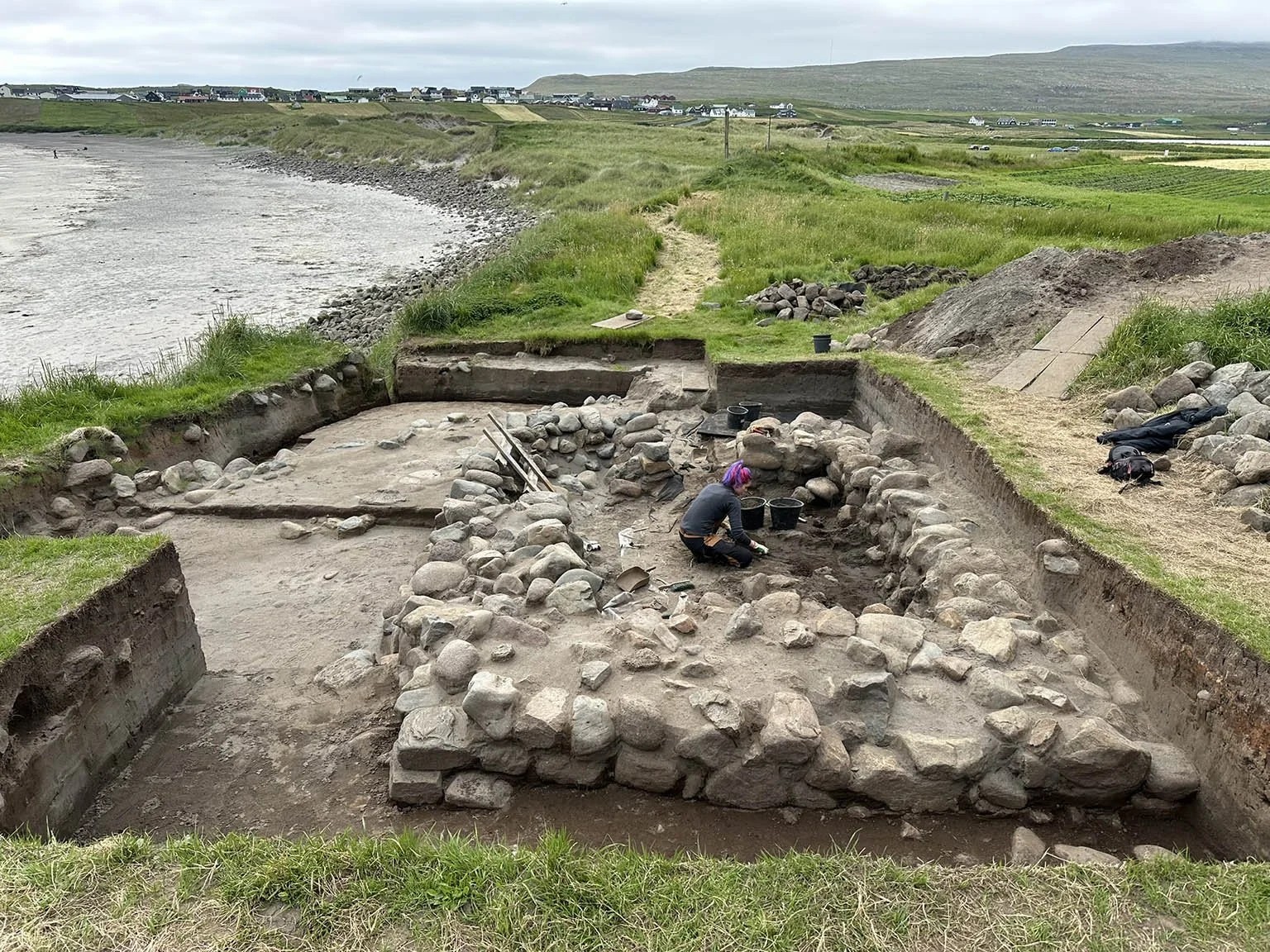
The archaeological excavation at Á Sondum on Sandoy, Faroe Islands, where the remains of a possible medieval Christian oratory or chapel have been uncovered. A rare runestone was discovered incorporated into the building's floor. (Helgi Michelsen/Tjóðsavnið)
How does the stone’s fragile condition impact research?
Researchers are taking important steps to protect the stone and preserve the inscription. Since the stone was buried in soil for centuries, it is now fragile and exposed to the elements. For protection, archaeologists have moved it from the excavation site to the National Museum, where it can be preserved and studied under controlled conditions. According to Museum press releases, the research team plans to use 3D scanning to create a precise digital model of the stone before its fragile surface deteriorates any further. The model will be a working research tool that adjusts virtual lighting and shadow angles on the scanned surface to enhance worn carvings that are difficult to see. Using raking-light analysis is a well-established method for reading weathered runic inscriptions. It is especially helpful to interpret stones that are broken or have runes that are missing or damaged.
- Earliest Runic Inscription Discovered in Norway
- Viking Runestone Uncovers Climate Fears That Fed Ragnarök Myth
What clues point to a link with early Christianity in the Faroe Islands?
During excavations, archaeologists recovered several clues to the building's original purpose. Near the stone, researchers recovered pieces of a small statue of the Virgin Mary holding the Christ Child and a kola– a small lamp that burned fat or oil. Early Christian worshippers lit the kola during devotions. Both objects suggest the building had a religious purpose tied to early Christianity. The research team points out that the structure’s architecture supports the hypothesis. The building is oriented east to west, with its entrance at the western end. This design is typical of medieval chapels and prayer houses across the region. The team maintains that the building may have served as a medieval oratory, a small house of prayer. Other oratories have been identified elsewhere in the Faroe Islands, including the oratory at Bønhúsberg on Mykines, Bønhústoft in Leirvík on Eysturoy, and a ruined site at Bakki in Velbastaður on Streymoy. The archaeologists believe that the newly excavated building has many parallels with the other structures. Further investigation is required to determine whether the runestone marked an actual burial, served another purpose within the chapel, or was simply a spanning stone.
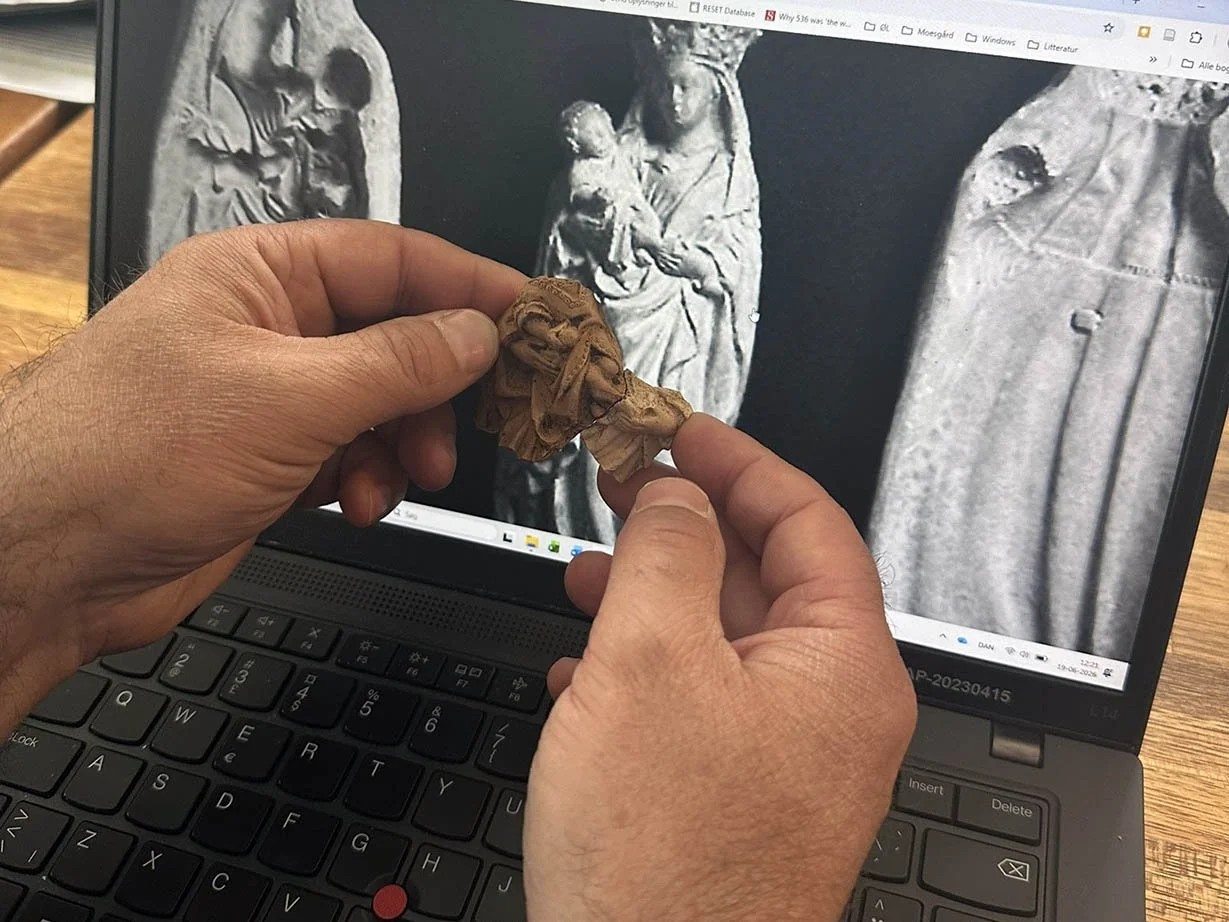
A fragment of a medieval statuette depicting the Virgin Mary and Christ Child at the National Museum was discovered during this summer’s excavation in the Faroe Islands at the same site as the newly discovered runestone and supports the possibility that the excavated structure served as a medieval oratory or chapel. (Helgi Michelsen/Tjóðsavnið)
What is the previous history of the excavation site?
Á Sondum is a site of increasing importance for understanding the Faroe Islands’ settlement history, with previous excavations revealing continuous human activity from before the Viking Age through the medieval period and into more recent centuries. According to reports on the Digital Archaeologist, Á Sondum was first investigated in 1994. This excavation produced only “a meager archaeofaunal assemblage.” The initial study was followed by paleoenvironmental sampling in 2002, and then by more extensive archaeological investigation in 2006 and 2007. Still, the most recent excavations at Á Sondum have yielded the earliest securely dated archaeological deposits in the Faroes, confirming human settlement on the islands by the 4th–6th centuries AD. Now the mysterious runestone will join the previous discoveries that add to the intriguing stories of the Faroe Islands’history.
Top Image: The newly discovered runestone from Á Sondum on Sandoy in the Faroe Islands. The rare inscribed stone was discovered incorporated into the floor of a building that archaeologists believe may have been a medieval Christian oratory or chapel. Source: (Helgi Michelsen/Tjóðsavnið)
By Ramsey Hardin
References
Buyukyildirim, O. August 5, 2026. “Rare Runestone found Beneath Medieval Chapel in the Faroe Islands.” Arkeonews. Available at:
https://arkeonews.net/rare-runestone-found-beneath-a-medieval-chapel-in…
Digital Archaeological Record. August 9, 2026. “A Sondum”. The Digital Archaeological Record (tDAR). Available at: https://core.tdar.org/collection/29671/a-sondum
Europe Says Staff. August 9, 2026. “Mysterious Medieval Runestone Found In The Faroe Islands–Denmark”. Europe Says. Available at:
https://www.europesays.com/dk/141749/
Livius. August 8, 2026. “Rare Runestone Found in Faroe Islands.” The History Blog.
Available at: https://www.thehistoryblog.com/
Medievalists Staff. “Rare Runestone Discovered in the Faroe Islands”. Medievalists.Net.
Available at: https://www.medievalists.net/2026/08/rare-runestone-discovered-in-the-f…
Milligan, M. August 9, 2026. “Runestone discovery sheds new light on medieval Faroe Islands”. Heritage Daily. Available at:
Spitz, E. “A Medieval Runestone With A Mysterious Inscription Was Just Found At The Ruins Of A Chapel On The Faroe Islands”. All That’s Interesting. Available at:
https://allthatsinteresting.com/faroe-islands-medieval-runestone