

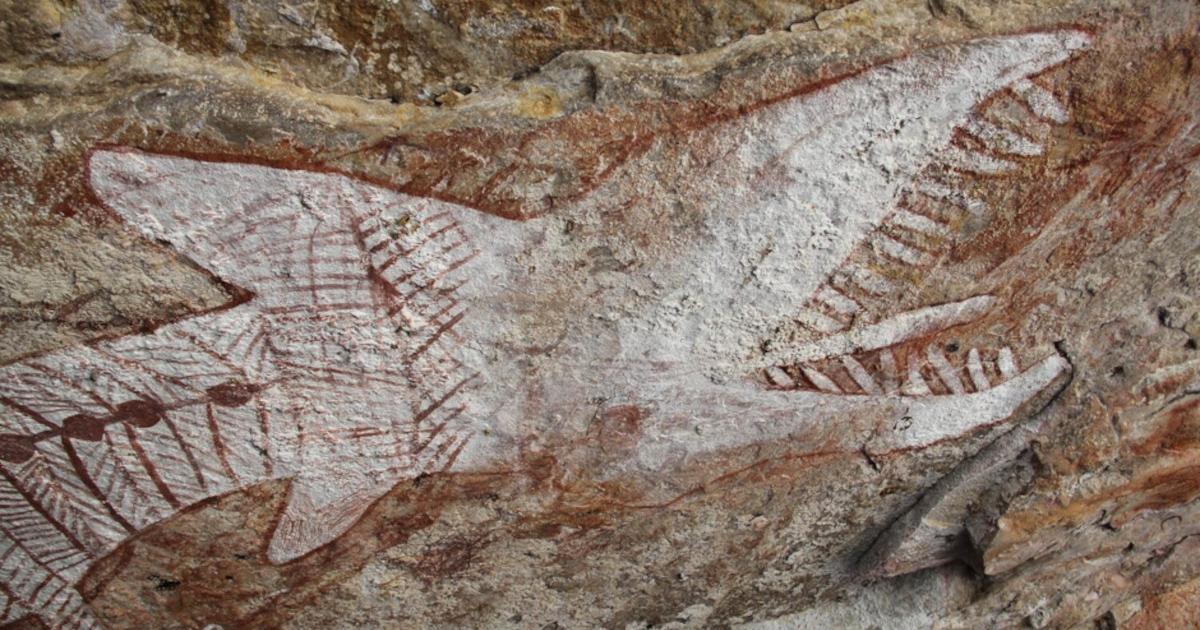

A recently released study has concluded that several huge Rainbow Serpent and other Deity images appeared all over the western part of Arnhem Land, as Indigenous peoples reacted to the impact of the European colonization of the continent. Researchers have documented a massive concentration of Rainbow Serpent artwork located at Awunbarna, with one oversized (6.1 meters (20 ft)) painted figure on the ceiling of the shelter. Instead of being a sign of a cultural retreat, the images may have been an affirmation of law, identity, and authority by the Aboriginal elders of Amurdak Country during a period of significant change.
A Remarkable Cluster in Amurdak Country
The article by Paul S.C. Taçon, Sally K. May, Andrea Jalandoni and senior Amurdak Traditional Owner Charlie Mungulda has recently been published in Australian Archaeology. Their team has recorded 165 rock-art sites around Awunbarna, or Mount Borradaile, since 2018, with 29 recorded as depicting the Rainbow Serpent across 21 different locations.
Out of these, 20 have been identified as post-contact works. With 38.5% of the most recent Rainbow Serpent representations known to exist in western Arnhem Land found within a 27km2 area in Awunbarna, this represents a very high concentration of Rainbow Serpent imagery in comparison to other areas, where similar images are found in roughly seven regions of approximately 1,000km2 each. As such, this research represents yet another chapter in the regional history that also includes the 6,000-to-9,400-year-old Maliwawa Figures.
- Ancient Lifeforms and Odd Humans Depicted in Maliwawa Rock Art
- Archaeologists Uncover Lost 9,000-Year-Old Rock Art Style in Australia
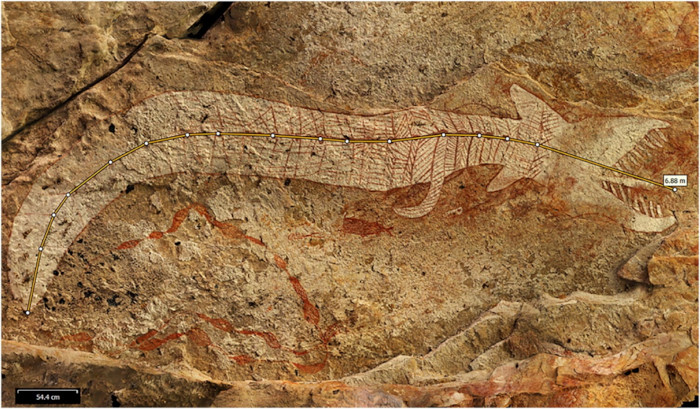
Close-up of the largest Awunbarna Rainbow Serpent with size indicated taking into consideration the curvature of the body. (photo by Andrea Jalandoni/Australian Archaeology)
How Researchers Dated the Giant Paintings
The huge works of art have not been directly radiocarbon dated, so the team used multiple forms of evidence to provide dating. These new serpents can be found in the upper layers where paintings overlap, and fall under the same category in terms of time periods and aesthetics, plus they have similar colors/infill designs to dated examples found in other parts of Arnhem Land that have been dated already.
Seven of these pieces were created using predominantly white kaolin pigment, which is a type of material that will degrade within several hundred years and, in some cases, may not last longer than thirty years before being destroyed. Earlier Awunbarna serpents average 1.14 meters long, while the recent examples average 2.4 meters, supporting a genuine shift toward monumentality rather than the chance survival of a few unusual pictures.
- Tracing Songlines: Unraveling Aboriginal Australia's Ancient Oral Maps
- Ancient Finger Traces from First Nations Found in Glittering Cave
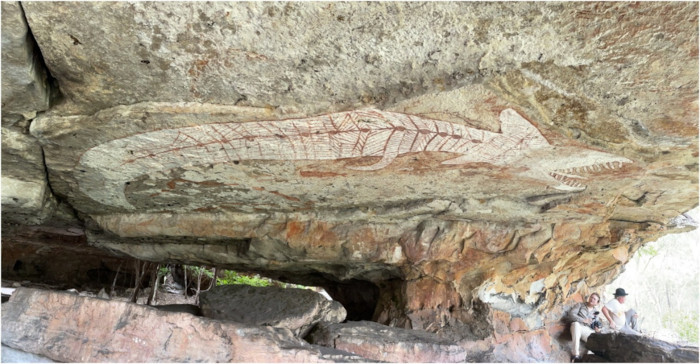
The largest Awunbarna Rainbow Serpent is on the ceiling of AW5 and makes visitors to the right appear very small. (Paul S.C. Taçon/Australian Archaeology)
A Whale, a Giant and a Serpent in Stone
The ceiling painting at AW5 is among the largest of the Awunbarna group and has a total length of 6.88 meters when measured along the body curve. The main body of the serpent is mostly solid white but contains sections that have been painted with red hatching and include X-ray detail. The crocodilian head has 18 teeth, a protruding tongue, and fins like that of a fish.
In addition to this painting, the survey identified a male giant (2.1m) and a likely humpback whale from its painted baleen, as well as a significant stone feature depicting the Rainbow Serpent created with 124 meters of rocks strategically positioned to create a shape. Mungulda established a connection between the stone feature and the Morak initiation ceremony that indicates how the practice of creating artworks, together with ancestral stories, teachings and songlines, is an intrinsic part of being part of the Country.
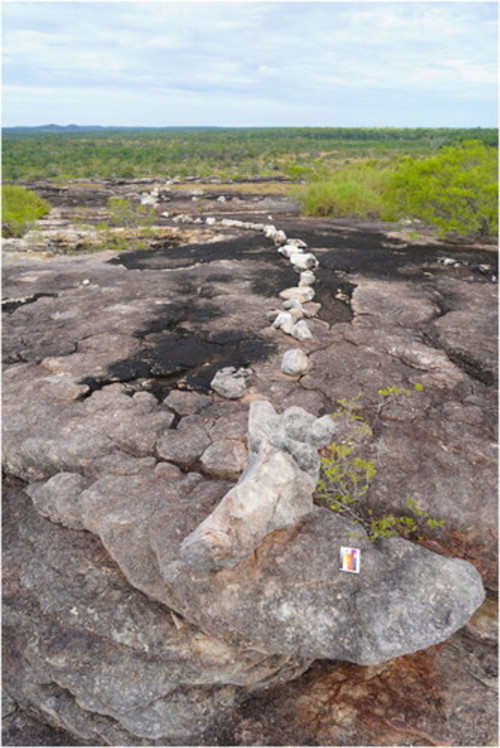
The head and neck of the Rainbow Serpent stone arrangement. (Paul S.C. Taçon/Australian Archaeology)
Painting Power Through Colonial Upheaval
According to the writers, massive Rainbow Serpent artwork emerged as a cultural instrument in the 1800s and early 1900s when the pursuit of buffalo and the settlement of Europeans interrupted the life of the locals. Awunbarna became a crossroads for trade, rituals and meetings between language communities, and the traditional subjects of art were sometimes covered by pictures of ships, guns and other things. The current date shows that the conflict between industrial development and Indigenous traditions still exists in Australia.
The giant Rainbow Serpent art was not simply a reaction to colonization but a commanding act of cultural continuity, comparable to the enduring power carried by Australian Dreamtime stories and other ancestral images.
Top image: Over 6 meters long rainbow serpent at AW5 in Awunbarna. Source: P. Taçon/Australian Archaeology
By Gary Manners
References
Kakadu National Park. n.d. Stories. Available at: https://kakadu.gov.au/discover/culture/stories/
Oster, S. 30 August 2026. Aboriginal artists painted giant ancestral beings as colonization arrived, study finds. Available at: https://phys.org/news/2026-08-aboriginal-artists-giant-ancestral-colonization.html
Taçon, P.S.C., May, S.K., Jalandoni, A. and Mungulda, C. 14 August 2026. Paintings of Rainbow Serpents and other big creatures of Awunbarna, Northern Territory, Australia. Australian Archaeology. Available at: https://www.tandfonline.com/doi/full/10.1080/03122417.2026.2676505






















