

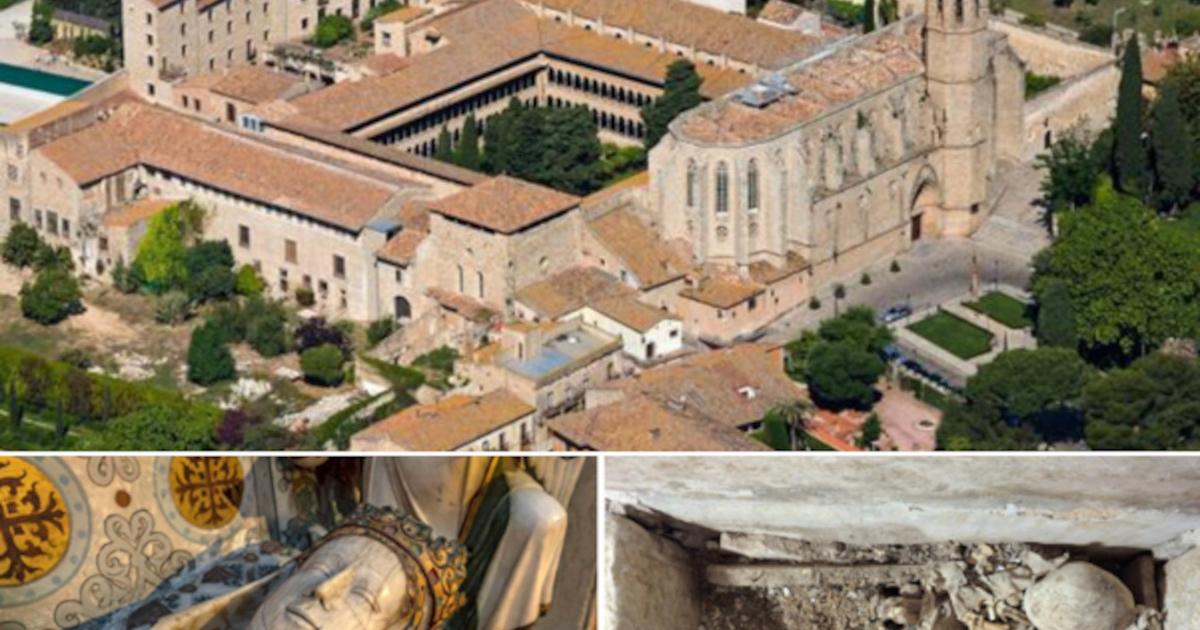

Spearheaded by the Culture Institute of Barcelona, the project has combined advanced paleogenomics and forensic archaeology to dismantle centuries of historical assumptions. While Queen Elisenda’s resting place was verified, her surrounding companions have unleashed a wave of chilling questions about the violent underbelly of medieval Catalan society. Scientists are now sequencing the genomes of these individuals, hoping to reconstruct the family lineages and traumatic events that led to their chaotic interments.
- Medieval Catalonian Nobility Unearthed in Santes Creus Monastery
- Slain Woman Warrior Amongst a Large Burial of Medieval Knights in Spain
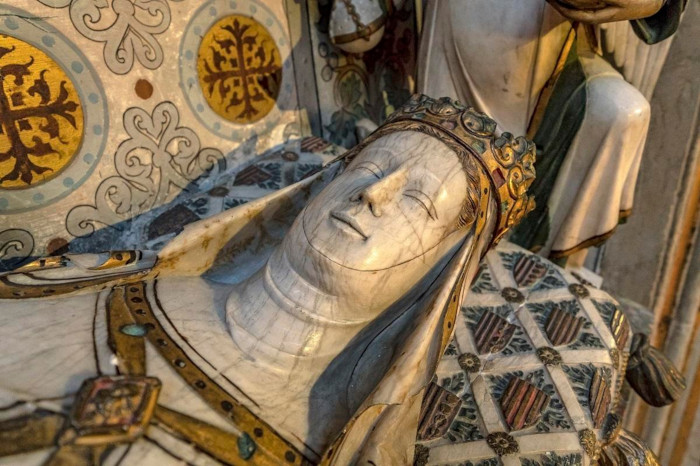
Sarcophagus of Queen Elisenda inside the Royal Monastery of Santa Maria de Pedralbes. (Culture Institute of Barcelona)
The Dual Immortality of a Powerful Sovereign
Queen Elisenda de Montcada was only thirty years old when she married the fifty-five-year-old King James II of Aragon in 1322, quickly establishing herself as a formidable political force in northeastern Spain. When her husband fell ill, she secured his permission to found the Monastery of Pedralbes in 1326 for the Order of the Poor Clares, a cloistered community of Franciscan nuns. Following the king's death in 1327, Elisenda retired to a modest palace built adjacent to the monastery, where she wielded immense spiritual and administrative authority until her death in 1364.
For seven centuries, historians believed that Queen Elisenda was interred within a single, magnificent double-sided Gothic sarcophagus that physically spanned the wall dividing the monastery's church from its cloister. However, the recent physical excavation of the tomb has completely debunked this long-standing architectural myth. Archaeologists discovered that the structure is actually split into two entirely separate burial chambers divided by a low internal partition wall. This ingenious design allowed the queen to achieve a dual immortality, representing her as a crowned, sovereign monarch on the public church side, and as a humble, penitent widow in monastic habit on the cloister side.
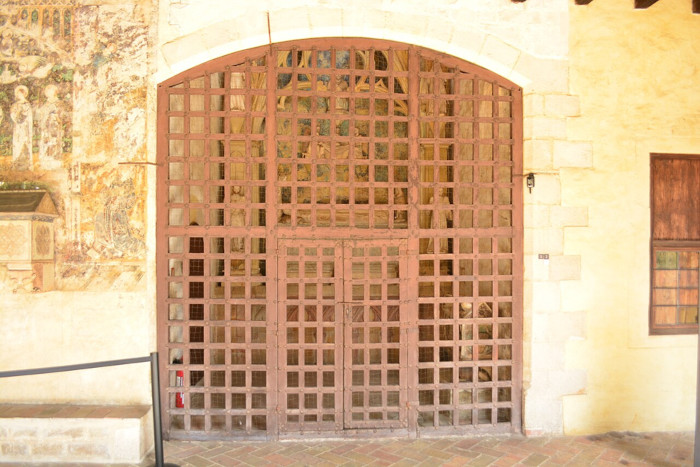
The double-sided Gothic tomb of Queen Elisenda de Montcada at the Monastery of Pedralbes. (Joe Mabel/CC BY-SA 4.0)
Chilling Secrets in the Cloister Graves
While Queen Elisenda’s skeletal remains matched historical records, revealing a tall woman of seventy who suffered from osteoarthritis and metabolic ailments, her neighbors’ graves contained shocking anomalies. The most disturbing discoveries were made inside the tomb of Francesca Saportella, the monastery’s second abbess and Queen Elisenda’s niece. Instead of housing a single revered abbess, researchers found a chaotic jumble of at least nine individuals, including four adult male skulls that bore fatal stab wounds from bladed weapons.
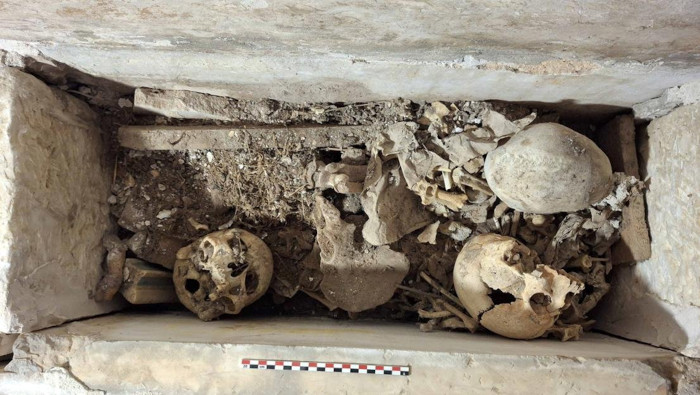
Tomb of Francesca Saportella, second abbess of Pedralbes, containing at least nine individuals including stabbed male skulls and a pregnant woman. (Culture Institute of Barcelona)
Even more tragic was the discovery of a partially mummified female torso within the same tomb, which still contained the skeletal remains of a twenty-two-week-old fetus. Anthropologists believe this grave was repeatedly reopened and reused over several centuries, possibly as late as the Peninsular War of the early 19th century, which would explain the weapon trauma on the male skulls. The tomb of Sobirana Olzet, the first abbess, also revealed a grim secret: her skull showed a severe facial injury inflicted by a sharp object.
Challenging the Identity of Medieval Knights
The forensic sweep of the foundational graves has also completely overturned the traditional identities of several prominent medieval figures. A tomb long believed to be the resting place of the celebrated Aragonese knight Artau de Foces yielded absolutely no male remains. Instead, archaeologists exhumed the skeletons of two young women and three children, with one of the women remarkably retaining a long, intact ponytail of hair after nearly seven hundred years.
- Medieval Remains of 'Noble Girl' Discovered Under Real Alcázar in Spain
- Blue Pigment Found on Medieval Teeth Reveals Secret Existence of Female Scribes
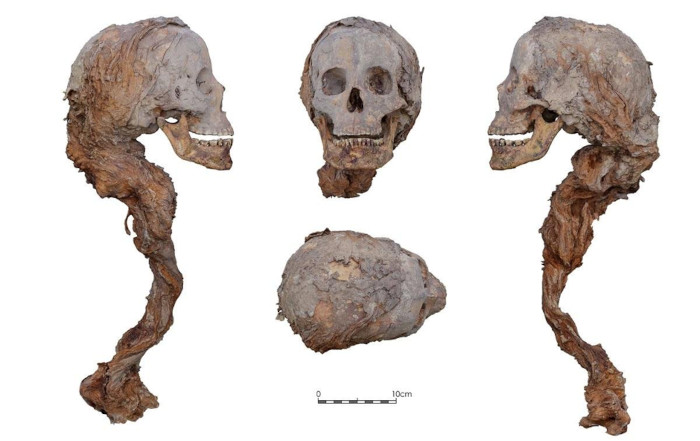
Partially mummified head of a 14th-century woman found in a tomb once attributed to the knight Artau de Foces at Pedralbes monastery. (Culture Institute of Barcelona)
These physical revelations have raised serious doubts about how many other medieval burials across Europe might be misidentified.
Reconstructing Ancient Funerary Rites
Beyond the bones, the investigation has shed light on the intimate and varied burial customs of the medieval Catalan nobility. Archaeobotanical analysis of over two hundred soil samples from the graves revealed that specific plants were chosen for different individuals. While Queen Elisenda’s coffin was packed with dill, rosemary, and myrtle, other noblewomen were wrapped in textile bundles and buried with wormwood and broom flowers, which served both ritualistic and preservative purposes.
As paleogenomic analysis continues through 2027, researchers hope to map the complete DNA of these individuals to establish exact kinship ties and identify ancient pathogens. This landmark study has bridged the gap between written records and physical reality, giving a voice to the silent women who lived and died within this center of power. The secrets of Pedralbes are finally stepping out of the shadows, offering a far more complex, violent, and fascinating portrait of medieval Catalonia than anyone had ever imagined.
Top image: The grand cloister of the Royal Monastery of Santa Maria de Pedralbes in Barcelona, Spain. With Sarcophagus of Queen Elisenda and Tomb of Francesca Saportella below. Source: Ajuntament de Barcelona/CC BY-SA 4.0
By Gary Manners
References
Castellano-Tresserra, A. 2026. Opening medieval tombs at Barcelona's Pedralbes monastery reveals new clues about 14th-century queen. Catalan News. Available at: https://www.catalannews.com/culture/item/opening-medieval-tombs-at-barcelonas-pedralbes-monastery-reveals-new-clues-about-14th-century-queen
Culture Institute of Barcelona, 2026. The Royal Monastery of Santa Maria de Pedralbes unveils new data on the foundational tombs with the study of 25 individuals from the fourteenth century. Available at: The Royal Monastery of Santa Maria de Pedralbes unveils new data on the foundational tombs with the study of 25 individuals from the fourteenth century | Press Institut de Cultura de Barcelona - ICUB
Killgrove, K. 2026. Skeletal remains of Queen Elisenda, one of the most powerful rulers in medieval Europe, unearthed in Barcelona. Live Science. Available at: https://www.livescience.com/archaeology/skeletal-remains-of-queen-elisenda-one-of-the-most-powerful-rulers-in-medieval-europe-unearthed-in-barcelona-along-with-several-others-who-bore-unexplained-stab-wounds
Radley, D. 2026. Archaeologists find Queen Elisenda's remains among 25 medieval skeletons, including individuals with unexplained stab wounds. Archaeology News Online Magazine. Available at: https://archaeologymag.com/2026/06/archaeologists-find-queen-elisenda-s-remains/
Riera, S. 2026. The DNA reveals the silenced chronicle of Pedralbes. Ara. Available at: https://en.ara.cat/culture/dna-reveals-the-silenced-chronicle-of-pedralbes-violent-deaths-and-unidentified-children_1_5751050.html





















